Woodroffe
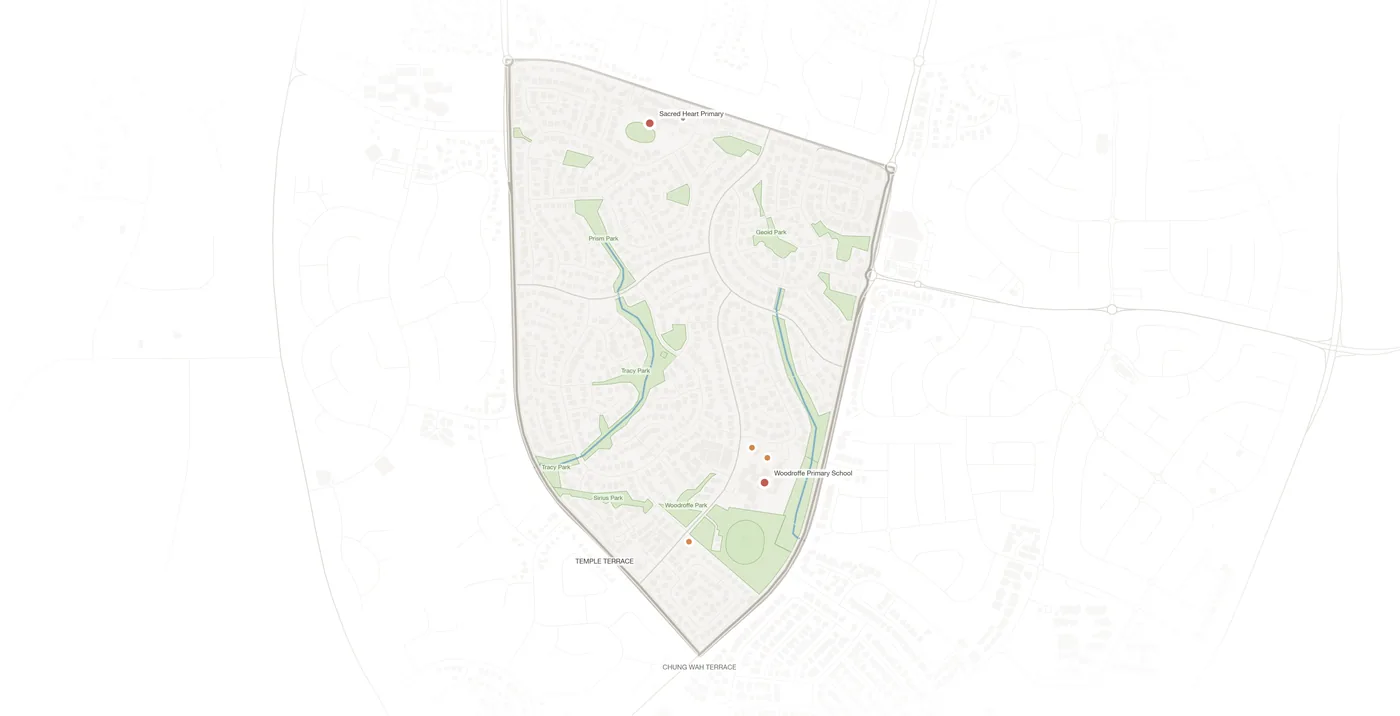
At 1,987 residents per square kilometre, Woodroffe packs 3,175 people into just 1.6 square kilometres south of Darwin, making it one of the denser suburban pockets in the Territory. The median age of 33 sits 7 years below the national figure, pointing to a working-age population that drives the 63.1% participation rate. Household income lands in the 70.6th percentile nationally, above average for an area that scores decile 3 on all four SEIFA indexes. That combination, relatively healthy incomes combined with low-advantage structural scores, reflects a public-sector and community-services employment base rather than private-sector wealth accumulation.
Population
3,175
Median Age
33.0
Household IncomeiMedian weekly household income (ABS Census)
$1,891/wk
DAs (12 months)iDevelopment Applications lodged in the past year
0
Median House
$410K
Estimated from rent (2025)
The median house price of $410,000 is an estimate derived from rental data for 2025, so buyers should treat it as indicative rather than transacted. At $360 weekly rent, the rent-to-income ratio sits at 19.0%, below the 30% stress threshold, which means the suburb is accessible for renters even on typical household incomes of $1,891 per week. For buyers, monthly mortgage repayments average $1,800, producing a mortgage-to-income ratio of 22.0%, also below the stress threshold. Separate houses dominate at 80.6% of dwellings and three-bedroom homes account for 56.2% of stock, with 4-plus bedroom homes at 22.8%, a profile suited to families. Apartments make up only 0.4%, so stock variety is limited.
For Buyers
The median house price of $410,000 is an estimate derived from rental data for 2025, so buyers should treat it as indicative rather than transacted. At $360 weekly rent, the rent-to-income ratio sits at 19.0%, below the 30% stress threshold, which means the suburb is accessible for renters even on typical household incomes of $1,891 per week. For buyers, monthly mortgage repayments average $1,800, producing a mortgage-to-income ratio of 22.0%, also below the stress threshold. Separate houses dominate at 80.6% of dwellings and three-bedroom homes account for 56.2% of stock, with 4-plus bedroom homes at 22.8%, a profile suited to families. Apartments make up only 0.4%, so stock variety is limited.
For Investors
The 42.5% renter share provides a solid tenant base, and the $360 weekly rent against the $410,000 median implies a gross yield around 4.6%, well above what most capital-city markets offer. The vacancy rate of 6.2% is elevated compared to typical healthy markets, so prospective landlords should factor in potential void periods. Net overseas migration adds 16 residents annually while internal migration removes 6, giving a modest positive net. Population has trended slightly downward at 0.17% per year, with the medium forecast projecting a gradual decline from around 3,430 in 2026 to 3,400 by 2031. The suburb is not gentrifying, and no development applications were recorded in the past 12 months, so value uplift will depend on the broader Darwin market rather than local supply constraints.
Schools in Woodroffe iICSEA: school advantage index. 1000 = national avg, higher = more advantaged
Sacred Heart Catholic Primary School
T-6 · 165 students
Woodroffe Primary School
T-6 · 327 students
Demographics
The median age of 33 is 7 years younger than the national figure, reflecting a working-age-heavy composition. English ancestry leads at 942 residents, followed by Irish (282) and Scottish (233), giving the suburb an Anglo-Celtic lean. Overseas-born residents account for 17.9%, which is 3.7 percentage points below the national average, lower diversity than most major urban areas. University qualifications reach only 16.9%, sitting 13.2 points below the national average, consistent with the trade and public-service occupational profile. Average household size of 2.6 is marginally above the national figure. The aging trajectory is mild, with the senior share rising 3.5 points and the working-age share gaining 2.2 points over the decade, suggesting the young base is maturing rather than departing.
Age Distribution
Bedrooms
Dwelling Structure
80.6%
Houses
19.1%
Townhouse
0.4%
Apartment
Tenure
Outright owners represent 13.0% of households, well below national norms, while mortgage holders account for 44.5% and renters 42.5%, a split that places Woodroffe firmly in mortgage-belt territory. The stock is overwhelmingly detached houses at 80.6%, with semi-detached homes at 19.1% and apartments at just 0.4%. Three-bedroom homes dominate at 56.2%, with 4-plus bedroom homes at 22.8% and two-bedroom at 16.9%. The $410,000 median house price, while an estimate, is affordable relative to the 70.6th percentile household income, and the mortgage-to-income ratio of 22.0% confirms that servicing costs remain manageable at current interest rate levels. Rent-to-income at 19.0% is below the 30% stress threshold, keeping the suburb accessible for the 42.5% tenant population.
Mortgage / mo
$1,800
Rent / wk
$360
HH Size
2.6
Personal Income / wk
$1,012
Vacancy Ratei% of dwellings unoccupied on Census night (ABS 2021)
6.2%
Unoccupied
73
Rent / IncomeiMedian rent as % of household income. Over 30% = housing stress
19.0%
Mortgage / IncomeiMedian mortgage as % of household income. Over 30% = housing stress
22.0%
Community Profile
Languages Spoken at Home
Ancestry
Household Composition
20.1%
Couples, no children
2,375
Total families
Economy & Employment
Public administration leads local employment at 18.0% (173 workers), followed by healthcare at 13.1% (126) and construction at 12.1% (117), with education at 9.9% (95). This government and community-services concentration means local incomes are relatively stable but tied to NT public-sector conditions. By occupation, Clerical/Admin (238) and Community/Personal roles (226) are the largest groups, with Professionals (219) and Managers (155) also significant. The full-time employment rate of 74.6% is healthy, but the unemployment rate of 6.4% is above national averages, and the 63.1% participation rate leaves 529 residents not in the labour force. All four SEIFA indexes place the suburb in decile 3, reflecting low-advantage structural conditions despite household income sitting in the 70.6th percentile nationally.
Unemployment
6.2%
Labour Force
1,982
Unemployed
123
Quarterly Trend
Source: SALM Dec-25
Socio-Economic Indexes (SEIFA)iABS index ranking suburbs from 1 (most disadvantaged) to 10 (most advantaged)
Full-time
74.6%
Part-time
19.0%
Participation
63.1%
Employed
1,437
Occupations
Top Industries
University
16.9%
Postgraduate
2.4%
Born Overseas
17.9%
Dwellings
1,101
Transport to Work
Car dependence is high: 88.3% of residents drive to work, compared with the national average where many urban suburbs see 60-70% car use, and only 2.4% use public transport. Walking and cycling together account for 2.1%. No schools are recorded within the 1.6 square kilometre boundary, so families rely on institutions in neighbouring suburbs. Crime data is not available for Woodroffe in this dataset, though the IRSD decile 3 score places the suburb among lower-advantage areas nationally, which typically correlates with higher crime exposure. On the positive side, housing stress is low: rent-to-income at 19.0% and mortgage-to-income at 22.0% both sit below stress thresholds. The volunteering rate of 14.5% is moderate, and 5.1% of residents (146 people) need daily assistance, slightly above the national average.
Drive
88.3%
Public Transport
2.4%
Walk / Cycle
2.1%
Work from Home
N/A
Population Forecast
-0.17%/yr
(-6 people/yr)
EstablishedPopulation declined 7.2% over the decade and is forecast to continue falling gradually, from an estimated 3,430 in 2026 to around 3,400 by 2031 under the medium scenario, an annual rate of minus 0.17%. The suburb is classified as established and not gentrifying, with a gentrification score of zero and no active signals. Internal migration runs at a small net outflow of 6 per year, offset by overseas migration adding 16 annually. Affordability improved from 40.4% in 2011 to 35.6% in 2021, better than the national direction, though real income growth over the decade was negative at minus 0.8%. Rent grew 7.5% over the period. The population trajectory is slow contraction, not collapse, and the working-age share has actually risen 2.2 points, so the decline reflects household-size changes and structural shifts rather than labour-market exodus.
Historical + Forecast
Hamilton-Perry + Holt smoothing on ERP 2001-2025
Age Cohort Forecast
Primary Driver
Balanced
Net Overseas / yr
+16
Net Internal / yr
-6
Gentrification Signal
Not gentrifying
National Ranking iPercentile rank among ~15,000 AU suburbs. 90% = higher than 90% of suburbs
How Woodroffe compares to ~15,000 Australian suburbs
Frequently Asked Questions
Is Woodroffe a good suburb to live in?
Woodroffe has practical strengths: housing costs are manageable with a mortgage-to-income ratio of 22.0% and rent-to-income of 19.0%, both below stress thresholds. Household income sits in the 70.6th percentile nationally. The main trade-offs are high car dependence at 88.3%, low SEIFA scores at decile 3 across all four indexes, and a slow population decline of 0.17% per year.
What is the median house price in Woodroffe?
The median house price is estimated at $410,000 based on rental data for 2025, making it affordable relative to Darwin and most Australian capital cities. Weekly rent averages $360 and monthly mortgage repayments run about $1,800, giving a mortgage-to-income ratio of 22.0% against median household incomes of $1,891 per week.
What schools are in Woodroffe?
No schools are recorded within the Woodroffe boundary in this dataset, so families rely on schools in neighbouring suburbs. The local population has university qualifications at 16.9%, which is 13.2 points below the national average, and the suburb's employment profile is centred on public administration, healthcare, and construction.
Is Woodroffe safe?
Crime statistics are not available for Woodroffe in this dataset. As a structural indicator, the suburb scores decile 3 on the IRSD index of relative disadvantage, placing it in the lower-advantage tier nationally. The unemployment rate of 6.4% is above the national average, which is a known correlate of elevated crime risk.
Is Woodroffe good for property investment?
The 42.5% renter share and $360 weekly rent against a $410,000 median imply a gross yield around 4.6%, above most capital-city markets. However, the 6.2% vacancy rate is elevated and population is forecast to decline gradually to around 3,400 by 2031. No development applications were recorded in the past 12 months, so growth will track the broader Darwin market.
How is Woodroffe's population changing?
Population declined 7.2% over the past decade and is forecast to fall at around 0.17% annually, reaching approximately 3,400 by 2031 under the medium scenario. Net overseas migration adds 16 residents a year while internal migration removes 6. The aging trajectory is mild, with the senior share rising 3.5 points over the decade.
How to read these comparisons
Phrases like "above the national average" reference the unweighted median across Australian suburbs with more than 1,000 residents, not population-weighted national figures. Suburb-level medians are more useful for ranking suburbs against each other; ABS census headlines are population-weighted (so dominated by Sydney and Melbourne) and can read very differently.
Current baseline (refreshed 2026-05-10): median age 40, university-educated 30.1%, born overseas 21.6%, average household size 2.5 people.
Data sources: ABS 2021 Census (demographics, income, tenure), state Valuer-General (house prices), Department of Jobs SALM (unemployment), ACARA (school ICSEA), state Crime Statistics agencies (offences), council DA portals (development applications). Population forecasts use a Hamilton-Perry cohort model calibrated to ABS ERP.
Explore Woodroffe on the Map
View parcels, zoning overlays, DA applications, schools and more.
Open Interactive Map