
Flood is the property risk that hides best. A block can look bone dry at every inspection all summer and still sit in a mapped floodway, because the event that defines it happens, on average, once in decades. Most buyers with flood exposure find out at one of two moments: when the insurance quote comes back, or when the water does.
The insurance quote is the expensive-but-recoverable version. Insurers price flood address-by-address using their own models, and for properties with real flood exposure, flood risk is commonly the single biggest driver of the premium. Buyers often discover this at insurance-quote time, after the contract is signed. By then it is not a due diligence question, it is a five-figure annual premium problem.
So how do you actually check flood risk before you sign? Here is every option, honestly.
The short version
| Council flood maps | State planning layers | Insurance quote | Flood consultant | Modelled score | |
|---|---|---|---|---|---|
| Cost | Free | Free | Free | Thousands | Free |
| What you get | Study maps, levels and sometimes depth grids | An in-or-out overlay answer | A price with a flood model baked in | Site-specific flood levels | 0-100 score nationally; council-study depth where available |
| Covers | Patchy, council by council | VIC, NSW (partial), SA, TAS, ACT | Any address an insurer will quote | Per site | Every address for screening; 55 integrated depth rasters in Brisbane and NSW |
| Best for | Deep dives where they exist | Confirming overlay status | Pre-contract reality check | Development and building | Shortlisting + comparison |
The rest of this guide goes through each, plus a two-minute primer on flood risk language so the maps actually mean something.
First: flood risk in two minutes
A few basics make every flood map easier to judge:
- "1-in-100-year flood" does not mean once per century. The technical term is the 1% AEP event: an Annual Exceedance Probability of 1%, meaning a 1% chance of that flood level being reached or exceeded in any given year. The odds reset every year. Over a 30-year mortgage, a 1% annual chance compounds to roughly a one-in-four chance of at least one such event. That is arithmetic, not pessimism.
- There are three different kinds of flooding, and they behave differently. Riverine flooding is a river or major creek breaking its banks, typically with hours or days of warning as water moves down the catchment. Overland flow (flash flooding) is intense local rain overwhelming drainage, arriving in minutes, and it can hit addresses nowhere near any river. Storm surge is coastal, driven by low pressure and wind pushing the sea inland. A property can be exposed to one, two or all three, and a map that covers only riverine flooding says nothing about the stormwater path through the backyard.
- Overlays show where studies were done, not where water goes. A planning flood overlay exists because a council or state commissioned a flood study for that area and adopted the result. No study, no overlay. An address outside every overlay might be genuinely safe, or might simply sit in a catchment nobody has studied. Absence of mapping is not evidence of absence of risk.
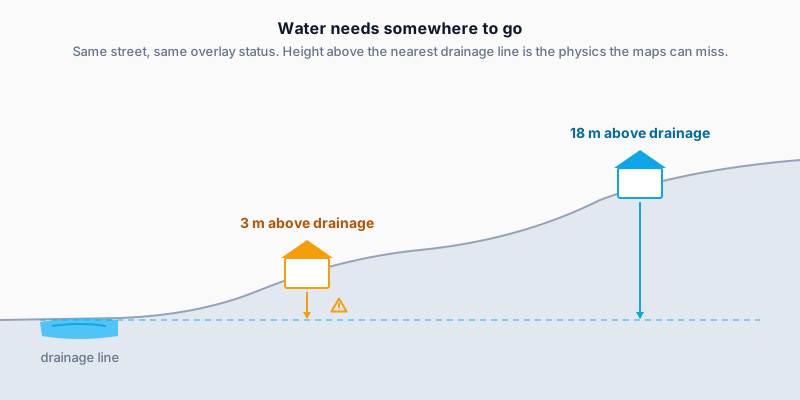
- Terrain is physics. Water flows downhill regardless of what has been mapped. How high an address sits above the nearest drainage path is a physical property of the land, and it applies everywhere, including the three states with no accessible statewide flood mapping.
What counts as "flood-prone"?
Australian planning systems use the 1% AEP event as the standard reference flood. The flood level that event produces, plus a freeboard margin, typically defines the flood planning area: the zone where development controls apply.
Being inside a flood overlay has real consequences beyond the insurance bill. It commonly triggers minimum floor levels for new construction, can require a flood risk assessment as part of a development application, and shapes what you are allowed to build at all. Victoria's Land Subject to Inundation Overlay, for example, maps the 1% AEP extent, while its Floodway Overlay marks the dangerous conveyance paths where controls are strictest. For anyone buying to develop, overlay status is a feasibility question, not a comfort question.
Option 1: Council flood maps and studies (free, patchy)
Councils commission the flood studies that everything else is built on, and some publish excellent tools. Brisbane City Council, for example, is commonly cited as having one of the best free flood mapping portals in the country, with historic events and flood types layered per address. Many councils will also provide flood level information for a specific property on request, sometimes as a formal flood information certificate.
The catch: it is completely uneven. One council publishes an interactive map with depths and historic events, the neighbouring one has a 15-year-old PDF, the next has nothing online at all. Fine for a deep dive on one property, hopeless for a shortlist.
Option 2: State planning systems (free, five states)
Above the councils, some states aggregate flood mapping into their planning portals:
- Victoria publishes its planning scheme flood overlays (Floodway Overlay, Land Subject to Inundation Overlay, Special Building Overlay for urban stormwater) through the state planning system, queryable per address.
- NSW has a flood layer in its ePlanning system, built from council flood studies that have been uploaded into the portal. Coverage is only as good as what councils have contributed, and it covers a subset of council areas, not the whole state.
- South Australia publishes flooding hazard layers through PlanSA.
- Tasmania and the ACT also publish queryable planning flood layers.
- Queensland, WA and the NT have no accessible statewide flood overlay. Queensland flood mapping lives council by council (which is why Brisbane's portal matters so much), and WA and the NT are similar: local studies exist, but there is no single statewide layer you can query.
The catch: five different systems with different semantics, and three states missing a single statewide portal. The planning layer itself is usually binary: you are in the overlay or you are not. Detailed council hydraulic studies may publish depth grids separately, but those files are spread across council portals, state catalogues and GIS services rather than delivered through one consistent address lookup.
Option 3: An insurance quote (free, brutal, honest)
Here is the cheapest professional flood assessment you will ever get: ask an insurer to quote the address. Insurers run their own flood models covering essentially every address in the country, typically in more detail than public mapping, because their money is on the line. The premium is the model's output.
A quote that comes back several times higher than a comparable property nearby is information. A quote where flood cover is excluded or loaded is information. Get quotes before going unconditional, not after settlement.
The catch: the model is a black box. You get a number, not a map, and no explanation of whether the driver is riverine, overland flow or something else. And quotes take effort per address: a tool for the final two or three candidates, not the first thirty.
Option 4: Professional flood assessment (thousands, the gold standard)
For development, or where the stakes justify it, a civil or hydraulic engineer can produce a site-specific flood assessment: surveyed levels, modelled flood behaviour for the site, and a report that stands up in a development application or a dispute. If you are building in or near a flood planning area, this is often not optional, the planning system will require it.
The catch: it costs thousands and takes weeks, per site. Nobody commissions one to compare a shortlist.
Option 5: A modelled flood score, with council-study depth where available
This is what we built at DA Leads: a free flood risk score for any address in Australia. Type an address, get a 0-100 score where 100 is the lowest risk, plus a plain statement of exactly which evidence produced it. In areas where an official council hydraulic study publishes a usable depth raster, the same result also reports the modelled water depth at that point for the study's 1% AEP event.
The national screening score combines three independent signals:
- Official planning overlays. We check official flood mapping in every state and territory except the NT: Victoria, NSW, Queensland, WA, South Australia, Tasmania and the ACT. For most of those states the check runs against our own copy of the state's published overlay dataset rather than a call to the state service at that moment, and every response says which basis answered. A severity-bearing official flood zone dominates the score. PlanSA's Flooding Evidence Required control is different: it requires further evidence but publishes no severity, so its score contribution is unknown and neutral rather than invented.
- Terrain drainage analysis. We measure how high the address sits above the nearest drainage line within 300 metres, sampled from Geoscience Australia's national airborne laser survey (LiDAR) bare-earth model: ~245,000 km2 of populated Australia in every state and territory, with sub-metre height accuracy. Live state elevation services fill any gaps, the national terrain model covers the rest, and an elevation_confidence flag on every response tells you which source answered. Low height above a drainage path means water has somewhere to go: towards you. This is the physics backstop that works everywhere, including where no official mapping exists.
- Water proximity. Distance to mapped rivers, creeks and water bodies, as a final signal where official layers are silent.
Where a licensed council-study raster covers the address, a fourth and stronger signal takes precedence:
- Modelled flood depth from the official hydraulic study. We sample the published 1% AEP depth grid at the address and return the depth in metres, the AEP, the source study and its licence. This is not a depth inferred from nearby water or terrain. It is the council study's modelled output, normalised into one response format.
The production depth library currently contains 55 rasters: 48 Brisbane catchments and seven NSW study areas. That is a coverage statement, not a national-depth claim. Every Australian address still receives the broader screening score, but addresses outside those study rasters do not receive an invented depth.
A covered response includes a block like this:
"flood_depth": {
  "depth_m": 0.7,
  "aep": "1% AEP",
  "source": "Official council flood study",
  "licence": "CC BY 4.0"
}
Newcastle is represented differently because its published study supplies the Australian Flood Hazard Classification rather than a depth grid. A result can therefore report H1 through H6, with H6 the highest mapped hazard. Hazard class and water depth answer related but different questions, so we do not convert one into the other.
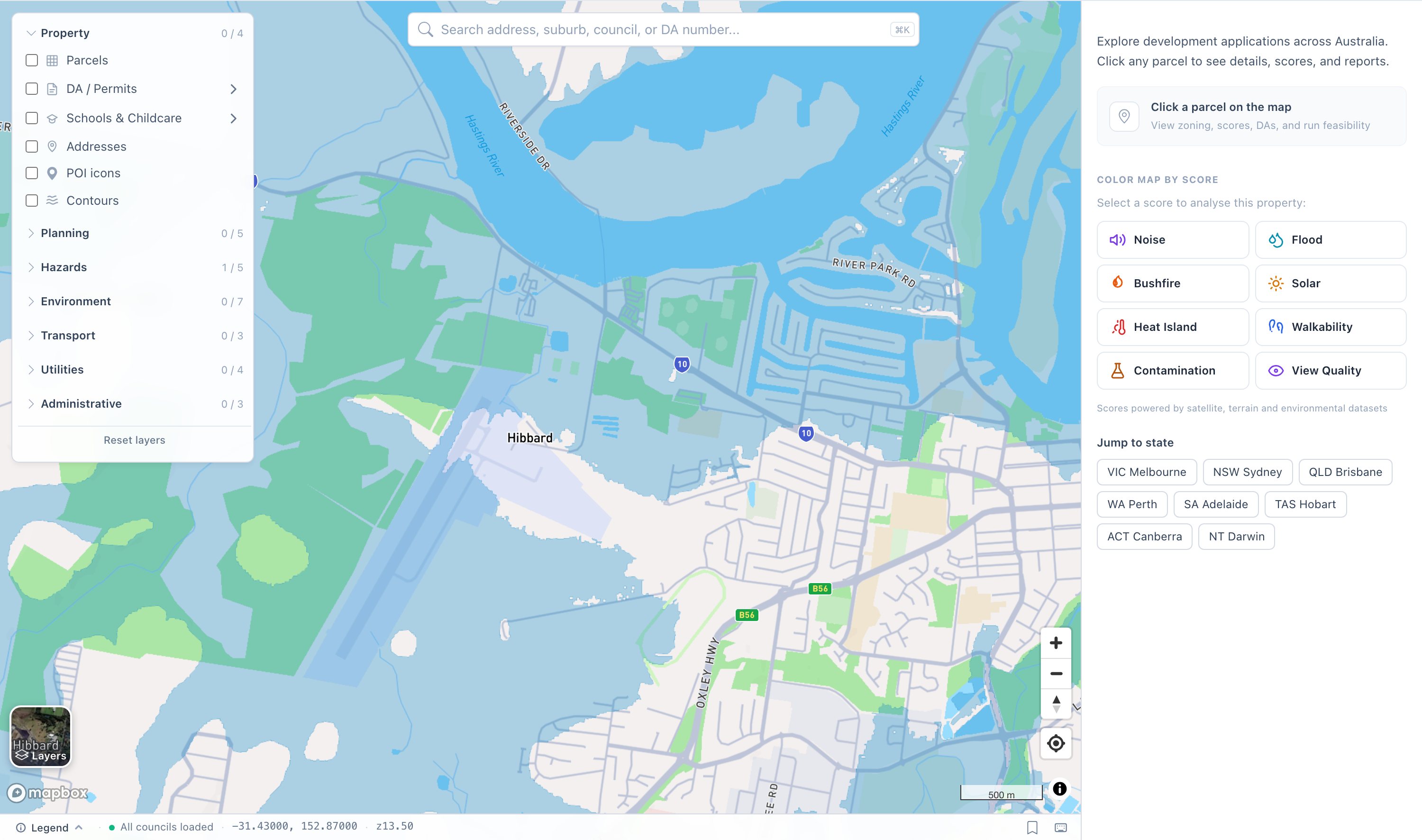
The flood layer on our map over Port Macquarie: official mapped flood extent across the Hastings floodplain, checkable for any address.
The part we are most deliberate about is provenance. Every response carries an official_layer flag with one of four values: hit (an official overlay or evidence control covers this address), checked_no_hit (a statewide severity-bearing layer was checked and the address is not covered), checked_partial_coverage (the official mapping for that state does not reach everywhere, so a miss does not clear the address), or none (no official layer exists for this state, so the score rests on terrain and proximity alone). For a PlanSA Flooding Evidence Required hit, official_layer_note says that the contribution is unknown and neutral and that site-specific evidence is still required. A flood score without its provenance is dangerous, so we state it every time.
You can also watch the terrain signal instead of reading it. On the map, the flood mode plays a water-level simulation: water rises over the local drainage line against the real bare-earth terrain, and you see exactly when it reaches the property you clicked, alongside a ground-profile cross-section through the address. A low-lying Elwood block goes under within a metre; a Kew ridge needs sixteen. It is a terrain-fill illustration of the same elevation data behind the score, not a hydraulic model, and it is labelled as such.
In practice, a typical clear result looks like 78, Low Risk, with the official overlay checked and not hit. Scores of 70 and above read as Low Risk, 90 and above as Very Low, with Moderate, High and Very High below that.
Be equally clear about what the result is not. DA Leads does not run a new hydraulic model for your property. Where depth is shown, it is sampled from an official published study and remains modelled study output, not a survey of the building or its finished floor level. It does not provide velocity unless the source publishes and the product explicitly reports it. It is not a substitute for a council flood certificate, a site survey, a hydraulic engineer or an insurance quote.
The honest limits
- A national score is not national depth coverage. The baseline score works nationally, but modelled depth only appears where a licensed study raster has been integrated. No depth field means "not available from our current study library", not zero metres.
- Queensland has no single statewide planning overlay. We integrate council and regional sources where they are published, including 48 Brisbane catchment depth rasters. Elsewhere the response states which official layers were checked and when it is falling back to terrain and proximity.
- NSW coverage is partial. The ePlanning flood layer only covers participating areas, and the current depth library contains seven NSW study areas. Newcastle H1-H6 adds official hazard classification but is not presented as depth.
- Overlays inherit the limits of the studies behind them. Mapping reflects where and when studies were done. A dated study, or no study, is a gap in the official record that no aggregator can fill.
- Terrain cannot see engineered protection. Piped stormwater and designed drainage capacity are invisible to any elevation model, LiDAR included (levees and earthworks do show up at LiDAR resolution). A protected floodplain and an unprotected one can look similar to terrain analysis.
Which option should you use?
- Shortlisting or comparing many addresses: the free modelled score on our map. Same baseline scale for every address, with official study depth or H1-H6 hazard shown where the source supports it.
- Serious about one property: the council's own flood information, plus an insurance quote before going unconditional. The quote is the second opinion that costs nothing.
- Buying to build or develop: confirm overlay status in the state planning system, then budget for a professional flood assessment if you are anywhere near a flood planning area. Bring the modelled picture as a starting map, not a substitute.
FAQ
How do I find out if my house is in a flood zone? Check the state planning portal if you are in VIC, NSW, SA, TAS or the ACT, and your council's flood mapping anywhere. Or type the address into our free flood score page, which checks the official overlays where they exist and tells you whether one was hit.
What does a 1-in-100-year flood actually mean? A 1% chance of that flood level being reached or exceeded in any single year (the 1% AEP event). It does not mean once per century: over a 30-year mortgage, a 1% annual chance compounds to roughly a one-in-four chance of at least one such event.
Does flood zoning affect insurance? Insurers price flood address-by-address using their own models, which typically consider more than the planning overlay. But mapped flood exposure and high premiums go hand in hand. Getting a quote before you go unconditional is the cheapest flood check available.
Can a property outside every flood overlay still flood? Yes. Overlays only exist where flood studies were commissioned, and overland flow flooding regularly hits addresses no study ever covered. That is why our score also measures how high the address sits above the nearest drainage line using laser-surveyed bare-earth elevation (the national terrain model elsewhere), which catches low-lying positions that mapping never covered.
Does every Australian address get a modelled water depth? No. Every address can receive the national screening score, but water depth is only returned where an official study raster in the current library covers the point. The result does not treat missing study coverage as zero depth.
What does the official_layer flag on the DA Leads score mean?
Every flood score reports whether an official planning control was hit, checked with no hit, checked against partial coverage, or not available for that state. A PlanSA Flooding Evidence Required hit is an evidence trigger, not a severity-bearing flood zone: read official_layer_note, obtain the required site evidence and do not treat the screening score as a clean result. The flag and note together tell you whether government mapping, an evidence trigger or terrain physics supports the result.
Is the DA Leads flood score free? Yes, for any address in Australia. It is a screening tool, not a hydraulic study: shortlist with it, then confirm anything decision-critical with council flood information or a professional assessment.
For research teams and property platforms
The useful enterprise output is not another coloured map. It is one consistent, report-ready payload for a list of addresses: score, official overlay status, modelled depth where available, H1-H6 hazard where published, source provenance and an explicit coverage status where no study raster is available.
Use the Property Intelligence API to review the response shape, or inspect a real Rocklea flood component with official 1% AEP modelled depth without an API key. If you are evaluating it for buyer reports, portfolio screening or a property platform, send us 20 addresses. We will return the available flood evidence in a consistent format so you can judge coverage and usefulness against your real workflow before discussing a licence.
Check any address free on the map, or read the full methodology and honest limitations on the flood score page.


