
Solar payback maths is more sensitive to yield than most people expect. The panels, the inverter and the installation cost roughly the same wherever you are, but the electricity they produce scales directly with how much sun actually arrives. Payback calculations for solar-plus-battery are especially sensitive: a 10 percent difference in output can move the answer by years.
Here is the part almost nobody checks. Most installer quotes assume a city-wide average yield. But the long-term solar resource is a property of your specific location, it shifts with local climate, elevation and latitude, and whatever difference exists at your address compounds over a 25-year system life.
So how do you check the solar potential of an actual address, before you sign a quote or buy the property? Here is every option, honestly reviewed, including our own free score and exactly what it does not do.
The short version
| Installer quotes | Global Solar Atlas | Government calculators | On-site shading assessment | Modelled score | |
|---|---|---|---|---|---|
| Cost | Free | Free | Free | Usually part of a quote | Free |
| What you get | A yield estimate with hidden assumptions | World-class irradiance data, raw | Bill savings estimates | The truth about your actual roof | 0-100 score for the location |
| Covers | Your address, their assumptions | Every address, if you dig | Varies | Your roof only | Every address in Australia |
| Best for | Getting a system priced | Checking the yield assumption | Rebate and bill context | The final decision on panel placement | Comparing addresses instantly |
The rest of this guide goes through each, plus a two-minute primer on how solar yield is measured so the numbers actually mean something.
First: how solar yield is measured, in two minutes
A few basics make every solar number easier to judge:
- GHI (global horizontal irradiance) is the total solar energy landing on a flat horizontal surface at a location, usually quoted in kWh per square metre per year. It is the raw resource: how much sun the sky delivers to that spot over the long term, averaged across seasons and weather.
- PVOUT (photovoltaic output potential) is the more useful number for panel owners: how many kWh a well-installed solar system would produce per kW of installed capacity (kWh per kWp) at that location, per year. Unlike raw sunshine figures, PVOUT folds in temperature losses and seasonal patterns, which is why it is the number utility-scale developers actually plan around.
- Hot panels produce less. Counterintuitively, a scorching afternoon is not a solar panel's best hour. Silicon panels lose efficiency as they heat up, with output commonly quoted as dropping a fraction of a percent for every degree above standard test conditions. This is why PVOUT matters more than raw irradiance: a very hot inland location does not convert its extra sunshine into extra electricity at full rate.
- Orientation and tilt. In Australia, north-facing panels are optimal: we are in the southern hemisphere, so the sun tracks through the northern sky. East or west-facing panels give up a slice of annual output, though west-facing arrays catch afternoon sun that lines up with evening usage. Tilt has an optimum angle per latitude, and good installers work with the roof pitch they have.
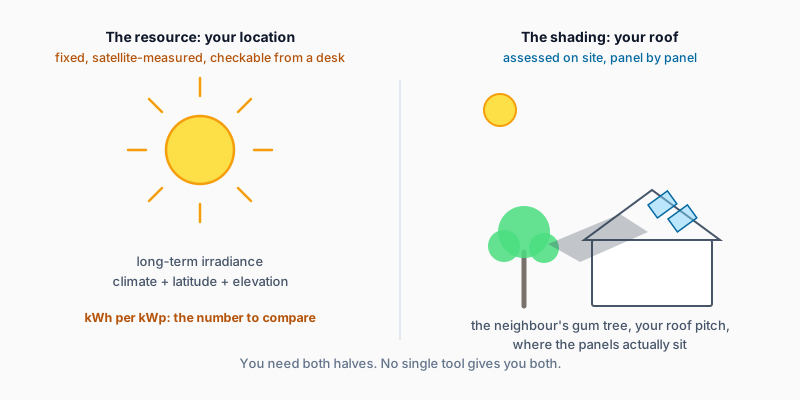
- Resource versus shading. This distinction runs through everything below. The solar resource of a location, its long-term irradiance, is fixed: you cannot change it and you cannot see it from a quote. Site shading, the neighbour's gum tree, the two-storey extension next door, the TV antenna shadow, is specific to your roof and is the part a good installer assesses on the day. You need both to get the yield right, and no single tool gives you both.
What counts as good solar in Australia?
Australia is world-class. Global Solar Atlas data puts the Australian PVOUT range at roughly 1,350 kWh/kWp per year in Hobart up to around 1,940 in Alice Springs. For context, rooftop solar remains viable even in high-latitude Europe at around 750 kWh/kWp, and the best locations on Earth reach about 2,000. Nearly all of Australia sits comfortably in the top half of that global range, which is why solar makes financial sense almost everywhere here.
Within Australia, the differences are more modest, but they are real, they are permanent, and they compound. A location-to-location gap in long-term yield does not average out the way weather does; it repeats every year for the life of the system. Between Hobart and Alice Springs the gap is over 40 percent. Between suburbs of one city it is usually far smaller, driven by local climate patterns, elevation and latitude, but over 25 years even single-digit percentage differences add up to a lot of electricity.
Option 1: Installer quotes (free, get several)
Any installer will estimate your annual production as part of a quote, and a good one will do it well. This is also the only option on this list that ends with panels on your roof, so you will use it regardless.
The catch: most quotes assume a city-wide average yield, and the assumption is rarely stated up front. Get several quotes, and ask each installer one specific question: what yield figure, in kWh per kW installed, did you assume for my address, and where does it come from? If two quotes promise different annual outputs for the same system size, this assumption is usually why.
Option 2: The Global Solar Atlas itself (free, world-class, and nobody checks it)
The strange thing about solar data is that the good stuff is free and public. The Global Solar Atlas publishes Solargis-modelled long-term irradiance and PV output potential for the entire planet at roughly 250-metre resolution, derived from satellite observation. It is the same class of data utility-scale developers use to site solar farms, and anyone can look up any address at no cost.
The catch: almost nobody does. The interface is built for energy professionals, the units (kWh/m², kWh/kWp, GHI, DNI, GTI) assume you already know what they mean, and there is no notion of what counts as good for Australia, only global colour scales on which the whole continent looks uniformly excellent. The data is world-class; the per-address answer takes work to extract and context to interpret.
Option 3: Government calculators and rebates (free, useful for the bill, not the resource)
Government-backed solar calculators exist to estimate system sizing and bill savings, and government incentives can substantially change the upfront cost of a system. Both are worth checking, and both change over time and vary by where you live, so verify the current rules for your state and the federal scheme directly rather than trusting any blog post, including this one.
The catch: these tools answer "what will solar do to my bill" using broad regional yield assumptions. They are not built to tell you how the solar resource at your specific address compares to anywhere else.
Option 4: An on-site shading assessment (the proper tool for the roof itself)
Once you are serious about a specific roof, someone needs to stand on or near it. A good installer will assess site shading as part of quoting: the trees, the neighbouring buildings, the chimney, which sections of roof face which way and at what pitch. This is the only way to know how much of your location's solar resource your particular roof can actually capture, and no satellite dataset or modelled score replaces it.
The catch: it covers one roof, after you have already engaged an installer, and it inherits whatever location-level yield assumption the installer started from. The assessment answers the shading half of the question; you still want the resource half checked independently.
Option 5: A free modelled solar score (instant, every address)
This is what we built at DA Leads: a free solar potential score for any address in Australia. Type an address, get a 0-100 score with a plain-English label and the underlying irradiance figures.
Be clear about what the number is. The score is built on the Global Solar Atlas: Solargis-modelled long-term global horizontal irradiance (GHI) and photovoltaic output potential (PVOUT) at roughly 250-metre resolution, derived from satellite observation. We then anchor the output potential against the observed Australian range, so the 0-100 score separates genuinely strong solar locations from merely average ones, rather than telling every Australian address it is wonderful on a global scale. A score of 84, for example, reads as Excellent Solar Potential: high long-term irradiance at that location.
And be clear about what it is not. The score is an open-horizon estimate. It makes zero shading assumptions. It does not model your neighbour's gum tree, your roof pitch, or where the panels would sit, and we never pretend it does. It measures the solar resource of the location, the part of solar yield you cannot change and cannot see from a quote. The shading question belongs to Option 4, and we say so on the solar score page itself.
That division of labour is deliberate. Location-level resource plus site-level shading is the whole yield picture, and the honest tool covers its half properly instead of pretending to cover both.
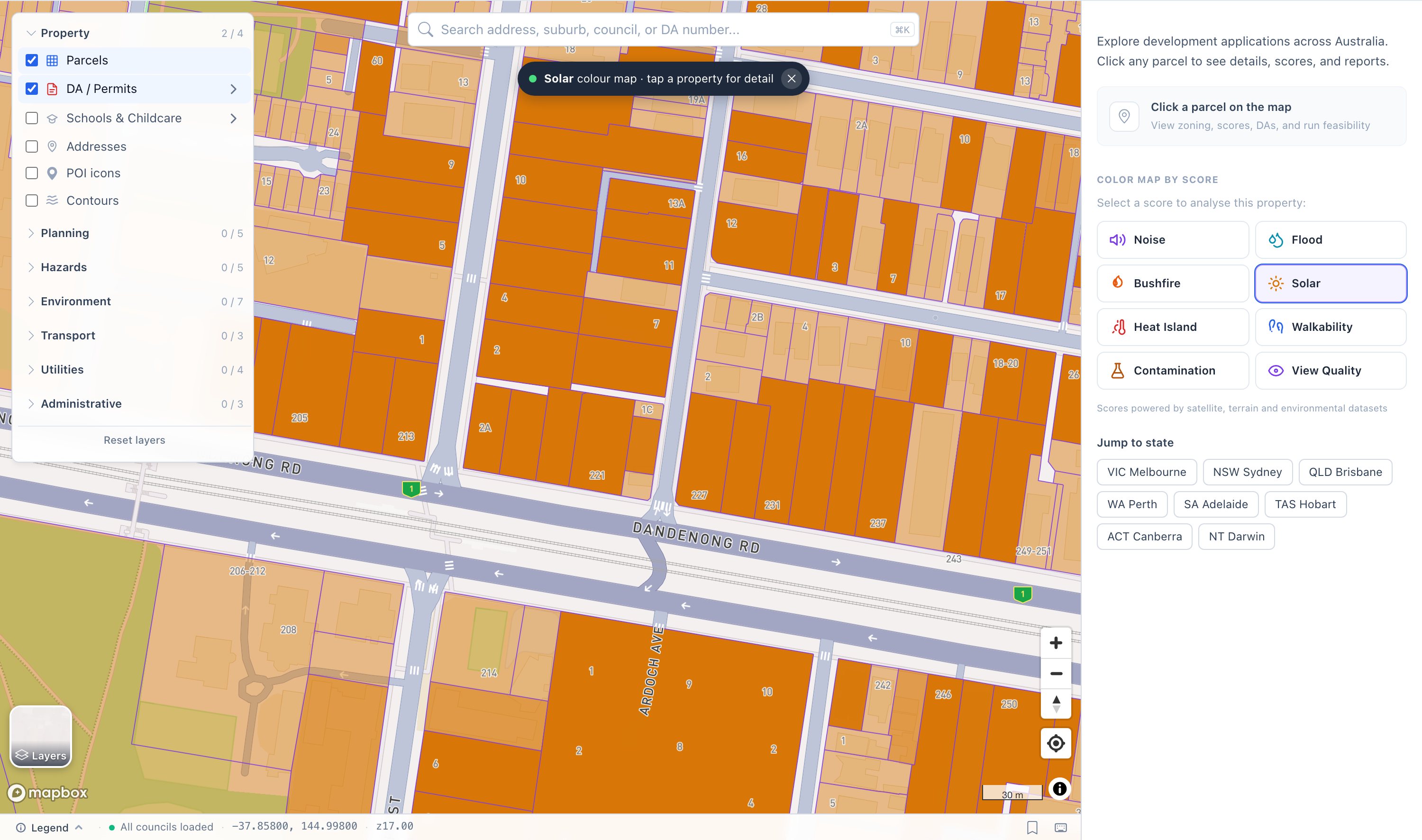
The solar colour map on our map: tap any parcel for its score and the irradiance behind it.
Which option should you use?
- Comparing addresses, or sanity-checking a suburb before you buy: the modelled score. Free, instant, same Australian-anchored scale for every address.
- Getting solar installed: several installer quotes, each asked what yield assumption they used, cross-checked against the long-term resource from the score or the Global Solar Atlas directly.
- The final call on a specific roof: an on-site shading assessment. Panels, pitch and trees are decided at the roof, not from a satellite.
- Bill and rebate context: the current government calculators and incentive rules for your state, checked at the source.
FAQ
How many kWh will my solar panels generate? A reasonable first estimate is system size multiplied by the location's PVOUT: a 6.6 kW system at an address with a PVOUT of 1,500 kWh/kWp would produce roughly 9,900 kWh per year, before any site shading losses. That is why the location figure matters: the same system at 1,350 versus 1,940 kWh/kWp produces very different totals. Your installer's estimate should also account for your roof's orientation, pitch and shading.
Does location matter for solar in Australia? Yes. Across the country, long-term PV output potential ranges from roughly 1,350 kWh/kWp in Hobart to around 1,940 in Alice Springs, a gap of over 40 percent. Within a single city the differences are usually modest, but they are permanent and they compound over a 25-year system life.
What is PVOUT? Photovoltaic output potential: the electricity a well-installed solar system would generate per kW of installed capacity at a location, in kWh per kWp per year. Unlike raw sunshine hours or irradiance, it folds in temperature losses and seasonal patterns, so it is the best single number for comparing solar locations.
Does the solar score account for shading from trees or buildings? No, and we are explicit about that. The score is based on open-horizon satellite-derived irradiance from the Global Solar Atlas. It measures the solar resource of the location. Site-level shading from trees, neighbouring buildings and roof orientation needs an on-site assessment.
What data is the solar score based on? The Global Solar Atlas, which publishes Solargis-modelled long-term global horizontal irradiance and photovoltaic output potential at roughly 250-metre resolution, derived from satellite observation. We anchor the result against the observed Australian range to produce the 0-100 score.
Why do solar scores differ between suburbs in the same city? Long-term irradiance shifts with local climate patterns, elevation and latitude. The differences within a city are usually modest but real, and they compound over a 25-year system life.
Check any address free on the map, or read the methodology, data sources and honest limitations on the solar score page.


