
Picture this: a homeowner has lodged plans for a rear extension, the application is now public, and the project has moved from "maybe one day" to an active approval process. They still need designers, surveyors and builders to get from paper to site.
That's what a development application (DA) is, and that's why it matters to you.
So What Actually Is a DA?
A development application is a formal request to a local council for permission to build, renovate or demolish something. In Victoria, these are technically called "planning permit applications," but everyone in the industry calls them DAs.
When someone wants to do anything beyond basic cosmetic work on their property (a new pool, a rear extension, a small second dwelling on a constrained lot, even removing a large tree), they often need to lodge an application with their council. That application becomes public record once it enters the planning system.
Here's what typically needs a DA in Victoria:
- New homes and multi-dwelling developments
- Renovations and extensions (especially anything that changes the building envelope)
- Swimming pools and spas
- Small second dwellings on lots under 300m² in residential zones
- Demolitions (particularly in heritage areas)
- Front fences over 1.2 metres
- Tree removal (since September 2025, any canopy tree over 5m tall in residential zones)
Why This Is Gold for Tradies
Every DA represents someone who has already decided to build. They're not tyre-kicking. They've paid fees, hired professionals, and committed to the process.
Think about how you normally find work. Maybe you run ads, ask for referrals, do letterbox drops. All of those are about finding people who might be interested. DA data flips that: you're finding people who are already committed.
The maths is simple. A homeowner who's spent months on planning and thousands on applications isn't going to back out. They need a tradie. The only question is which one they'll pick.
How the Permit Process Actually Works
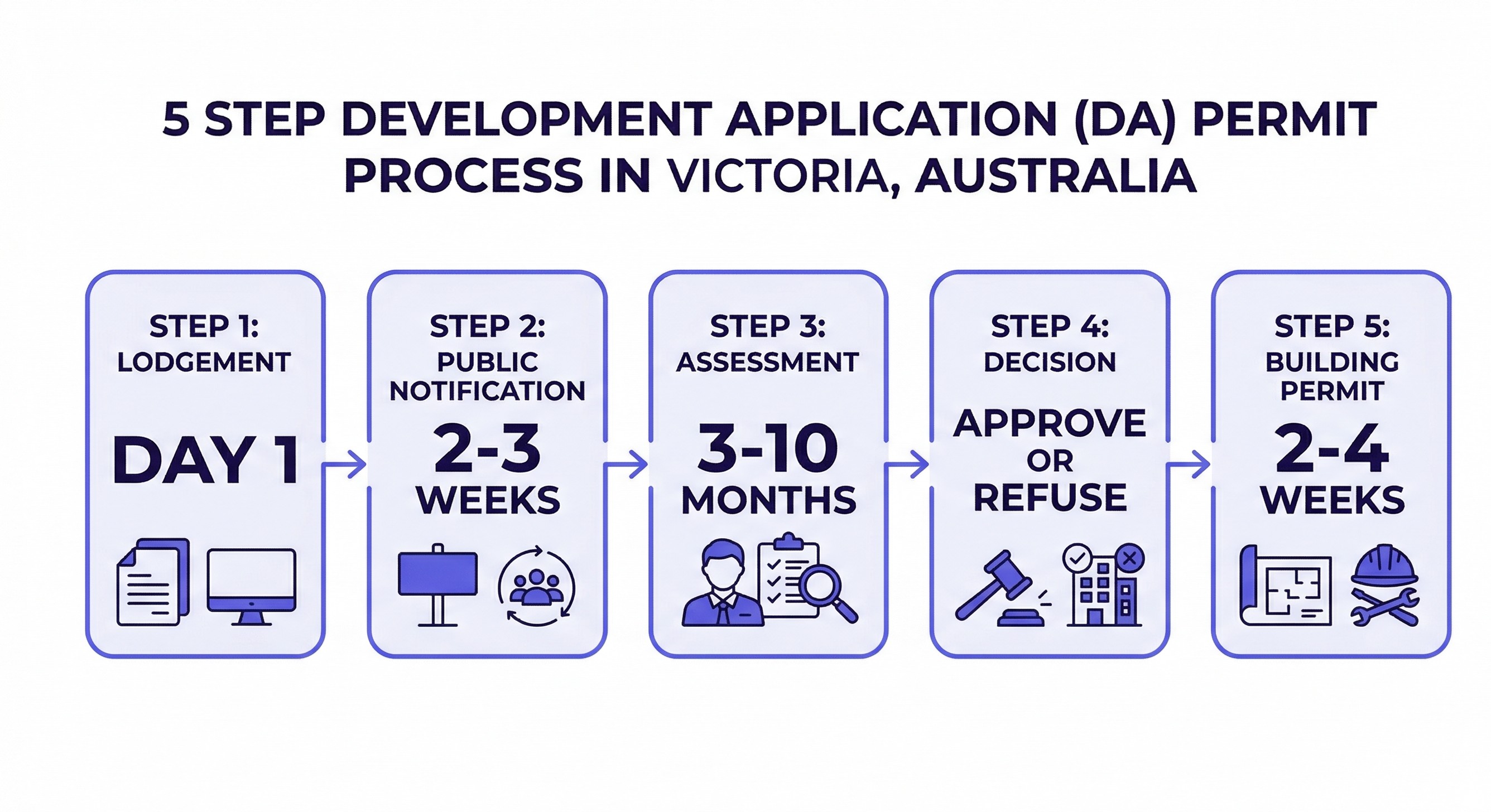
The five-step DA permit process in Victoria: lodgement, notice, assessment, decision, and building permit usually sit in that order for projects that trigger planning approval. Source: DA Leads synthesis of the Victorian planning permit process.
Here's the reality of how planning permits work in Victoria, and why timing matters:
| Stage | What happens | Duration |
|---|---|---|
| 1. Lodgement | Homeowner submits plans, reports and fees. Application becomes public. This is when it appears on DA Leads. | Day 1 |
| 2. Public notification | Council notifies neighbours if notice is required. The closing date for submissions must be at least 14 days after the last notice is given. Many homeowners start getting quotes during this time. | At least 14 days |
| 3. Assessment | Council planners review the application. The statutory timeframe is 60 days for most applications, but the clock can pause for further information, referrals and notice requirements, so the real timeline is often longer. | 60 statutory days, often longer in practice |
| 4. Decision | Council approves (often with conditions), refuses, or sends it to VCAT for review. | Varies |
| 5. Building permit | After planning approval, a separate building permit is usually needed before construction can start, and it must be consistent with the planning permit. | Varies |
That long waiting period is your window. The homeowner is sitting there with approved plans, ready to go, actively looking for someone to do the work.
How to Actually Use This
Here's what the tradies who get the most out of DA data actually do:
-
Filter for your trade. Pool builder? Filter for "Swimming Pool / Spa." Renovator? Look at "Renovation / Extension." Don't waste time scrolling through categories that aren't yours.
-
Focus locally. A job in your council area is worth more than a bigger job an hour away. Travel time eats your margin.
-
Contact early. The earlier you reach out, the fewer competitors you'll face. By the time a project is approved and on its way to site, the homeowner might have three quotes already. Reach out when the DA is first lodged and you could be the only one.
-
Be specific. "I saw you've applied for a rear extension at your property on Park Street" lands completely differently to a generic cold call. You're showing that you pay attention.
For a deeper dive into how the permit process works step by step, see our detailed guide. And if you're a builder watching Melbourne's growth corridors, new home DAs in growth areas are worth tracking weekly.
We built DA Leads to make this easy. Instead of checking 30+ council websites every week, you get a single dashboard with everything filtered and classified by trade.
Browse the latest leads to see what's happening near you.


