
Demolition costs blow out for one reason more than any other: people think the budget is mainly about knocking the building down. It is not. Permits, asbestos, access and site remediation usually matter more than the machine time.
If you want a realistic demolition budget, start with the approval stack and the hazard stack.
When Do You Need a Demolition Permit?
Almost always, some form of formal approval is involved.
At a minimum, demolition commonly sits inside the building-permit framework. On top of that, some jobs also trigger:
- A planning permit
- Report and consent or similar council approvals
- Hazard and asbestos controls before work starts
The Real Cost Stack
The biggest budget drivers are usually these four buckets:
- Permit layer
- Hazard layer
- Site condition layer
- Licensing and compliance layer
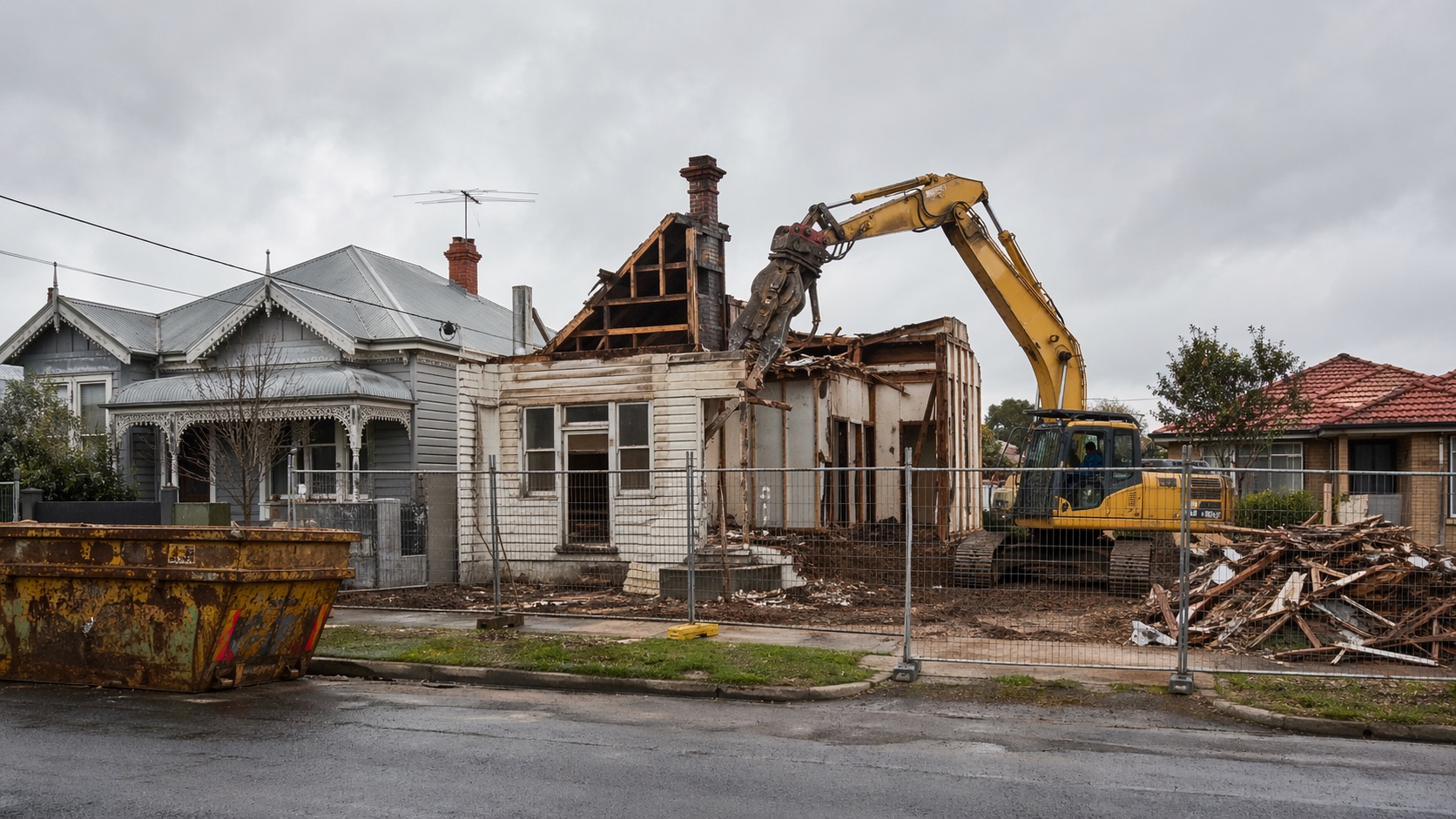
A Melbourne demolition site: the excavator and skip bin are the visible costs, but permits, asbestos, access and site remediation usually matter more than the machine time.
Permit Layer
The permit cost is rarely just one form.
- A building permit is the base layer
- Heritage or planning controls may add a planning permit
- In Victoria, report and consent can sit between council and the building permit
This is why a "simple demolition" can stop being simple very quickly. If you are working in Victoria, our guide to council planning permits covers the layers in more detail.
Hazard Layer: Asbestos Changes Everything
For buildings built before 2004, the safest assumption is that asbestos may be present until a proper survey says otherwise.
The implications are serious:
- Demolition work must account for hazardous materials first
- Licensed asbestos removal may be required before general demolition starts
- Friable asbestos brings a much heavier compliance response than bonded materials
In real projects, asbestos is one of the biggest reasons the final cost moves away from the original expectation.
Site Condition Layer
These are the hidden budget movers owners underestimate:
- Difficult access for machinery
- Utility disconnections
- Traffic control and hoarding
- Contamination or remediation issues
- Extra cleanup after demolition
This is why two similar houses can produce very different demolition costs.
Timelines: What Actually Slows the Job
The slowest part is often not the demolition itself. It is the path to getting the site ready for demolition.
Typical delay points are:
- Waiting on permit layers to line up
- Information requests or extra conditions
- Asbestos identification and removal
- Utility disconnections
- Heritage or planning controls
If the site also sits inside a larger redevelopment, the demolition timeline often gets dragged by the project around it.
Licensing Still Matters
Demolition is not just an excavator-and-truck job. Licensing is state-based and is part of the cost and risk profile.
Examples:
- Victoria: building practitioner demolition registration categories apply
- NSW: demolition work sits under SafeWork NSW licensing
- Queensland: structural demolition licensing sits under WorkSafe Queensland
If the licensing is wrong, the project risk goes up fast for both contractor and owner.
What This Means for Budgeting
If you are budgeting demolition properly, stop asking for one national average rate.
Ask these instead:
- Is there only a building permit, or are there planning layers too?
- Does the site have asbestos or contamination risk?
- How hard is access and servicing?
- What licensing and compliance controls apply in this state?
Those four questions do more for budget accuracy than any generic online rate table. For a broader look at where budget surprises come from, see our hidden costs of property development breakdown.
| Cost driver | What it covers | Why it matters |
|---|---|---|
| Permit layer | Building permit, planning permit, report and consent | Multiple layers can stack; "simple" jobs stop being simple |
| Hazard layer | Asbestos survey, licensed removal, friable vs bonded | Pre-2004 buildings may require removal before demolition starts |
| Site conditions | Access, utility disconnections, traffic control, contamination | Two similar houses can produce very different costs |
| Licensing | State-based demolition practitioner registration | Wrong licensing increases project risk for contractor and owner |
The Bottom Line
The most honest answer to demolition cost is this: the permit and hazard structure matters more than the headline building size. If you understand the approval path first, the cost picture gets much clearer.
Browse the latest demolition leads on DA Leads to find projects where the approval process is already signalling complexity, budget and timing.


