
You're scrolling through listings and a 750m² block in Oakleigh catches your eye. The price guide looks reasonable. But before you call the agent, you need to know: can this site actually be developed? And if so, into what?
Assessing a development site in Melbourne isn't guesswork. There's a systematic process that experienced developers follow, and once you learn it, you can screen a site in under 30 minutes, which means you'll spend your time running feasibilities on viable sites instead of falling in love with properties that were never going to work. Here's how.
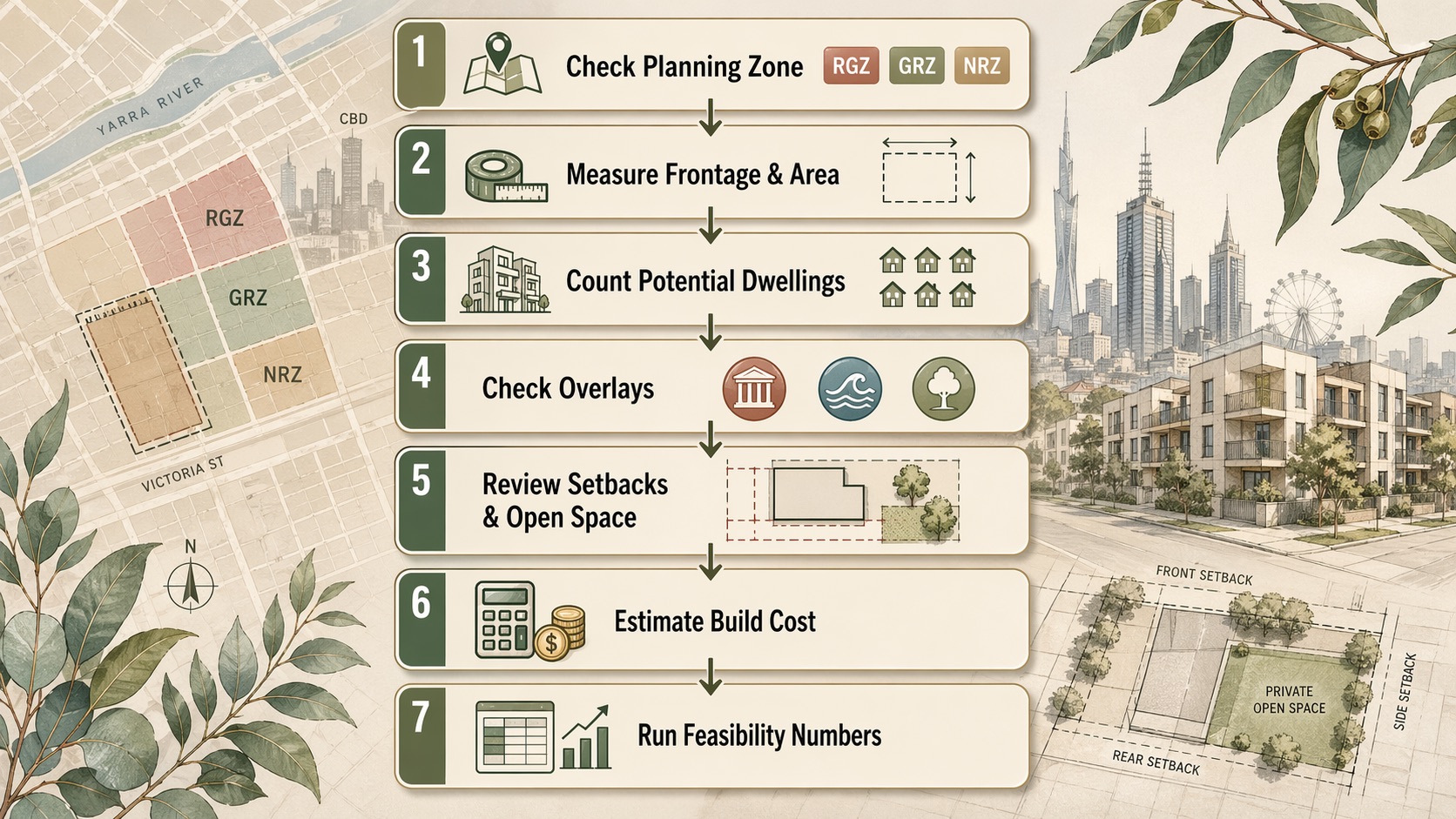
The 7-step site assessment process: from planning zone through to feasibility numbers. Each step filters out sites that won't work before you spend money on consultants.
Step 1: Check the Zoning
Zoning is the single biggest factor determining what you can build. For a deeper dive, see our full guide to Victorian planning zones. In Melbourne, the three residential zones you'll encounter most often are:
General Residential Zone (GRZ)
This is where most Melbourne townhouse developments happen. GRZ allows multi-dwelling development (subject to a planning permit), with these key parameters:
- Maximum height: 11 metres (typically 3 storeys)
- Garden area requirement: 35% of the lot must be retained as garden area for lots between 400m² and 650m². Lots over 650m² must provide at least 35%.
- No minimum lot size per dwelling (but each dwelling must meet ResCode standards)
A 700m² GRZ site with 35% garden area leaves you 455m² of building footprint and hard surfaces. That's typically enough for three townhouses with single garages.
Neighbourhood Residential Zone (NRZ)
NRZ is more restrictive. It's designed to protect neighbourhood character.
- Maximum height: 9 metres (2 storeys)
- Maximum dwellings: no cap in the base zone (Amendment VC110 removed the old two-dwelling limit), but many council schedules still set their own caps. Check the schedule for your site.
- Garden area: 35% for lots 400–500m², up to 40% or more in some schedules
- Character requirements: design must respond to the prevailing neighbourhood character
NRZ sites are better suited to duplexes than townhouse rows. Don't try to squeeze three or four dwellings onto an NRZ site. It won't get through council.
Residential Growth Zone (RGZ)
RGZ is the most permissive residential zone, found along activity centres and transport corridors.
- Maximum height: 13.5 metres (typically 4 storeys, but check the schedule)
- No mandatory garden area requirement (unless specified in a schedule)
- Suited to apartments and larger townhouse projects
If you find an RGZ site near a train station, that's where the real density opportunities are.
How to check
Go to VicPlan and type in the address. The zoning map will show you the zone immediately. Click on the parcel for details including overlays.
Step 2: Check for Overlays
Overlays are the hidden killers of development projects. They add extra requirements on top of the base zone. The overlays that matter most in Melbourne:
Heritage Overlay (HO)
If the property or the streetscape has a heritage overlay, expect significant constraints. You may need to retain the existing dwelling, match materials and design to the streetscape, and potentially engage a heritage consultant ($3,000–$8,000). Heritage overlays don't make development impossible, but they make it slower and more expensive.
Vegetation Protection Overlay (VPO) and Significant Landscape Overlay (SLO)
Common in leafy eastern suburbs like Whitehorse, Manningham, and Boroondara. If there are significant trees on site, you may need an arborist report ($1,500–$3,000) and might not be able to remove them. A large tree in the middle of a site can kill a development layout entirely.
Design and Development Overlay (DDO)
These set specific design requirements: sometimes stricter height limits, setback requirements, or building envelope controls. Always read the DDO schedule for the specific site.
Special Building Overlay (SBO) and Land Subject to Inundation Overlay (LSIO)
Flood overlays. You can still develop, but you'll need flood-level surveys, raised floor levels, and potentially expensive engineering solutions. Budget an extra $30,000–$80,000 for stormwater management on flood-affected sites.
Step 3: Measure the Site
Get the real dimensions, not the ones from the listing. Agents round up. You need:
- Frontage width: Minimum 15–16 metres for a side-by-side dual occupancy. For three townhouses, you generally want 18 metres or more.
- Depth: Deeper is better. A 40-metre-deep site gives you room for rear units with proper daylight access.
- Total area: Cross-check the title with the council property report. Discrepancies are common, especially on older titles.
- Shape: Regular rectangular lots are easiest to develop. Irregular shapes, battle-axe lots, or lots with easements complicate layouts and reduce yield.
The frontage test
Here's a quick rule of thumb for standard Melbourne townhouses:
| Frontage | Likely yield |
|---|---|
| Under 14m | Duplex (2 dwellings) |
| 14–18m | 3 dwellings (tight) |
| 18–22m | 3–4 dwellings |
| 22m+ | 4+ dwellings |
These assume a standard depth of 35–45 metres and GRZ zoning. Narrow frontages with deep lots may suit a "battleaxe" layout with one unit behind another.
Step 4: Calculate Garden Area
This trips up more developers than any other single requirement. Since the garden area rules were introduced, they're the biggest density limiter on GRZ and NRZ sites in Melbourne.
Garden area is defined as permeable area at natural ground level with no buildings, paving, or hard surfaces above it. Driveways, paths, patios, and decks don't count.
For a 700m² GRZ site requiring 35% garden area:
- 700m² × 35% = 245m² must be garden
- Leaves 455m² for buildings, driveways, paths, and hard surfaces
- A typical 6m-wide driveway running 20m into the site consumes 120m² alone
- Each single garage (3m × 6m) is 18m²
- Each dwelling footprint (say 7m × 12m for two-storey) is 84m²
Three dwellings: 3 × 84m² footprint + 120m² driveway + 3 × 18m² garage = 426m² of hard coverage. That leaves 274m² garden, just above the 245m² requirement. It works, but it's tight.
Four dwellings on 700m²? Almost certainly fails garden area unless you're very creative with the layout. The chart above shows why: with 4 dwellings, only 172m² remains for garden, well below the 245m² required.
Step 5: Check Setbacks and Overlooking
ResCode (Clause 55 of the Victorian Planning Scheme) sets minimum standards:
- Front setback: Generally matches the average of the two adjoining properties (or the prevailing streetscape setback)
- Side setbacks: 1 metre for walls up to 3.6m high on a boundary, increasing with height
- Rear setback: Varies with wall height, but typically 3–5 metres for a two-storey dwelling
- Overlooking: Habitable room windows within 9 metres of a neighbour's private open space or habitable room window must be screened to 1.7m above floor level
- Overshadowing: Must not overshadow more than 75% of a neighbour's secluded private open space at the September equinox
The north-south trap
Watch the orientation. If the site has its long boundary facing north, the overshadowing requirements become critical because your building will cast shadows directly onto the southern neighbour's yard, and Standard B21 says you can't overshadow more than 75% of their private open space at the September equinox. Sites where the rear boundary faces south are significantly easier to develop. Shadows fall onto your own land. Problem solved.
Step 6: Research Comparable Sales
Before you commit to a purchase price, you need evidence for your end sale values. This means finding recent sales of comparable finished products within 1–2 kilometres of your site.
Look for:
- Similar product type: if you're planning three-bedroom townhouses, find recent townhouse sales, not apartment sales
- Similar quality: match the finish level you're planning (standard, mid-range, or premium)
- Recent sales: within the last 6 months ideally, 12 months maximum
- Adjust for differences: an extra bathroom adds $15,000–$25,000, a double garage adds $30,000–$50,000 over a single
Where to find data
- Domain.com.au and realestate.com.au for recent sold prices
- Council rate notices for unimproved land values
- REIV median prices for suburb benchmarks
- Real estate agents: call the local agents and ask. They'll talk to you because they want your listing when the project completes
Red flags in comparables
- If you can only find comparable sales from 12+ months ago, the market may have shifted
- If comparable townhouses are sitting on market for 60+ days, don't assume you'll sell at asking price
- If there are multiple competing developments in the same street, supply may suppress prices
Step 7: Run the Numbers
With all the above information, you can now run a preliminary feasibility:
- Estimate dwelling yield from zoning, frontage, and garden area
- Estimate end values from comparable sales
- Estimate construction costs at $2,800–$3,500/m² for standard townhouses
- Add all soft costs (stamp duty, professional fees, council contributions, finance, selling costs)
- Calculate your margin. Does it hit 15–20%?
For a walkthrough of the three feasibility frameworks, see our separate guide. If the preliminary numbers show less than 12–13% margin, move on. By the time you account for the things you've missed, a 12% preliminary margin becomes 5% reality.
The 10-Minute Site Screen
When you're scanning multiple listings, use this quick checklist before doing the full analysis:
- [ ] Zoning allows multi-dwelling development (GRZ, RGZ, or MUZ)
- [ ] No heritage overlay on the specific property
- [ ] Frontage is at least 15m (for 3+ dwellings: 18m+)
- [ ] Lot size is at least 500m² (for 3+ dwellings: 650m²+)
- [ ] Regular shape (no extreme battle-axe or triangular lots)
- [ ] No major easements through the middle of the site
- [ ] Comparable sales support end values that make the numbers work
- [ ] Land price is under 40% of expected gross realisation
If a site fails two or more of these, it's usually not worth the deeper analysis.
Automate Your Site Assessment
Doing this manually for every site takes time. The DA Leads feasibility calculator pulls zoning, overlays, lot dimensions, and comparable sales data automatically for any Melbourne address. It calculates garden area compliance, estimates dwelling yield, and runs the financial feasibility, all in about 30 seconds. It's not a substitute for due diligence, but it's the fastest way to screen sites and focus your time on the ones that actually stack up.
Sources and Further Reading
- VicPlan - Victoria's planning map - check zoning, overlays, and parcel details for any Victorian address
- Victorian Planning Provisions - Residential zones - GRZ, NRZ, and RGZ zone specifications
- ResCode (Clause 55) - Victorian Planning Provisions - setback, overlooking, overshadowing, and garden area standards
- Amendment VC110 - Planning Victoria - removed the two-dwelling limit from NRZ
- Domain.com.au - comparable sales data
- realestate.com.au - comparable sales data
- REIV median prices - suburb benchmark data
- DA Leads internal database snapshot, queried 2026-03-16
- DA Leads feasibility calculator


