
This is the story of a development application that looked straightforward on paper and still blew up. It is a composite Melbourne case study, not a verbatim council file. The planning issues are real. The site details, dates, and scenario numbers are simplified so you can see exactly where the scheme went wrong.
The Site
A 720m² property in an established inner-south Melbourne suburb. The existing dwelling was a 1960s cream brick house, unrenovated, structurally sound, but with no obvious heritage value to the untrained eye. The site had an 18-metre frontage to a quiet residential street, with a laneway at the rear.
In the scenario model, the developer purchased the site for $1.35 million, with plans to demolish the existing house and build four three-bedroom townhouses. The feasibility showed a 17% margin, which looked healthy enough to proceed.
The Application
The developer engaged an architect and town planner to prepare a planning permit application for demolition of the existing dwelling and construction of four dwellings. The application was lodged with council in May, accompanied by:
- Architectural plans (prepared by a residential architect)
- A town planning report
- A shadow analysis
- A landscape concept plan
- Stormwater management plan
- Waste management plan
In the worked scenario, the first-round document cost was approximately $42,000.
The application was assessed by council over four months. In the worked scenario, the site was carrying about $6,200 per month in interest, rates, and insurance.
In September, council issued a Notice of Decision to refuse the permit on three grounds.
Ground 1: Heritage Overlay, "Demolition Not Justified"
The first ground came as a genuine shock. The developer knew the property sat in a Heritage Overlay precinct, but assumed heritage only mattered for landmark houses or individually significant buildings. The 1960s cream brick house was not a landmark. It did not look special. That assumption still failed.
Council's reasoning: The fight was not about whether the house was famous. It was about whether the building contributed to the precinct character and whether demolition plus replacement responded to the statement of significance. That is the part developers regularly underestimate.
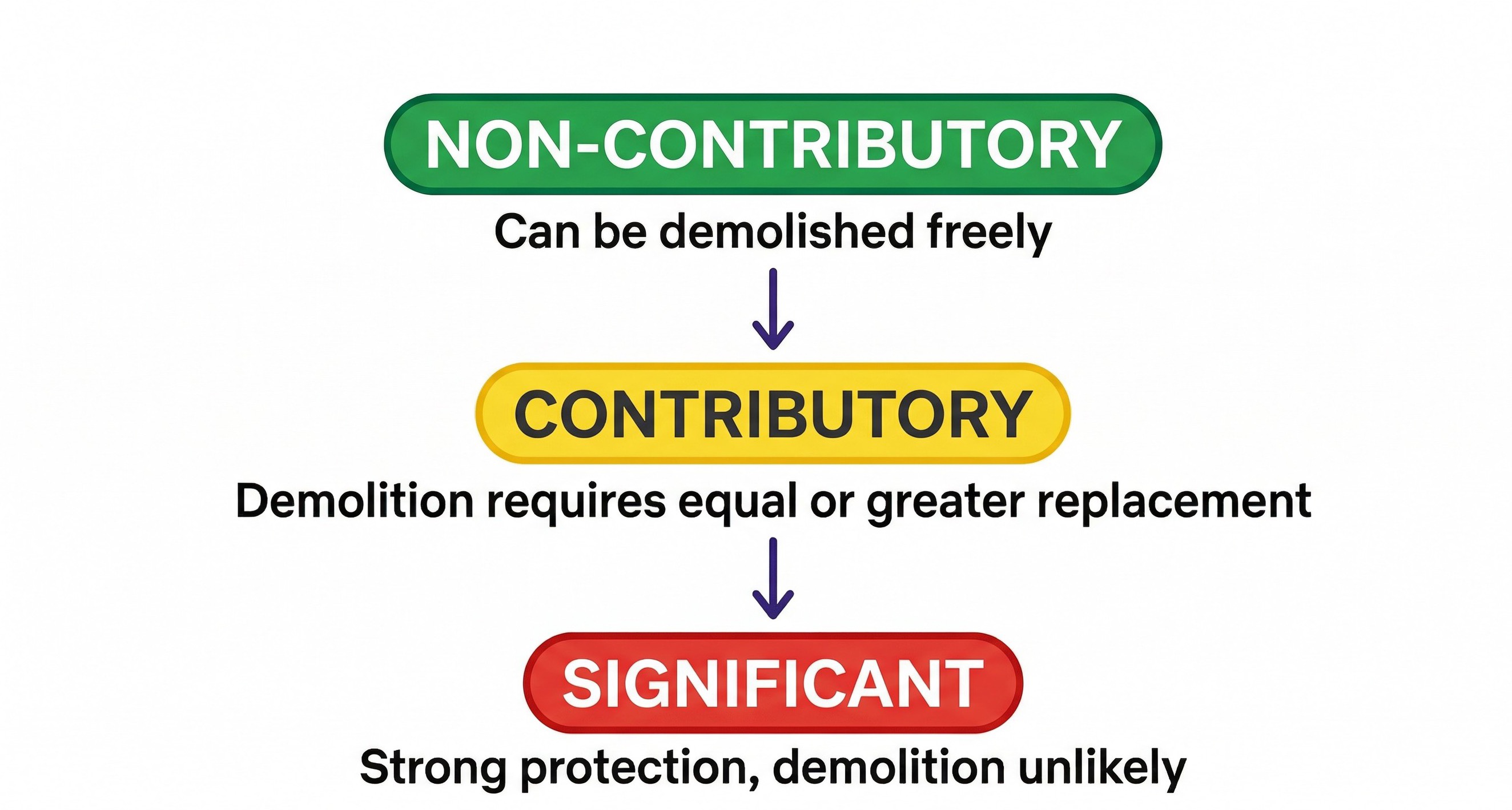
Heritage building classification: non-contributory, contributory, and significant buildings carry very different demolition and redevelopment risk. Source: DA Leads visual summary of Victorian heritage grading concepts.
In many Melbourne heritage precincts, the practical grading split is non-contributory, contributory, and individually significant. Once a place is treated as contributory, the question stops being "is this building iconic?" and becomes "does demolition harm the precinct, and does the replacement actually respond to its significance?" Council's heritage adviser said the four-townhouse scheme failed that test.
What the developer missed
The Heritage Overlay applied to the precinct, not just to individually famous houses. The architect designed a contemporary townhouse scheme without showing how it responded to the street's character. Setbacks, roof form, materiality, and the garden-forward presentation that gave the precinct its rhythm were treated as style choices rather than policy constraints.
Cost of this mistake: A heritage consultant engaged at the start could have tested whether a retain-and-build-behind strategy, a lower-yield scheme, or a more precinct-responsive design had a realistic approval path. Instead, the first concept walked straight into a heritage objection that should not have been a surprise.
The lesson
Always check the statement of significance and local grading, not just the overlay. If a site is in a Heritage Overlay, read the heritage study, the local policy, and the precinct statement of significance before you sketch yield. "Contributory" is not a cosmetic label. It usually means demolition and replacement will be tested against the character of the precinct, not against your intuition about whether the house looks old enough to matter.
Ground 2: The Parking Strategy Was Never Properly Tested
The development proposed four three-bedroom townhouses, each with a single-car garage. Four spaces total.
This is the part that needs a 2026 update. Victoria changed car parking requirements in December 2025. The current Clause 52.06 settings now depend on the Car Parking Requirement Map and the site's Public Transport Accessibility Level (PTAL) category. So the old habit of memorising one blanket rate for every three-bedroom townhouse is no longer good enough.
Council's reasoning in the worked scenario: the proposal showed four resident spaces and no visitor space, but the planning team never proved that the applicable car parking category supported that layout, and it never backed a reduction with traffic evidence.
The scenario gap looked like this:
- 4 dwellings × 2 spaces = 8 resident spaces
- 1 visitor space (for 4 dwellings)
- Total required: 9 spaces
- Total provided: 4 spaces
- Shortfall: 5 spaces
Scenario parking gap in this composite case study. The point is not that every 2026 townhouse project needs this exact number of spaces. The point is that a one-space layout without a current PTAL check or parking-reduction evidence is asking for trouble. Source: DA Leads internal case model, updated 2026-04-11.
| Parking check | Why it mattered in this case |
|---|---|
| PTAL / map category | The team never proved the site qualified for a lower requirement |
| Visitor parking | No visitor space was designed into the scheme |
| Reduction evidence | No traffic report or supporting parking analysis was lodged |
The developer assumed single-car garages would be acceptable because the site felt inner-urban and "close enough" to public transport. That is not how current Clause 52.06 should be read. If a site benefits from lower parking rates, prove it with the actual mapped category and the planning evidence. If it does not, redesign early instead of hoping the planner will forgive the gap.
What the developer missed
The real mistake was not just under-providing spaces. It was designing first and checking the applicable parking framework second. The options were:
- Run the current PTAL and map check first. Do not use pre-2025 parking rules from memory.
- Redesign the product mix. Fewer bedrooms or fewer dwellings can change the parking problem fast.
- Submit a traffic report. If you want a reduction, support it properly.
- Provide a cleaner parking layout. Tandem spaces or a visitor space may solve more than one objection at once.
The lesson
Never assume parking standards, and definitely do not rely on the old blanket rule by memory. Check the current Clause 52.06 framework, the Car Parking Requirement Map, and the site's PTAL category. If you want a reduction, turn up with evidence, not optimism.
Ground 3: Non-Compliant Side and Rear Setbacks
The third ground was a cascading series of ResCode non-compliances related to side and rear setbacks, overlooking, and overshadowing.
Council's findings:
-
Side setbacks: The first-floor walls of dwellings 1 and 4 were set back only 1.0 metre from the side boundaries. Under Clause 55.04-1 (Standard B17), the required setback for walls over 3.6 metres high is 1 metre plus 0.3 metres for every metre of height over 3.6 metres. The walls were 6.5 metres high, requiring a 1.87-metre setback. Non-compliant by 870mm on each side.
-
Overlooking: First-floor bedroom windows of dwellings 1 and 4 had direct views into the secluded private open space of adjacent properties within 9 metres. Standard B22 (Clause 55.04-6) requires screening to 1.7 metres above floor level. No screening was proposed.
-
Overshadowing: The shadow analysis showed that dwelling 4 would overshadow more than 75% of the southern neighbour's secluded private open space at the September equinox (the relevant test date). Standard B21 (Clause 55.04-5) requires that existing sunlight to a neighbour's private open space not be reduced below 75%, or not further reduced if already below.
What the developer missed
These are standard ResCode issues that should have been tested before the scheme was lodged. The setback formula is mathematical. Overlooking and overshadowing are also measurable, not vibes. The development was drawn to maximise floor area before anyone seriously asked whether the built form still met the amenity objectives.
The lesson
ResCode standards are not free suggestions. A different design response can still work if it meets the objective, but the burden is on the applicant to prove it. Walking into council with multiple measurable shortfalls and no strong justification is how a scheme goes from "push it and see" to refusal.
The Financial Damage in the Worked Scenario
Because this is a composite case study, the dollar figures below are a worked scenario rather than a verbatim council invoice file. The point is not the exact suburb or exact fee quote. The point is how quickly a refusal chews through soft costs and holding costs.
Here is the scenario cost stack:
| Cost item | Amount |
|---|---|
| Architect fees (initial design) | $22,000 |
| Town planning report | $8,500 |
| Other consultant reports | $7,500 |
| Council application fee | $4,200 |
| Holding costs during assessment (4 months) | $24,800 |
| Legal advice (post-refusal) | $3,500 |
| Total wasted on failed application | $70,500 |
Worked-scenario cost stack showing how a refusal turns soft costs and holding costs into the biggest damage line items. Source: DA Leads internal composite case model, updated 2026-04-11.
The developer then had a choice: spend another round of legal and expert fees at VCAT, or redesign and resubmit. They chose to redesign.
In the worked scenario, the redesigned application reduced the yield to three townhouses, used a more heritage-responsive design language, provided a cleaner parking outcome, and fixed the setback and amenity issues. It was approved five months later.
In the worked scenario, total time from purchase to permit stretched to about 15 months, and total pre-construction cost exposure climbed to roughly $130,000.
The original 17% paper margin on four townhouses? In the reworked scenario, once yield dropped and soft costs rose, the margin fell below 7%. The developer still got a permit. That does not mean it was a good deal.
How to Avoid This
The three refusal grounds in this case study, heritage, parking, and setbacks, are all things that can be identified before buying a site:
| Risk area | What to check before purchase | Who usually helps |
|---|---|---|
| Heritage | Overlay, statement of significance, local grading, and likely demolition posture | Heritage consultant + town planner |
| Parking | Current Clause 52.06 framework, Car Parking Requirement Map, PTAL category, and whether a reduction needs evidence | Traffic engineer + town planner |
| Setbacks and amenity | B17 setbacks, B21 overshadowing, B22 overlooking, and likely yield once those are all applied | Architect + town planner |
| Feasibility | Best case, base case, and lower-yield fallback before you commit to the land price | Developer + feasibility model |
- Check heritage overlays AND the heritage study grading before purchase
- Count your car parking against Clause 52.06 before designing
- Calculate setbacks mathematically before assuming a dwelling yield
- Engage consultants early. A heritage consultant, traffic engineer, and experienced architect cost money upfront, but that is still cheaper than designing the wrong scheme
The cheapest part of any development project is due diligence. The most expensive part is discovering problems you should have found earlier.
For more on the costs developers underestimate, see our guide on the hidden costs of property development.
Check Before You Commit
The DA Leads feasibility calculator identifies zoning, overlays (including heritage), and key development standards for any address in Victoria. It won't replace a town planner's assessment, but it will flag the issues you need to investigate before you commit to a purchase, and before you spend $42,000 on plans for a site that can't deliver what you need.
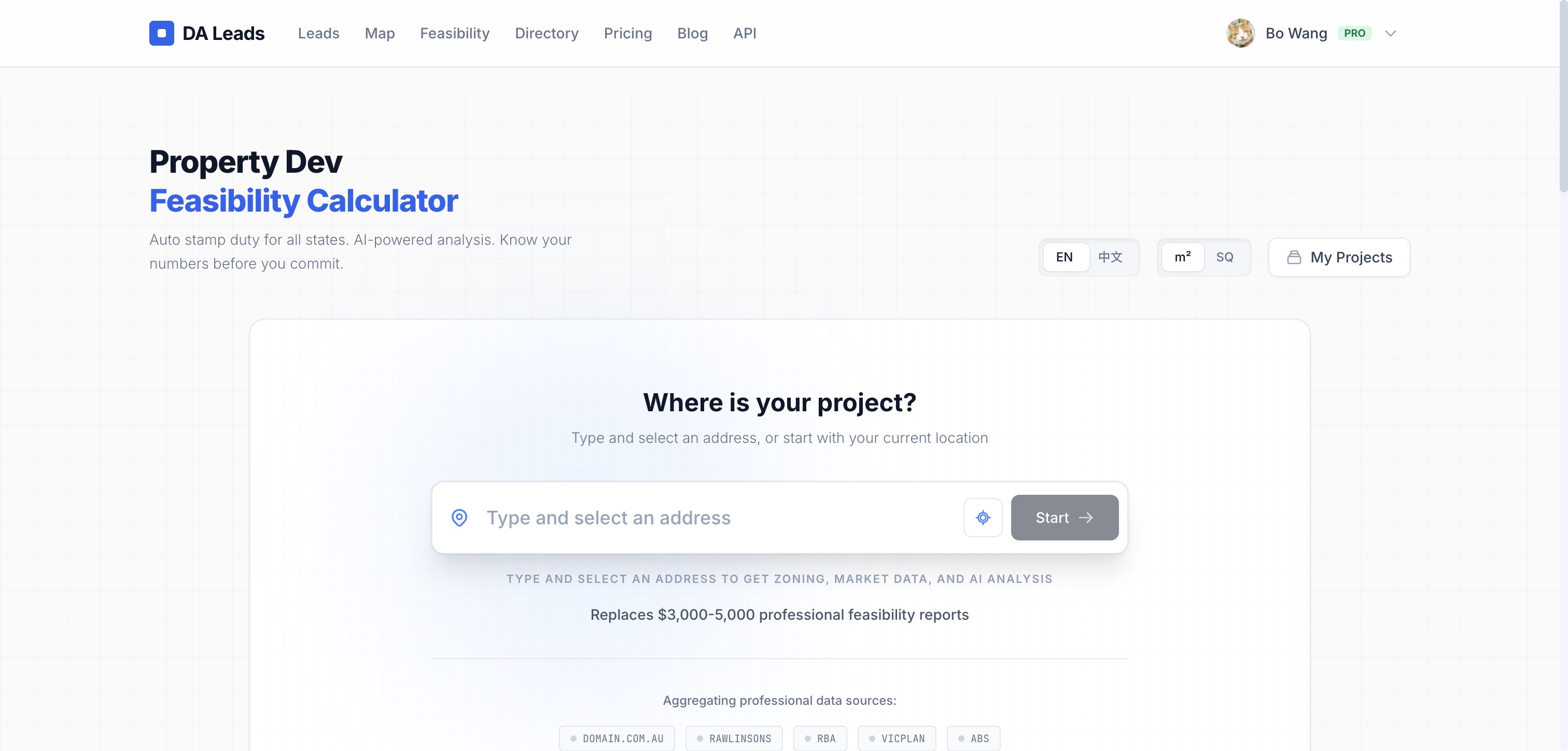
The DA Leads feasibility calculator gives you a fast first-pass screen before you pay for a full planning strategy. It is the right place to sanity-check zoning, overlay risk, and whether a site is worth deeper consultant work. Source: DA Leads product screenshot (brand asset).
| Tool | What it is good for | What it does not replace |
|---|---|---|
| DA Leads feasibility check | Fast scan of overlays, zoning, and first-pass development constraints | A full planning strategy or consultant-led redesign |
| Heritage study + statement of significance | Understanding whether demolition risk is low, moderate, or ugly | A heritage design response |
| Current Clause 52.06 + PTAL / map check | Checking whether your parking idea is even plausible | Traffic evidence for a reduction |
| Early architect / planner review | Testing yield against setbacks, amenity, and likely council posture | Formal permit approval |
If you're still getting familiar with how the DA approval process works in NSW or QLD, those guides cover the state-specific steps.
Sources and Further Reading
- Applying the Heritage Overlay, Planning Practice Note 1
- Local Heritage Protection Provisions in Planning Schemes, Planning Practice Note 95
- Understanding the Residential Development Provisions, Planning Practice Note 27
- Car parking requirement reforms FAQ, December 2025
- Planning disputes, VCAT
- DA Leads internal MySQL snapshot, Victoria status fields, queried 2026-04-11
- DA Leads internal composite case model, updated 2026-04-11


