
Renewable developers tend to meet the EPBC Act late, and the reasons are structural. Almost every other constraint on a site screen lives inside a state system: zoning, overlays, bushfire mapping, flood studies. The EPBC Act is different in both dimensions at once. It is Commonwealth law that sits on top of state planning rather than inside it, so your state consent does not answer it. And its trigger is not a line on a map. The Act bites when an action is likely to have a significant impact on a matter of national environmental significance, and "significant" is a judgment call, made against published guidelines, informed by surveys, and tested by a federal decision.
That combination, a separate approval system with a judgment-based trigger, is exactly the shape of problem that surfaces after the option agreement is signed. You cannot clear EPBC from a desktop. What you can do, early and cheaply, is find out whether you are walking into it, which changes the order you spend money in, and on a renewables shortlist that is most of the game.
The EPBC Act in plain terms
The Environment Protection and Biodiversity Conservation Act 1999 is the Commonwealth's central environmental law. It protects nine categories of matters of national environmental significance (MNES): world heritage areas, national heritage places, Ramsar wetlands, threatened species and ecological communities, migratory species, protection of the environment from nuclear actions, Commonwealth marine areas, the Great Barrier Reef Marine Park, and protection of water resources from coal seam gas and large coal mining development.
Read that list against a solar or storage project and most of it falls away. The matter that usually decides things for a renewables site is threatened species and ecological communities; Ramsar wetlands and migratory species join the conversation on sites near water. A desktop screen's job is to work out which of the nine are in play for your parcel.
Nobody licenses you up front. You assess your own action first: DCCEEW describes self-assessment as the step you take before deciding whether to refer. If a significant impact on a protected matter is likely, or genuinely arguable, you refer the action to the department. The Environment minister or their delegate then decides, within 20 business days of receiving the referral, whether your action is a controlled action that needs formal assessment and approval, is not a controlled action, or is not a controlled action provided you carry it out in the particular manner you described.
Getting this wrong is not a paperwork problem. Where an action may have a significant impact on a protected matter, starting it without referring, or after referring but before the decision arrives, is a serious breach or offence: civil penalties run to 5,000 penalty units for an individual and 50,000 for a body corporate, criminal penalties reach seven years' imprisonment, and the Federal Court can issue an injunction stopping the works.
A currency note for mid-2026: the Commonwealth's environmental reform package stood up a national environment protection agency with expanded compliance and enforcement powers from 1 July 2026. The referral and assessment process described in this article is unchanged by that commencement; the minister remains the primary decision-maker for referrals and approvals, with power to delegate. If anything, the enforcement side of getting EPBC wrong just acquired a dedicated regulator.
The desktop checklist
Five checks, each paired with the tool that answers it. Together they tell you whether EPBC is a footnote or a workstream for the site in front of you.
| Step | Tool | What it tells you |
|---|---|---|
| 1. Protected Matters Search on site + buffer | DCCEEW's free PMST | Which MNES could occur in the landscape (predictive) |
| 2. Mapped MNES layers over the parcel | National TEC, Ramsar and protected-area layers (our screen queries these) | Whether a protected matter is actually mapped on or beside the site |
| 3. Historical EPBC referrals nearby | Published referral points (in our screen) | Whether federal triggers have bitten in this landscape before |
| 4. Distance to conservation areas | Protected-areas database (in our screen) | Context for indirect impacts and buffer arguments |
| 5. Significant-impact self-assessment | Significant Impact Guidelines 1.1 | The judgment call the first four checks feed |
Step one: run a Protected Matters Search. The Protected Matters Search Tool (PMST) is a free, interactive web application on the DCCEEW site that identifies potential protected matters on or near a project site and produces a report you can export as PDF or Excel. Run it over the site plus a generous buffer, not the bare footprint. Two honesty notes from the department: the PMST covers only MNES, and its results are indicative. A report listing dozens of potential matters is normal for rural Australia and does not mean dozens of problems; it is the starting list for step five, not a verdict.
Step two: check what is actually mapped over the parcel. The PMST predicts; some matters also exist as hard spatial layers you can intersect with a boundary: threatened ecological communities, Ramsar wetlands, and the national protected-areas database. Our screening engine runs these intersections for every parcel, and when mapping hits, the screen escalates. On the public sample report's 15.8 ha site at Tailem Bend in South Australia, the threatened-community layer intersects the parcel itself ("Site intersects threatened biota / native vegetation: Mallee Birds Ecological Community"), and the EPBC row is rated Moderate, with a matter of national environmental significance likely triggered and a referral required. That mapped intersection is much of why Tailem Bend scores 62/100, "Heavily constrained", against the NSW screens' 34 and 44 below.
Step three: check the landscape's referral history. Past EPBC referrals are published as mappable points, one of the most underused signals in early screening. Both real NSW screens in the next section flagged one; the engine's finding on each reads "EPBC referral point within about 0m (evidence of nearby federal triggers)", rated Minor with self-assessment required. A nearby referral tells you that someone with money on the line judged the federal question live enough in this landscape to refer. It is not a verdict on your site in either direction: a neighbour's referral does not contaminate your parcel, and an empty landscape does not clear it. Treat referral history the way a geotech treats a neighbouring borehole log: evidence about the ground, not a substitute for your own hole.
Step four: measure the distance to protected and conservation areas. Footprint impacts are obvious; the harder arguments are indirect, and they turn on distance. Our Darlington Point solar demo records the nearest conservation area, Murrumbidgee Valley, at about 5.9 km; the Tailem Bend sample records Poonthie Ruwe at about 3.3 km. Neither distance triggers anything by itself, but both numbers belong in the self-assessment, because context and intensity are what the guidelines ask you to weigh.
Step five: self-assess against the Significant Impact Guidelines 1.1. The Commonwealth publishes Significant Impact Guidelines 1.1 (Matters of National Environmental Significance), the document a significant-impact self-assessment is judged against. This is where the judgment call lives; the first four checks exist to feed it. The PMST gives you candidate matters, the mapped layers and referral history give you the landscape, the distances give you context. Where the honest answer is "a significant impact is likely, or we cannot say it is not", the pathway is a referral to DCCEEW.
How EPBC shows up inside a full screen
EPBC is one line of 19 in our screening memo. In July 2026 we ran the production engine over two real cadastral parcels as demonstrations (not client projects, not proposals for that land): a 20.4 ha parcel at Gregadoo in the Wagga Wagga LGA screened for a BESS, and a 391 ha irrigated parcel at Darlington Point in the Murrumbidgee LGA screened for solar.
| Screen | EPBC rating | Desktop finding | Required next step |
|---|---|---|---|
| Gregadoo BESS, 20.4 ha (NSW) | Minor | Historical referral point within about 0 m of the site | PMST report, then self-assessment against the nine MNES; refer to DCCEEW if a significant impact is likely |
| Darlington Point solar, 391 ha (NSW) | Minor | Historical referral point within about 0 m; nearest conservation area 5.9 km | Same |
| Tailem Bend sample, 15.8 ha (SA) | Moderate | Mapped threatened ecological community intersects the site | EPBC referral to DCCEEW, targeted MNES surveys, avoid / mitigate / offset |
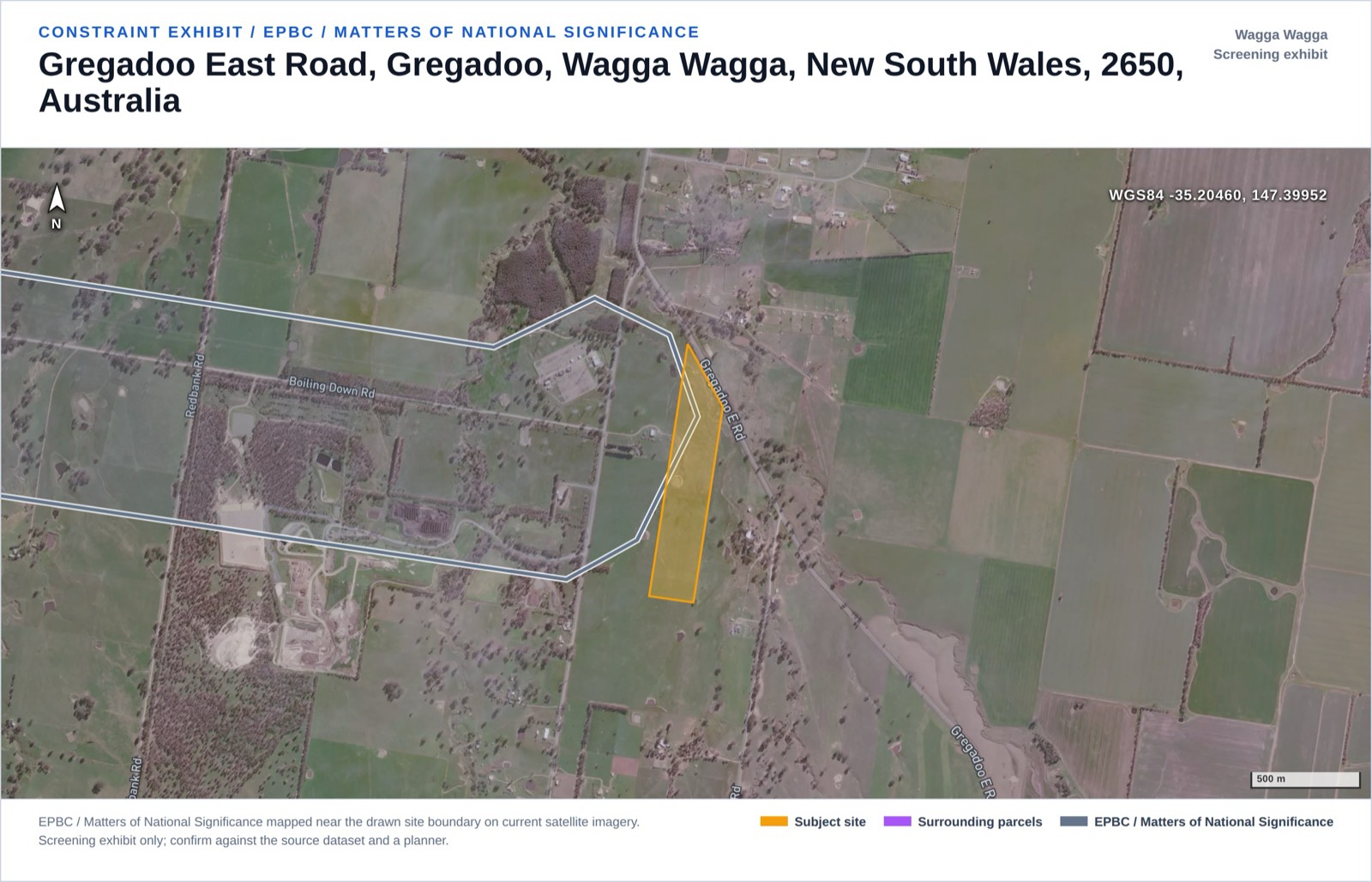 The Gregadoo EPBC exhibit: the mapped EPBC / MNES feature runs against the parcel boundary. A real parcel, screened as a demonstration, not a proposal for that land.
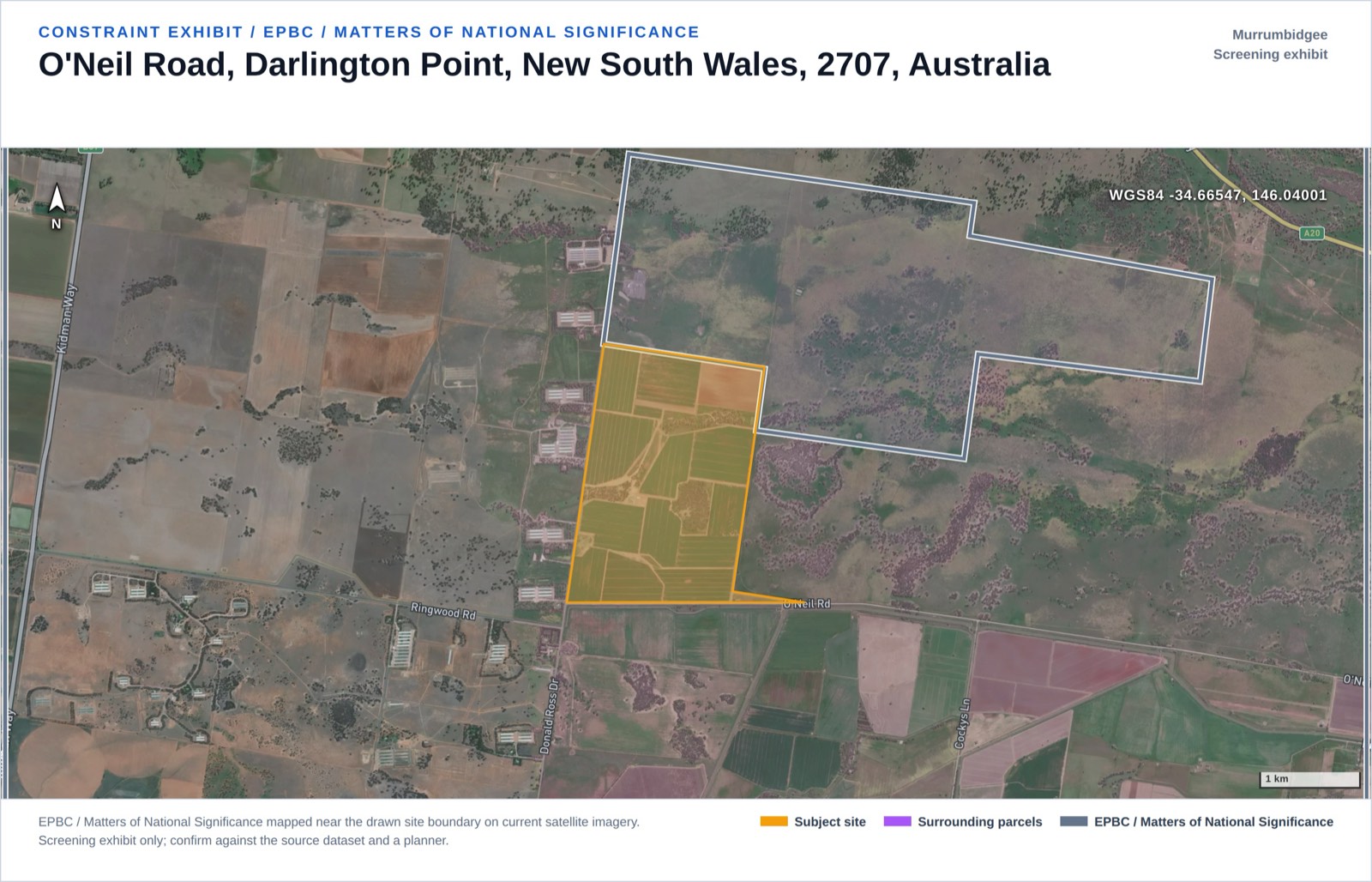 The Darlington Point solar demo's EPBC exhibit: a mapped EPBC feature adjoins the northeastern boundary. Rated Minor, self-assessment required.
The gradient across those three rows is the method in miniature. Referral history nearby but nothing mapped on the parcel reads as Minor: evidence of triggers in the landscape, self-assessment required. A protected matter mapped over the parcel itself reads as Moderate: referral likely, and the avoid-mitigate-offset conversation begins. Neither reads as "cleared", because a desktop cannot produce that word under this Act.
Both NSW reports also carry EPBC in their approvals pathway, verbatim: step "EPBC referral (if MNES significantly impacted)", authority "DCCEEW (Commonwealth)", trigger "Potential significant impact on a Matter of National Environmental Significance". It sits alongside state planning consent, native vegetation clearance and grid connection, which is where EPBC belongs in a programme: not before or after the state process, but beside it.
What a desktop screen honestly cannot close
A PMST report accompanies a referral, but it does not decide one. PMST output is indicative, and whether a listed community is actually present, in what condition, and whether your footprint can avoid it, is answered by ecologists on the ground. The risk tables in our own reports carry the calendar cost plainly: a Phase 1 flora survey is listed at about 8 to 10 weeks, and targeted flora work is seasonal, so a spring survey window missed is not a delay of weeks but a wait for the next one. If EPBC is live on your site, that seasonality belongs on the critical path from the first programme draft.
Our screen's EPBC wording is deliberately modest, and we would rather quote it than improve it: the risk is recorded as "Federal triggers have occurred nearby", and the mitigations are "EPBC self-assessment against the MNES" and "Refer if a significant impact is likely". The screen positions the federal question; it does not answer it. The same honesty runs through the memo: on both NSW demonstrations, Aboriginal heritage returned PENDING because the NSW register (AHIMS) is restricted rather than an open layer, and flooding returned PENDING because NSW council flood mapping is partial. Both reports finish at "Indeterminate - key data missing" despite zero Major flags, because an unassessed constraint is not a low-risk constraint.
FAQ
Do solar farms and batteries need EPBC approval in Australia? Only where the project is likely to have a significant impact on a matter of national environmental significance. You self-assess first and refer to DCCEEW if a significant impact is likely; if the minister decides it is a controlled action, formal assessment and approval follow. The question has to be answered per site, not assumed.
What are the matters of national environmental significance? Nine categories: world heritage areas, national heritage places, Ramsar wetlands, threatened species and ecological communities, migratory species, nuclear actions, Commonwealth marine areas, the Great Barrier Reef Marine Park, and water resources in relation to coal seam gas and large coal mining. For a renewables site, threatened species and ecological communities usually decides the outcome.
How long does an EPBC referral decision take? The minister decides whether a referred action is a controlled action within 20 business days of receiving the referral. If it is, the assessment and approval that follow take longer and depend on the assessment method the department sets.
What is the Protected Matters Search Tool? A free, interactive web application on the DCCEEW site that identifies potential protected matters on or near a project site and exports a PDF or Excel report. It covers only MNES and its results are indicative, so treat it as the start of a self-assessment, not a clearance.
A past EPBC referral is mapped near my site. Is that a problem? It is evidence, not a verdict. A nearby referral means federal triggers have been judged live in that landscape before, which tells you to take the self-assessment seriously; it does not transfer any finding onto your parcel. Both of our NSW demonstration screens carried one and still rated EPBC as Minor.
Can a desktop screen clear EPBC for my site? No, and you should be suspicious of any product that says otherwise. A desktop screen can find mapped protected matters, referral history and conservation-area distances, and tell you whether the federal question is live; ours marks the constraint as needing self-assessment rather than pretending clearance. Field surveys and the formal self-assessment close it.


