
Ask who approves a data centre in Australia and you get three answers depending on size and state. In NSW one number decides everything: above 15 megawatts of total power consumption, a data centre is State Significant Development, determined by the Minister for Planning or a departmental delegate; the council never holds the decision. Victoria has no megawatt trigger; hyperscale projects ride an expedited ministerial pathway based on development cost. Below both lines sits everything else: the fitouts, amendments and sub-threshold builds that still go through an ordinary council DA.
Which lane your project lands in decides who you negotiate with, what documents you produce, whether third parties can drag the decision to a tribunal, and in what order your diligence money gets spent. This is the data centre version of the "who actually approves it" question, backed by what our DA database says councils are actually seeing.
NSW: the 15 MW line
The NSW rule is unusually crisp. In June 2021 the State and Regional Development SEPP was amended, in the government's own words temporarily, to allow more warehouses and data centres to be assessed as State Significant Development. The trigger was set at 10 megawatts of total power consumption and moved to 15 megawatts on 1 June 2023.
It is a power consumption test, not a floor area or dollar test, and 15 MW is small by modern standards: a single hyperscale building passes it several times over, so effectively every serious campus in NSW is now an SSD project. And while "temporarily" is still attached to the amendment, the pathway keeps producing determinations.
Victoria: the ministerial fast lane
Victoria never bothered with a megawatt test. Its lever is the Development Facilitation Program (DFP), the Minister for Planning's fast-track for priority projects. Under Clause 53.22 of the Victoria Planning Provisions (significant economic development), eligible permit applications go to the Minister instead of the council, and data centres have their own category, "Digital technologies": at least $20 million in estimated development cost in metropolitan Melbourne, or $10 million in regional Victoria.
The fine print is where the pathway gets interesting. DFP applications are not exempt from the public notice and referral requirements of the Planning and Environment Act 1987 (unless exempted elsewhere in the planning scheme), so neighbours can still object and referral authorities still comment. But decisions made by the Minister for Planning under these provisions cannot be appealed to the Victorian Civil and Administrative Tribunal. The objection survives; the appeal does not. One more gate: requests need written advice from the Chief Executive Officer of Invest Victoria confirming investment certainty, so the commercial story is examined alongside the planning one.
What the fast lanes look like in practice
Both lanes have produced real decisions recently, and the documents are public.
NSW, the SSD route. NEXTDC's S4 campus at Horsley Park in western Sydney (SSD-63741210) was approved on 24 December 2025: six data centre buildings with a maximum height of 38 metres and an operational capacity of 250 MW. The project ran the full SSD sequence, SEARs to environmental impact statement to public exhibition to response to submissions, with the determination made under delegation by a departmental executive director. Behind it on the same portal, NEXTDC's S5 Data Centre and Innovation Hub at Macquarie Park (SSD-63168959) was still in assessment at the time of writing.
Victoria, the DFP route. The West Footscray data centre at 63 Sunshine Road (PA2403320) was decided by ministerial permit on 4 April 2025, with the Minister for Planning as responsible authority under the Maribyrnong Planning Scheme. The permit carries a definitional quirk worth knowing: it allows use of the land for "utility installation (data centre)", because Victorian planning schemes treat a data centre as a species of utility installation.
The council tail: what our DA data actually shows
If the big projects go to the state, what do councils see? We queried our national DA database, 848,592 council-lodged applications, for data centres. The answer: 46 records. NSW has 31, South Australia 6, Victoria 5 and the ACT 4.
DA Leads database snapshot, queried 2026-07-12.
The curve is the interesting part: one application in 2021, four in 2022, two in 2023, then twelve in 2024, sixteen in 2025, ten in the first half of 2026. Even the council tail feels the boom.
Geography tells the same story as the state registers, one tier down. Blacktown City Council leads with 10 applications and The Hills Shire Council follows with 6; with Camden's 3 behind them, western Sydney anchors the council-lodged record too, the same corridor as the Horsley Park SSD campus.
Be honest about what these 46 records are, though. They are not the hyperscale wave; that wave is in the state registers, which our council-sourced database does not capture. The council tail is what happens around and beneath the big builds:
- Fitouts inside existing facilities. An application lodged with Adelaide's council in June 2026 is simply an "internal POD fitout in existing data centre on Level 2". Capacity growing inside a building approved years ago, one council application at a time.
- Alterations to operating campuses. The Hills Shire's recent records are dominated by "alterations or additions" applications at Norwest, filed under high technology industry and data centre land uses, several concurrent in 2026.
- Sub-threshold new builds. Blacktown took a new-structure data centre application at Minchinbury in April 2026, and Blue Mountains City Council one at Katoomba in May 2026: projects small enough to stay under the 15 MW line and in front of a council rather than the department.
So a council register search will never show you where the next 250 MW campus is going. What it shows is where operators are densifying existing sites and which precincts have industrial land turning into data centre floor space. Different questions, worth asking with the right dataset.
The pathway decision table
| NSW SSD | VIC Development Facilitation Program | Council DA | |
|---|---|---|---|
| Trigger | Data centre above 15 MW total power consumption | Data centre with estimated development cost of at least $20M in metro Melbourne ($10M regional), accepted into the DFP | Everything below or outside those lines: sub-threshold builds, fitouts, alterations, ancillary works |
| Decision-maker | Minister for Planning or departmental delegate | Minister for Planning as responsible authority, in place of the council | The local council (or a local planning panel) |
| Instrument | SSD development consent, preceded by SEARs, an EIS and public exhibition | Planning permit issued by the Minister under Clause 53.22 of the planning scheme | Development consent or planning permit issued by the council |
| Third-party challenge | Public exhibition and submissions during assessment | Notice and objections still apply, but the Minister's decision cannot be appealed to VCAT | Merit objections, and in most jurisdictions some form of review or appeal right |
Why the pathway changes your diligence sequencing
The constraint set on the ground does not care which lane you are in. The order in which you have to deal with it does.
On the SSD route, the scope of your assessment is fixed early and by someone else: SEARs issued for the project define what the EIS must cover, and state agencies weigh in through the process. That rewards knowing the site's constraint profile before you request SEARs: every constraint discovered late is a study bolted onto a program that is already public. The S4 sequence at Horsley Park is the template.
On the DFP route, the appeal tail risk is removed but nothing about the merits is waived: applications are assessed on planning merit against the Act, the planning scheme and site context including amenity and environmental impacts, with a design review process on top, and public notice still runs unless the scheme exempts it. In practice the application has to arrive complete: there is no VCAT hearing at which to repair a thin ecology chapter later.
On the council route, the assessment is a local merit exercise, and that is where receptor and amenity contests happen closest to the ground. Cooling plant runs 24 hours a day and standby generators are tested through the year, so the neighbours' questions are concrete ones about noise, traffic and visual bulk. Sub-threshold does not mean low scrutiny; it arrives from fifty metres away instead of from a state agency.
Whichever lane: the site decides before the lodgement does
The constant across all three pathways: the planning constraints of the parcel determine feasibility before any application is lodged. A zoning problem, a grassland reserve on the fence line, an easement through the buildable envelope or a dwelling too close for 24/7 plant noise will surface in a SEARs process, a DFP assessment and a council DA alike. The only choice is finding it before or after committing money to the lodgement.
That is what a desktop screen is for. Our engine runs 19 planning and environmental constraints against a drawn site boundary; the live sample report is a real 24.7 ha industrial-zoned parcel in Laverton North which screened at 44/100, "workable with conditions", with four moderates: a 66 kV line crossing the parcel with its easement, the Derrimut Grassland Nature Conservation Reserve 39 metres away, a likely EPBC referral, and the nearest dwelling about 221 metres from cooling plant that never switches off. Each becomes a chapter in whichever pathway the project ends up in. (How we picked that site, and the three real parcels that failed first, is its own story.)
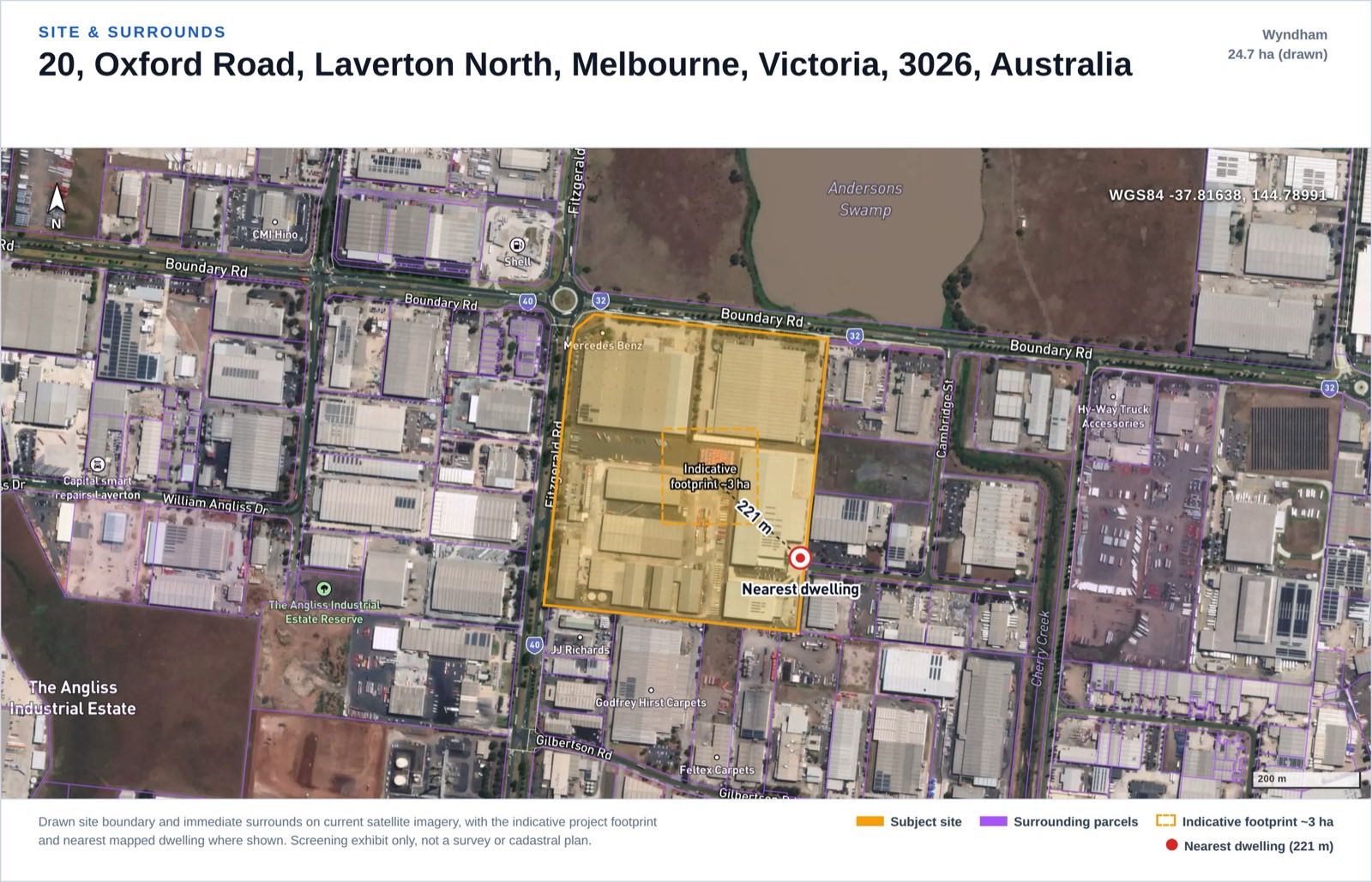
Exhibit from the screening report our engine generated on a real Laverton North parcel as a demonstration. Not a client project, and not a proposal for that land.
Plainly, on the limits: the screen is a desktop exercise, A$1,000 per site on the pilot, one business day, and it is not planning advice; it scopes specialist work rather than replacing it. Where data is missing it says so instead of scoring the gap as safe: NSW Aboriginal heritage (AHIMS) is access-restricted and NSW council flood mapping is partial, so those constraints come back pending there, never as a quiet green tick. And it holds no grid hosting capacity or fibre data; power and connectivity live with the network operator and the carriers.
The free first move is the zone and overlay check on our map, for any address in Australia. The full 19-constraint screen is described at /solutions/data-centre-site-screening/.
FAQ
Who approves data centres in NSW? Above 15 MW of total power consumption, a data centre is State Significant Development: the state assesses it and the Minister for Planning or a departmental delegate determines it, not the council. Below that line it is an ordinary development application to the local council.
Where did the 15 MW threshold come from? A June 2021 amendment to the State and Regional Development SEPP, described at the time as temporary, made data centres above 10 MW total power consumption SSD; the trigger moved to 15 MW on 1 June 2023. The amendment remains in operation and projects are still approved under it.
Who approves data centres in Victoria? There is no megawatt trigger. Large projects typically use the Development Facilitation Program, where a data centre with an estimated development cost of at least $20 million in metropolitan Melbourne ($10 million regional) can apply directly to the Minister for Planning under Clause 53.22 as significant economic development. Anything outside that lane is a planning permit application to the local council.
Can neighbours appeal a ministerial data centre permit at VCAT? No. Notice and objection rights still apply unless the planning scheme exempts them, but decisions of the Minister for Planning under the DFP provisions cannot be appealed to VCAT. The West Footscray permit (PA2403320, issued 4 April 2025) is a recent example.
Why do so few data centres appear in council DA registers? Because the big ones are not there. Our database of 848,592 council-lodged DAs contains just 46 data centre applications, mostly fitouts, alterations and sub-threshold builds. Hyperscale projects sit in the NSW major projects register and Victoria's ministerial permits register, which council data does not capture.
Does the approval pathway change what site diligence you need? It changes sequencing more than substance. The same constraints, zoning, ecology, EPBC, easements, noise receptors, feed an SSD environmental impact statement, a DFP application or a council DA. On the state pathways the cost of late discovery is higher: the assessment scope is fixed early and, in Victoria, there is no appeal stage at which to repair the application.


