Solutions // Childcare Centre Sites

Should a childcare centre go here?

A site decision memo for childcare centre candidates anywhere in Australia, leading with what actually decides the investment: every existing service around the site with its NQS rating and approved places (ACECQA register), who rates above and below the standard, the applications coming behind them, the children and families in the catchment and how fast they are growing (ABS Census plus our cohort forecasts), the school run and how parents would actually drop off, then the 19-constraint planning screen read for a sensitive use. The filter you run before an option deed, not a substitute for consultants.

Sample verdict Hume · VIC
Heavily constrained
No fatal flaws identified
0major
5moderate
19/19assessed
100%data
Read the full sample report →
Re
Childcare Site Decision Memo
Project
Craigieburn childcare site (demo) · Childcare Centre
Site
11, Hamilton Street, Craigieburn, Melbourne, Victoria, 3064, Australia · 1,000 m²
Council / State
Hume · VIC

The First Question

Who is already here, and who is coming.

Before any planning question: the competition and the catchment. Every report leads with the ACECQA register (every approved service near the site, rated, with places) and the ABS Census profile of the suburb. On the sample site the screen found a heavily supplied catchment, and said so.

21
approved services within 2.0 km of the sample site
holding 1,339 approved places, the nearest 287 m away. NQS mix: 3 Exceeding NQS, 16 Meeting NQS, 1 Working Towards NQS, 1 Not yet rated. ≈ 12.5 children (0–14) per approved place

Catchment: Craigieburn (VIC)

  • 65,178 residents, median age 32, growing 6.1% a year (≈ 689 people/yr, high growth)
  • About 16,751 children aged 0–14 (25.7% of the suburb)
  • Median family income $1,855/week, average household 3.3
  • 18,944 dwellings, 89.2% separate houses, 29.2% renting

Distances are straight-line and the demographics are the suburb's Census profile, not a modelled trade area. The ratio compares sites; it is not a utilisation claim.

NQS ratings within 2 km

Exceeding
3
Meeting
16
Working Towards
1
Not yet rated
1

Overall NQS rating of each approved service, ACECQA register.

Competition by distance

0-500m
2
500m-1km
5
1-1.5km
6
1.5-2km
8

Approved services per straight-line distance band from the candidate site.

Who lives in Craigieburn

25.7%
0-14
13.1%
15-24
35.3%
25-44
19.1%
45-64
6.8%
65+

Age structure, ABS Census. The 0–14 share is the childcare and school pipeline.

Existing serviceSuburbDistanceOverall NQS ratingApproved places
Hilton Street PreschoolCraigieburn287 mExceeding NQS33
Early Foundation Childcare CraigieburnCraigieburn416 mNot yet rated80
Where We Grow ELC CraigieburnCraigieburn521 mMeeting NQS92
Craigieburn Early Childhood Services CentreCraigieburn658 mMeeting NQS75
Craigieburn Leisure Centre CrecheCraigieburn659 mMeeting NQS47
Busy Bees at CraigieburnCraigieburn695 mMeeting NQS102
Camp Australia - Our Lady's Primary School - Craigieburn OSHCCraigieburn987 mMeeting NQS40
325 Early Education CraigieburnCraigieburn1161 mMeeting NQS38

The school run

5 primary / combined schools within 2.5 km holding 2,674 enrolments — families already drive past this site daily.

  • Our Lady's School · 971 m · 703 enrolled
  • Craigieburn Secondary College · 1,468 m · 1,008 enrolled
  • Craigieburn South Primary School · 1,476 m · 545 enrolled
  • Craigieburn Primary School · 1,742 m · 458 enrolled

ACARA school profiles; ICSEA percentile mean 36 = fee-point context.

How parents drop off

  • Craigieburn station · 652 m
  • 29 bus stops within 1.2 km
  • 45 mapped public parking areas within 1.5 km
  • Craigieburn Community Hospital · 2,033 m; 6 clinics within 3 km
  • 22 parks, 6 playgrounds within 1.2 km

OpenStreetMap at build time; Census says 87.9% of locals drive to work, so drop-off is car-first — the report reads parking and queuing as a contested DA issue, not a footnote.

Incoming supply & the local bar

  • No childcare application within 3 km in our tracked records (84 state-wide in 12 months)
  • 3 services rated Exceeding NQS in the radius: Hilton Street Preschool, Bank Street Preschool, Willmott Park P.S. Out of School Hours Care
  • 1 rated Working Towards: where the local bar is beatable

Application counts are our tracked records; coverage varies by council, so zero means none tracked, not none lodged. Ratings are ACECQA's, quoted as-is.

The Planning Screen

Then the planning screen, on the same real sample.

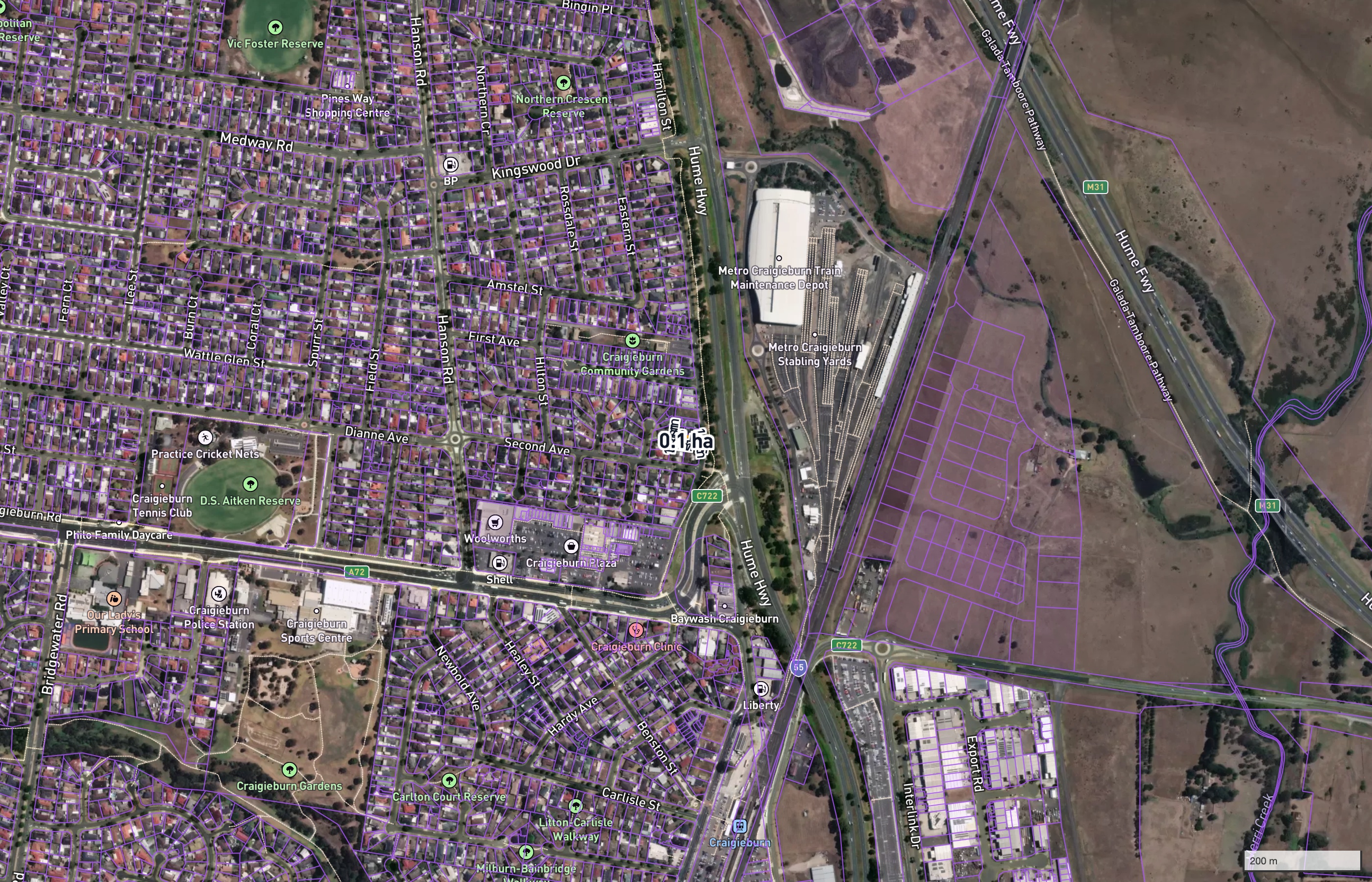
This is the actual constraint table of the sample report: a residential lot on Hamilton Street, Craigieburn, in Melbourne's northern growth corridor, on the same street as a live childcare centre application currently before Hume City Council. The zone came back General Residential and was read the childcare way: assessable with consent, not a conflict. The screen held noise and traffic open as the two matters councils actually contest, and picked up the volcanic-plain ecology questions that are real in Craigieburn. It did not flatter the site: five moderates, disclosed as such.

Zoning minor assessed · hit
Cadastral / Title & Easements minor data limited
Planning Overlays minor assessed · hit
Aboriginal Heritage minor assessed · hit
Historic / Federal Heritage insignificant assessed · clean
Bushfire insignificant assessed · clean
Flora & Fauna / Ecology moderate assessed · hit
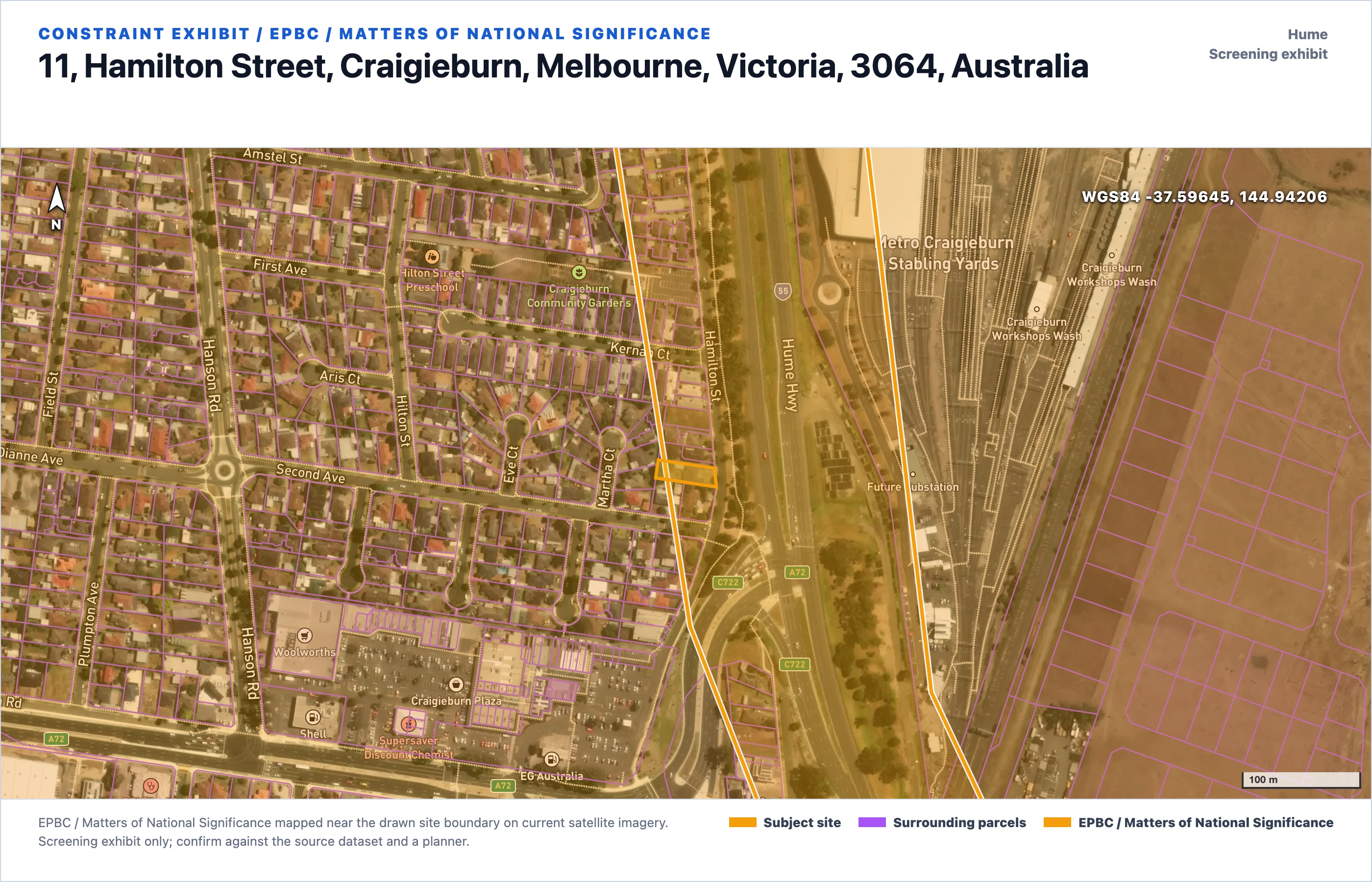
EPBC / Matters of National Significance moderate assessed · hit
Hydrology / Flooding insignificant assessed · clean
Noise (residential amenity) moderate data limited
Visual Amenity minor assessed · hit
Contours / Topography insignificant assessed · clean
Geotechnical minor data limited
Soils minor data limited
Utilities (power / gas / water / NBN) moderate assessed · hit
Traffic & Access moderate data limited
Contaminated Land insignificant assessed · clean
Air Quality minor assessed · hit
Hazard & Risk (fire / explosion) insignificant assessed · clean
major — potential fatal flaw moderate — needs mitigation minor — readily mitigated insignificant pending — data unavailable, disclosed as such
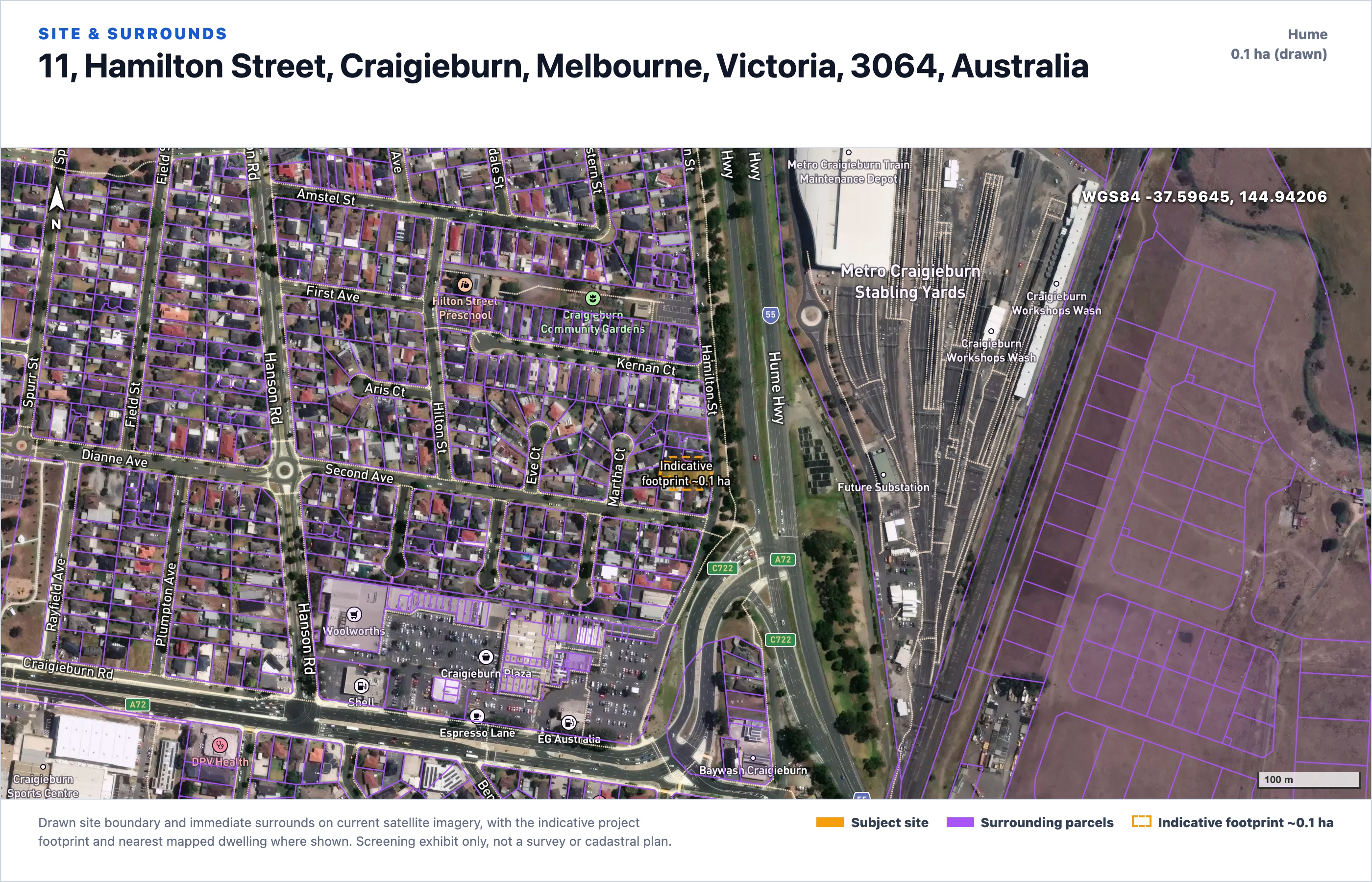
Site and surrounds satellite exhibit with indicative building footprint
Site & surrounds exhibit
Constraint context map exhibit
Constraint context exhibit
EPBC matters of national environmental significance context exhibit
EPBC context exhibit
Full sample report Sample PDF

How It Works

Send a site. Get a memo back.

No software to adopt, no seats, no onboarding. It slots in front of your existing consultant workflow as an early filter.

01

Send one candidate site

An address, coordinates or a boundary file. That is all we need to start.

addresscoordinatesKML / GeoJSON
02

We run the desktop screen

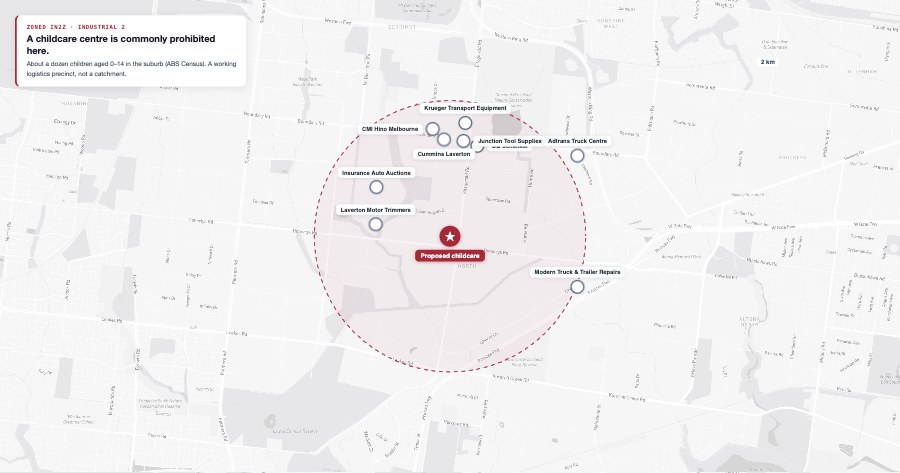
19 constraints against state and federal spatial data: zoning, overlays, easements, bushfire, flooding, EPBC, heritage, contamination and more. Ratings are weighted for a childcare use: residential and commercial zones read as the natural pathway, industrial zones as the conflict, noise and traffic held open as the contested matters, and hazard separation read for vulnerable occupants.

statutory referenceschildcare weighting
03

Memo + PDF within one business day

A decision memo in the order a buyer reads: the catchment decision (every nearby service with NQS ratings, who rates above and below the standard and on which quality areas, incoming applications from our own records, suburb demand and growth), location and access (the school run with ICSEA and enrolments, station, buses, parking, health and open space), then the planning pathway with the contested issues in full, approvals plus the NQF licence, a strengths and watch-outs verdict, and a phased action plan.

verdictsite risk scorenext steps

Honest by Design

What this screen is, and what it is not.

19
constraints, two fields each
every constraint carries a rating AND a separate data status, so a gap in public data is disclosed as pending, never dressed up as clean

Three things we do not have, said plainly

Acoustic and traffic studies. Play-area noise at the neighbouring boundary and drop-off queuing are the two matters childcare DAs are actually fought over, and both need measurement and modelling on the real design. The screen tells you they will be contested and what the interface distances are; it does not produce the acoustic report or the TIA.

Demand modelling and operator economics. The report gives you the register facts (who operates nearby, rated how, with how many places) and the Census facts (who lives in the catchment). It does not turn them into a demand model: no utilisation, waitlist, fee or projected-need estimate, and the NQF service approval to operate remains a separate process from planning consent.

The hiring market. The memo gives the workforce backdrop from the Census (residents' qualifications and industry mix), but educator award wages, vacancy competition and which nearby institutions run early-childhood courses are not in our data. The action plan sequences a workforce check with the licence phase; we do not pretend to have done it.

What the screen does close out early, from public data:

  • The zoning verdict: whether the zone family typically allows a centre with consent, or is a genuine conflict
  • Hazard separation, read inward: service stations, dangerous-goods sites, pipelines and contamination history near a vulnerable-occupant use
  • Bushfire and flood exposure: elevated protection and evacuation requirements apply to childcare in bushfire-prone areas, and the screen says when that conversation starts
  • Ecology, heritage and EPBC: the triggers that add seasons to a program (the sample site carries real volcanic-plain grassland questions)
  • Existing services, their NQS standing and where the local bar dips: every approved service within 2 km with overall rating and places, plus who rates Exceeding and who rates Working Towards (and on which quality areas), from the ACECQA register
  • Incoming supply: childcare applications near the site and across the LGA from our own tracked records — the pipeline the register cannot show
  • The school run and access: nearby schools with ICSEA and enrolments (ACARA), plus station, bus, parking, health and open-space facts (OpenStreetMap) and how locals actually travel (Census journey to work)
  • Catchment demographics: population, children 0–14, growth trend, family income, house prices, household size and dwelling mix from the ABS Census profile of the suburb
  • DA precedent volume: 6,518 childcare-related applications tracked across our national database, so the memo can say how active the LGA actually is

Coverage varies by state and the report says so per constraint: Victorian screens run with full layer coverage; in NSW the Aboriginal heritage register is access restricted and council flood mapping is partial, so those constraints are reported pending there, not assumed clear. This is a preliminary desktop screen to support early site selection; it is not planning advice, and it does not replace the specialist assessments a development application requires.
Field Guides

The homework, published.

The research behind this screen is free to read. Every guide below is built on our national development application database.

Pricing

Priced like a filter, not a study.

A consultant desktop constraints study typically runs to five figures and takes weeks. This screen exists so you only commission those for sites that survive the first cut.

10-site credit pack

A$7,500 + GST
  • Screen a shortlist or an acquisition pipeline
  • Ranked side-by-side comparison across sites
  • Credits valid 12 months
  • Priority turnaround

Constraints that cannot be assessed from public data are disclosed as pending, never padded. If the screen returns materially less than the sample report shows for your state, we will say so before you pay.

Have a shortlist?

Send one real candidate site.

Address or coordinates. We reply with scope confirmation and an invoice, then the report within one business day.

Email a site Read the sample first