Applecross
Three SEIFA indices sit at decile 10 (IRSAD 1,124, IRSD 1,096 and IEO 1,132), placing Applecross in the top tier nationally on advantage and education, yet the rental vacancy rate of 12.9% signals a market with real slack underneath that affluence. The contradiction is explained by tenure: 45.2% of homes are owned outright and only 28.4% rent, so the small rental pool can swing hard when demand softens. University qualifications reach 58.9%, 28.8 points above the national figure, and household income sits in the 91.7th percentile. The median age of 44 runs 4 years above national, and an aging trajectory (senior share up 5.4 points) sets this riverside Perth suburb apart from younger inner-city markets.
Population
7,228
Median Age
44.0
Household IncomeiMedian weekly household income (ABS Census)
$2,453/wk
DAs (12 months)iDevelopment Applications lodged in the past year
0
Median House
$649K
Estimated from rent (2025)
The estimated median house price of $649,000 buys into a genuinely house-dominated market, with 61.9% separate houses and only 16.6% apartments, the reverse of most inner-Perth suburbs. Family-sized stock dominates because 44.1% of dwellings have 4 or more bedrooms and 36.1% have 3, so buyers chasing larger floor plans have real choice here. Monthly mortgage repayments of $2,800 translate to a mortgage-to-income ratio of 26.4%, below the 30% stress threshold, which holds because household income sits in the 91.7th percentile and absorbs the cost. With 45.2% of owners holding outright, turnover is low at 25.7%, so listings are scarcer than the price alone suggests.
For Buyers
The estimated median house price of $649,000 buys into a genuinely house-dominated market, with 61.9% separate houses and only 16.6% apartments, the reverse of most inner-Perth suburbs. Family-sized stock dominates because 44.1% of dwellings have 4 or more bedrooms and 36.1% have 3, so buyers chasing larger floor plans have real choice here. Monthly mortgage repayments of $2,800 translate to a mortgage-to-income ratio of 26.4%, below the 30% stress threshold, which holds because household income sits in the 91.7th percentile and absorbs the cost. With 45.2% of owners holding outright, turnover is low at 25.7%, so listings are scarcer than the price alone suggests.
For Investors
A weekly rent of $475 against the $649,000 median produces a gross yield near 3.8%, stronger than many premium markets, but the 12.9% vacancy rate is the headline risk and points to oversupply in the small rental segment. Only 28.4% of homes are rented, so the tenant pool is shallow, and a high-vacancy reading in a thin market means landlords compete hard for fewer tenants. Migration is balanced rather than a growth engine, with net internal inflow averaging 44 a year and overseas just 15, so demand is steady rather than surging. With no development applications recorded in the past 12 months, new supply is not the threat; the existing vacancy is the constraint to underwrite against.
Schools in Applecross iICSEA: school advantage index. 1000 = national avg, higher = more advantaged
Applecross Primary School
K-6 · 571 students
St Benedict's School
PP-6 · 336 students
Demographics
Overseas-born residents make up 40.5%, which is 18.9 points above the national figure, with English ancestry leading at 2,607 followed by Chinese at 1,017, Irish at 665 and Scottish at 642, a blend of Anglo-Celtic settlement and a substantial East Asian community. Mandarin (158) and Cantonese (69) are the top non-English languages, ahead of Persian (42) and Italian (35). University attainment of 58.9% runs 28.8 points above national, consistent with a Professionals-heavy workforce. The average household size of 2.5 matches the national average exactly, but couples with children (2,320) outnumber couples without (1,765), so this skews more family-oriented than the median age of 44 might suggest.
Age Distribution
Bedrooms
Dwelling Structure
61.9%
Houses
21.5%
Townhouse
16.6%
Apartment
Tenure
Tenure here is owner-dominated: 45.2% own outright, 26.5% carry a mortgage and just 28.4% rent, well below renter-heavy inner suburbs. The stock is 61.9% separate houses, 21.5% semi-detached and 16.6% apartments, and large homes prevail with 44.1% at 4-plus bedrooms versus only 3.2% in studios or one-bedrooms. The estimated $649,000 median sits against household income in the 91.7th percentile, so the price-to-income relationship is comfortable, with mortgage-to-income at 26.4% and rent-to-income at 19.4% both under stress thresholds. The IER decile 9 confirms strong economic resources, which tracks the high outright-ownership rate because accumulated property wealth lifts the index.
Mortgage / mo
$2,800
Rent / wk
$475
HH Size
2.5
Personal Income / wk
$1,167
Vacancy Ratei% of dwellings unoccupied on Census night (ABS 2021)
12.9%
Unoccupied
413
Rent / IncomeiMedian rent as % of household income. Over 30% = housing stress
19.4%
Mortgage / IncomeiMedian mortgage as % of household income. Over 30% = housing stress
26.4%
Community Profile
Languages Spoken at Home
Ancestry
Household Composition
30.2%
Couples, no children
5,838
Total families
Economy & Employment
Healthcare leads employment at 19.7% (540 workers), ahead of Professional/Tech at 15.6% (427), Education at 9.0% (247), Mining at 8.8% (241) and Construction at 7.0% (191), so the local economy leans on care and knowledge work with a distinctly West Australian mining thread. Professionals dominate occupations at 1,339, with Managers second at 736, which aligns with the IEO decile 10 education ranking. Unemployment is low at 4.0%, below the national average, though the participation rate of 59.4% sits lower than younger suburbs because the senior share has grown 5.4 points and 2,085 residents are not in the labour force. Full-time employment at 61.6% underpins the high household incomes.
Unemployment
1.6%
Labour Force
7,371
Unemployed
116
Quarterly Trend
Source: SALM Dec-25
Socio-Economic Indexes (SEIFA)iABS index ranking suburbs from 1 (most disadvantaged) to 10 (most advantaged)
Full-time
61.6%
Part-time
34.4%
Participation
59.4%
Employed
3,445
Occupations
Top Industries
University
58.9%
Postgraduate
16.2%
Born Overseas
40.5%
Dwellings
2,787
Transport to Work
Daily life leans heavily on the car: 80.9% drive to work, well above suburbs near rail, while public transport carries 9.7% and walking or cycling just 3.7%, reflecting a low-density riverside layout at 2,262 people per km2. The IRSAD decile 10 score of 1,124 confirms top-tier advantage nationally, and the volunteering rate of 22.1% points to an engaged, settled community. Housing pressure is mild, with rent-to-income at 19.4% comfortably below the 30% stress line. The need-for-assistance rate is low at 3.8% (262 residents), consistent with a healthy, affluent population, though the median age of 44 above national means aged-care and accessibility services matter more here than in younger markets.
Drive
80.9%
Public Transport
9.7%
Walk / Cycle
3.7%
Work from Home
N/A
Population Forecast
+1.37%/yr
(+43 people/yr)
EstablishedPopulation growth runs at 1.37% a year (about 43 persons), classifying as moderate and slower than high-growth fringe markets, with a 17.4% rise over the past decade. Migration is balanced, averaging 44 net internal arrivals and 15 overseas a year, so growth is organic rather than migration-led. The trajectory is aging: the senior share rose 5.4 points while the young share fell 3.9 points, consistent with an established suburb where families stay long-term rather than turn over. Affordability worsened from 21.2% of income in 2011 to 29.5% in 2021 as rents climbed 83.0%. The gentrification score of 63 marks an active stage, with real income up only 6.9% over the decade.
Historical + Forecast
Hamilton-Perry + Holt smoothing on ERP 2001-2025
Age Cohort Forecast
Primary Driver
Balanced
Net Overseas / yr
+15
Net Internal / yr
+44
Gentrification Signal
Early signs
Population +22% since 2011, Accelerating: -0% → 22%
National Ranking iPercentile rank among ~15,000 AU suburbs. 90% = higher than 90% of suburbs
How Applecross compares to ~15,000 Australian suburbs
Frequently Asked Questions
Is Applecross a good suburb to live in?
Applecross ranks in the top national tier, with all three SEIFA deciles at 10 (IRSAD 1,124) and household income in the 91.7th percentile. University attainment of 58.9% is 28.8 points above national. The main trade-offs are heavy car reliance at 80.9% of commuters and a median age of 44, 4 years above national, so it suits established households more than young renters.
What is the median house price in Applecross?
The estimated median house price is $649,000, derived from rental evidence for 2025. Monthly mortgage repayments average $2,800 and weekly rent is around $475, giving a gross yield near 3.8%. With household income in the 91.7th percentile, the mortgage-to-income ratio is a manageable 26.4%, below the 30% stress threshold.
What schools are in Applecross?
No schools are recorded inside the Applecross boundary in this dataset, so families typically rely on schools in neighbouring suburbs. Education is a strong sector for the workforce, employing 9.0% of residents (247 workers), and university attainment reaches 58.9%, which is 28.8 points above the national figure, reflecting a highly educated population.
Is Applecross safe?
Detailed crime figures are not available for Applecross in this dataset. As a proxy for community stability, the suburb sits at SEIFA IRSAD decile 10 (score 1,124) and IRSD decile 10, the highest national tier for advantage and low disadvantage, with a low need-for-assistance rate of 3.8%, factors that typically correlate with lower reported crime.
Is Applecross good for property investment?
A $475 weekly rent on a $649,000 median gives a gross yield near 3.8%, but the 12.9% vacancy rate is a clear warning of oversupply in a thin rental pool, since only 28.4% of homes are rented. Balanced migration (44 net internal, 15 overseas per year) means demand is steady rather than rising, so capital growth is the likely driver, not yield.
How is Applecross's population changing?
Population grows at 1.37% a year (about 43 persons), a moderate pace, with a 17.4% increase over the past decade. The suburb is aging: the senior share rose 5.4 points while the young share fell 3.9 points. Migration is balanced, averaging 44 net internal and 15 overseas arrivals annually, so growth is organic rather than migration-driven.
How multicultural is Applecross?
Overseas-born residents make up 40.5%, which is 18.9 points above the national average. Chinese ancestry numbers 1,017 alongside English at 2,607, and the top non-English languages are Mandarin (158), Cantonese (69) and Persian (42), reflecting a substantial East Asian community within a largely Anglo-Celtic base.
How to read these comparisons
Phrases like "above the national average" reference the unweighted median across Australian suburbs with more than 1,000 residents, not population-weighted national figures. Suburb-level medians are more useful for ranking suburbs against each other; ABS census headlines are population-weighted (so dominated by Sydney and Melbourne) and can read very differently.
Current baseline (refreshed 2026-05-10): median age 40, university-educated 30.1%, born overseas 21.6%, average household size 2.5 people.
Data sources: ABS 2021 Census (demographics, income, tenure), state Valuer-General (house prices), Department of Jobs SALM (unemployment), ACARA (school ICSEA), state Crime Statistics agencies (offences), council DA portals (development applications). Population forecasts use a Hamilton-Perry cohort model calibrated to ABS ERP.
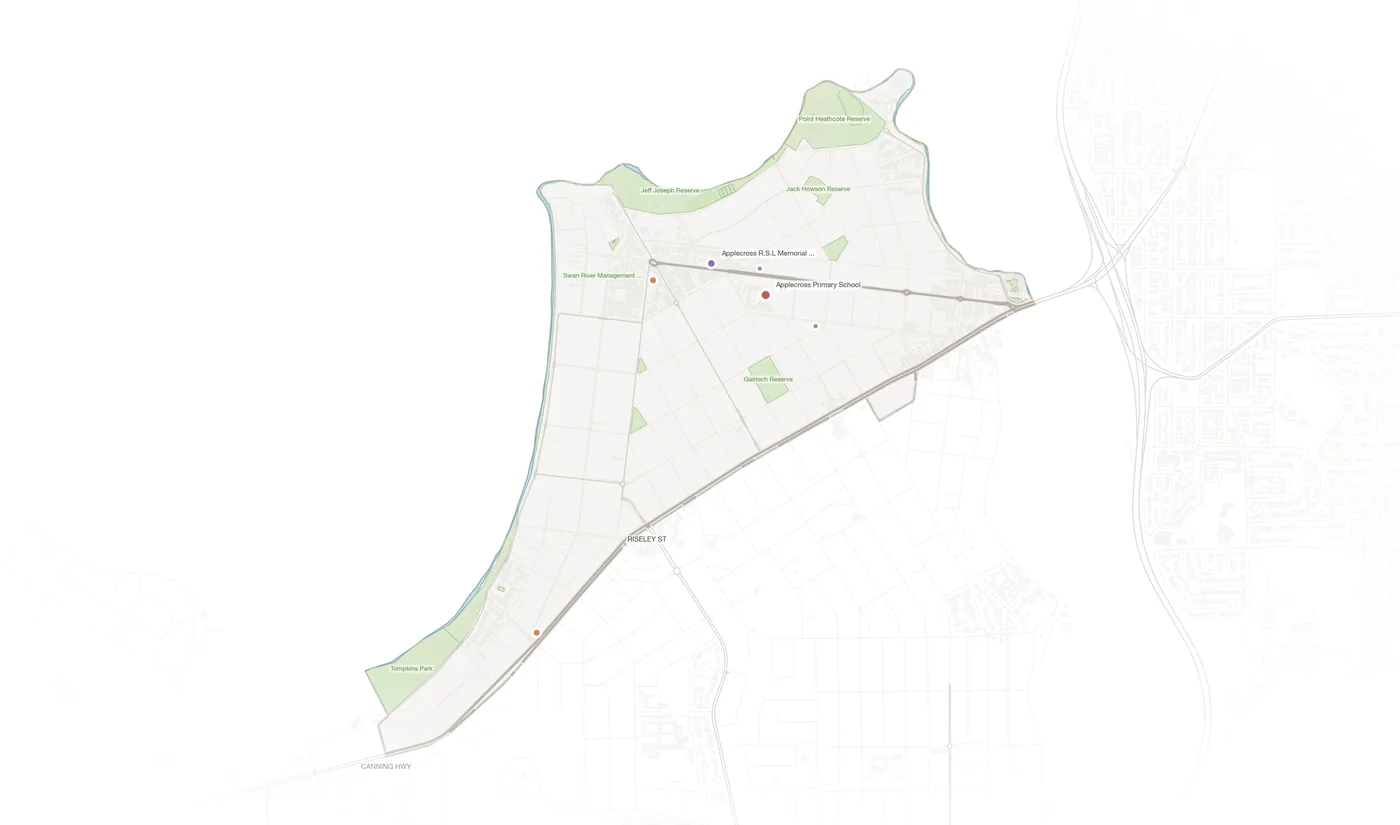
Explore Applecross on the Map
View parcels, zoning overlays, DA applications, schools and more.
Open Interactive Map