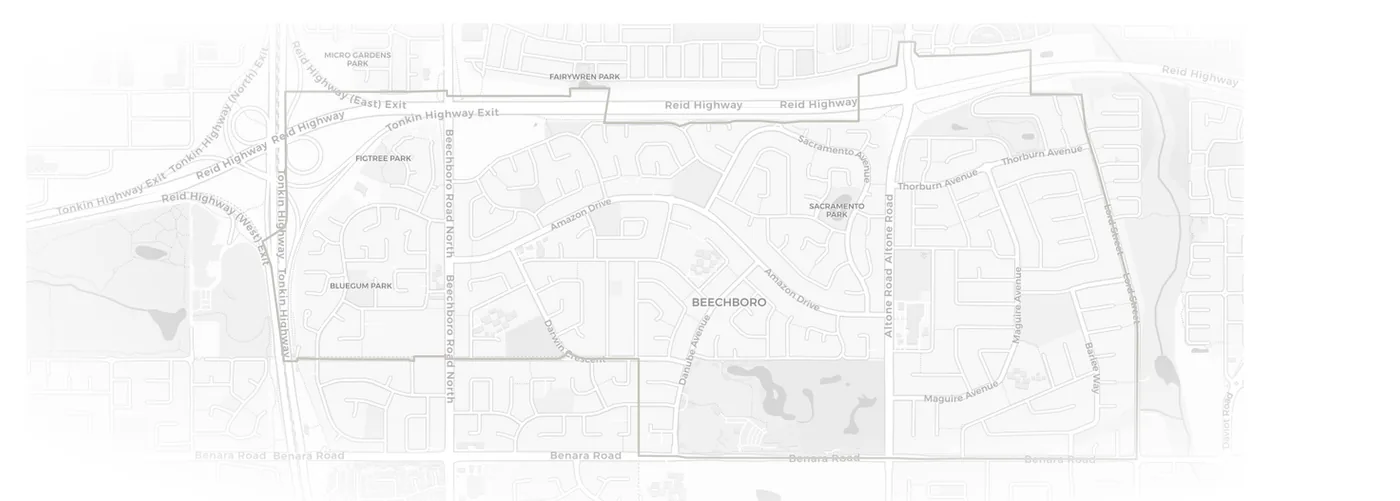
Beechboro
Active gentrification is reshaping Beechboro: the gentrification score of 50 reflects net internal migration of +509 per year combined with strong overseas inflow of +377, accelerating from 18% to 43% population growth rate. Yet household incomes remain at the 42.1st percentile ($1,426/week), placing it firmly in Perth's affordable tier at a $395,000 median house price. The suburb is growing at 2.51% annually (676 persons/year) and the ERP reached 26,928 in 2025. The SEIFA profile reveals a split: IER decile 7 (moderate economic resources) against IEO decile 3 (low education), an unusual combination where asset ownership outstrips formal qualifications.
Population
9,112
Median Age
38.0
Household IncomeiMedian weekly household income (ABS Census)
$1,426/wk
DAs (12 months)iDevelopment Applications lodged in the past year
48
Median House
$395K
Estimated from rent (2025)
At $395,000 (estimated from rent), Beechboro sits well below Perth's metro median, offering affordability with 90.6% detached houses. Three-bedroom homes (51.8%) dominate, with 4+ bedrooms at 41.4%. Monthly mortgage repayments of $1,517 produce a mortgage-to-income ratio of 24.6%, comfortably below the 30% stress threshold and lower than most comparable Perth suburbs. The 31.7% outright ownership rate is above average, indicating established, long-term residents alongside the new arrivals. Three primary schools serve the suburb, with ICSEA scores ranging from 813 to 969, all below the 1,000 national benchmark. Buyers should note car dependency at 87.7% and public transport at just 4.0%.
For Buyers
At $395,000 (estimated from rent), Beechboro sits well below Perth's metro median, offering affordability with 90.6% detached houses. Three-bedroom homes (51.8%) dominate, with 4+ bedrooms at 41.4%. Monthly mortgage repayments of $1,517 produce a mortgage-to-income ratio of 24.6%, comfortably below the 30% stress threshold and lower than most comparable Perth suburbs. The 31.7% outright ownership rate is above average, indicating established, long-term residents alongside the new arrivals. Three primary schools serve the suburb, with ICSEA scores ranging from 813 to 969, all below the 1,000 national benchmark. Buyers should note car dependency at 87.7% and public transport at just 4.0%.
For Investors
Renters at 25.6% provide a moderate tenant base. Weekly rent of $320 against a $395,000 estimated median gives gross yield around 4.2%, competitive by Perth standards. The vacancy rate of 5.8% is slightly elevated but not alarming. Development activity logged 30 DAs in 12 months, indicating steady infill and subdivision. Net internal migration of +509 per year, combined with overseas inflow of +377, delivers strong population-driven demand. The gentrification signal (score 50, active stage) suggests the suburb is transitioning, which historically precedes price appreciation. However, the 8.6% unemployment rate is notably higher than the national average, adding rental default risk.
Development Activity
Total DAs
48
Last 12 Months
48
YoY ChangeiYear-over-year change in DA lodgements
—
Avg DA CostiAverage estimated cost per DA in the past year
N/A
Monthly DA Lodgements
DA Categories
Schools in Beechboro iICSEA: school advantage index. 1000 = national avg, higher = more advantaged
East Beechboro Primary School
K-6 · 362 students
West Beechboro Primary School
K-6 · 429 students
Beechboro Primary School
K-6 · 273 students
Demographics
The median age of 38 is 2 years below the national median. Overseas-born residents make up 39.2%, 17.6 points above the national average, with English ancestry leading at 2,709, followed by Irish (615) and Scottish (607). Mandarin (97), Cantonese (77) and Arabic (74) are the top non-English languages, reflecting moderate linguistic diversity. University qualifications at 22.2% sit 7.9 points below the national rate, consistent with the IEO decile 3 reading. Average household size of 2.7 is close to national. Community/Personal services (594) and Labourers (585) are the top two occupation groups, above Professionals (445), giving the suburb a distinctly working-class occupational mix despite the ongoing gentrification.
Age Distribution
Bedrooms
Dwelling Structure
90.6%
Houses
8.4%
Townhouse
1.0%
Apartment
Tenure
Mortgage holders at 42.7% are the largest tenure group, with outright owners at 31.7% and renters at 25.6%. The dwelling stock is 90.6% separate houses, with semi-detached at 8.4% and apartments at just 1.0%. Three-bedroom homes dominate at 51.8%, and 4+ bedrooms comprise 41.4%. The SEIFA IER decile 7 indicates moderate economic resources, consistent with a suburb where many residents own their homes outright. Rent-to-income sits at 22.4% and mortgage-to-income at 24.6%, both below stress levels. The 31.7% outright ownership rate is notably higher than many growth suburbs, suggesting a cohort of long-established residents who purchased at earlier, lower price points.
Mortgage / mo
$1,517
Rent / wk
$320
HH Size
2.7
Personal Income / wk
$651
Vacancy Ratei% of dwellings unoccupied on Census night (ABS 2021)
5.8%
Unoccupied
199
Rent / IncomeiMedian rent as % of household income. Over 30% = housing stress
22.4%
Mortgage / IncomeiMedian mortgage as % of household income. Over 30% = housing stress
24.6%
Community Profile
Languages Spoken at Home
Ancestry
Household Composition
21.9%
Couples, no children
7,292
Total families
Economy & Employment
Healthcare leads at 17.5% (417 workers), followed by Construction at 9.7% (230) and Retail at 8.2% (195). Education at 8.0% and Manufacturing at 7.0% complete the top five, producing a diversified blue-collar economy. Community/Personal workers (594) and Labourers (585) outnumber Professionals (445), a ratio that is unusual for a suburb with gentrification signals. The unemployment rate of 8.6% is above the national average, and participation at 57.8% is below it, with 2,469 residents not in the labour force. Full-time employment at 63.6% is moderate. All four SEIFA deciles sit in the lower half except IER (decile 7), indicating an economically mixed suburb where asset-rich older residents coexist with lower-income newcomers.
Unemployment
4.4%
Labour Force
14,962
Unemployed
653
Quarterly Trend
Source: SALM Dec-25
Socio-Economic Indexes (SEIFA)iABS index ranking suburbs from 1 (most disadvantaged) to 10 (most advantaged)
Full-time
63.6%
Part-time
27.8%
Participation
57.8%
Employed
3,895
Occupations
Top Industries
University
22.2%
Postgraduate
3.6%
Born Overseas
39.2%
Dwellings
3,242
Transport to Work
Car dependency at 87.7% dominates, with public transport at 4.0% and walking/cycling at 1.5%. Three government primary schools serve the suburb: East Beechboro (ICSEA 969, 362 students), West Beechboro (ICSEA 959, 429 students) and Beechboro Primary (ICSEA 813, 273 students). All sit below the national 1,000 ICSEA benchmark, with Beechboro Primary significantly lower, suggesting considerable educational disadvantage. The IRSAD decile 4 confirms below-average socio-economic conditions overall. The 6.2% needing assistance rate is above average. The volunteering rate of 11.1% is moderate. Rent-to-income at 22.4% and mortgage-to-income at 24.6% are both manageable, keeping housing costs below stress levels.
Drive
87.7%
Public Transport
4.0%
Walk / Cycle
1.5%
Work from Home
N/A
Population Forecast
+2.51%/yr
(+676 people/yr)
EstablishedPopulation growth runs at 2.51% per year (676 persons), with the 10-year change at 40.4%, above the national average. The ERP reached 26,928 in 2025 and medium forecasts project 29,677 by 2031. Both internal migration (+509/year) and overseas migration (+377/year) are positive, a rare dual-inflow pattern. The gentrification score of 50 (active stage) reflects this acceleration from 18% to 43% growth rate. The senior share expanded by 2.7 percentage points while the working-age share contracted by only 0.3 points, suggesting moderate aging. Real income growth of 3.7% over the decade barely kept pace with inflation. Affordability has been improving, with the ratio declining from 52.5% in 2011 to 45.0% in 2021.
Historical + Forecast
Hamilton-Perry + Holt smoothing on ERP 2001-2025
Age Cohort Forecast
Primary Driver
Internal Migration
Net Overseas / yr
+377
Net Internal / yr
+509
Gentrification Signal
Active
Net internal migration +509/yr, Strong overseas inflow +377/yr, Accelerating: 18% → 43%
National Ranking iPercentile rank among ~15,000 AU suburbs. 90% = higher than 90% of suburbs
How Beechboro compares to ~15,000 Australian suburbs
Frequently Asked Questions
Is Beechboro a good suburb to live in?
Beechboro offers affordable entry at $395,000 with 90.6% detached housing and mortgage-to-income of 24.6%, below the stress threshold. The IRSAD decile 4 is below the national midpoint, and schools score below the ICSEA 1,000 benchmark. Active gentrification (score 50) suggests the suburb is transitioning, with dual inflows of 509 internal and 377 overseas migrants per year.
What is the median house price in Beechboro?
The estimated median is $395,000 (derived from rent data, 2025). Weekly rent averages $320 and monthly mortgage repayments are $1,517. Gross rental yield sits around 4.2%, competitive within Perth's northern suburbs. The mortgage-to-income ratio of 24.6% is well below the 30% stress line.
What schools are in Beechboro?
Three government primary schools serve the suburb: East Beechboro (ICSEA 969, 362 students), West Beechboro (ICSEA 959, 429 students) and Beechboro Primary (ICSEA 813, 273 students). All sit below the national 1,000 ICSEA benchmark, with Beechboro Primary notably lower. No secondary schools are within the suburb.
Is Beechboro safe?
Crime data is not available for Beechboro in the current dataset. The IRSD decile 4 indicates below-average socio-economic conditions, which typically correlates with higher than average property crime. The IRSAD decile 4 and 8.6% unemployment rate suggest mixed socio-economic conditions across the suburb.
Is Beechboro good for property investment?
Gross yield of approximately 4.2% ($320/week on $395,000) is competitive by Perth standards. The 25.6% renter share provides a reasonable tenant pool, and the 5.8% vacancy rate is moderate. Active gentrification (score 50) with dual migration inflows of 886 net per year supports demand growth. The 30 DAs in 12 months indicate ongoing infill development.
How is Beechboro's population changing?
The population grew 40.4% over 10 years, reaching 26,928 in 2025 with 2.51% annual growth (676 persons). Both internal (+509/year) and overseas (+377/year) migration are positive, a rare dual-inflow pattern. The median age of 38 is 2 years below national. Gentrification is active (score 50), with population acceleration from 18% to 43%.
How to read these comparisons
Phrases like "above the national average" reference the unweighted median across Australian suburbs with more than 1,000 residents, not population-weighted national figures. Suburb-level medians are more useful for ranking suburbs against each other; ABS census headlines are population-weighted (so dominated by Sydney and Melbourne) and can read very differently.
Current baseline (refreshed 2026-05-10): median age 40, university-educated 30.1%, born overseas 21.6%, average household size 2.5 people.
Data sources: ABS 2021 Census (demographics, income, tenure), state Valuer-General (house prices), Department of Jobs SALM (unemployment), ACARA (school ICSEA), state Crime Statistics agencies (offences), council DA portals (development applications). Population forecasts use a Hamilton-Perry cohort model calibrated to ABS ERP.
Explore Beechboro on the Map
View parcels, zoning overlays, DA applications, schools and more.
Open Interactive Map