Bentley
A 65.0% renter share, 12.2% vacancy rate, and household incomes at the 26th percentile ($1,212/week) define Bentley as Perth's affordable renter-majority suburb, a profile shaped by proximity to Curtin University. The migrant share at 59.2% is 37.6 points above the national average, the highest gap in this batch. Yet university qualifications at 41.9% sit 11.8 points above national, a paradox explained by the student population: highly educated but asset-poor. The SEIFA split confirms this: IEO decile 7 (above-average education) against IER decile 2 (very low economic resources). Semi-detached housing at 48.6% exceeds detached at 37.3%, an unusual structural mix for a Perth suburb.
Population
9,051
Median Age
32.0
Household IncomeiMedian weekly household income (ABS Census)
$1,212/wk
DAs (12 months)iDevelopment Applications lodged in the past year
1
Median House
$400K
Estimated from rent (2025)
At $400,000 estimated median, Bentley offers deep affordability, but the unusual housing mix complicates purchasing. Semi-detached at 48.6% exceeds detached houses at 37.3%, with apartments at 14.1%. Three-bedroom homes at 37.9% are the most common, with 4+ bedrooms at 29.7% and studios/one-bedrooms at 12.9%. Monthly mortgage repayments of $1,555 produce a mortgage-to-income ratio of 29.6%, the highest in this batch and very close to the 30% stress threshold. Only 16.7% own outright and 18.3% carry mortgages, meaning buying is a minority tenure. Three schools cover primary and secondary: Canning College (ICSEA 1,073), Al-Hidayah Islamic School (ICSEA 1,055) and Bentley Primary (ICSEA 974). Public transport at 13.2% is above average.
For Buyers
At $400,000 estimated median, Bentley offers deep affordability, but the unusual housing mix complicates purchasing. Semi-detached at 48.6% exceeds detached houses at 37.3%, with apartments at 14.1%. Three-bedroom homes at 37.9% are the most common, with 4+ bedrooms at 29.7% and studios/one-bedrooms at 12.9%. Monthly mortgage repayments of $1,555 produce a mortgage-to-income ratio of 29.6%, the highest in this batch and very close to the 30% stress threshold. Only 16.7% own outright and 18.3% carry mortgages, meaning buying is a minority tenure. Three schools cover primary and secondary: Canning College (ICSEA 1,073), Al-Hidayah Islamic School (ICSEA 1,055) and Bentley Primary (ICSEA 974). Public transport at 13.2% is above average.
For Investors
The 65.0% renter share is the highest in this batch, providing an exceptionally deep tenant pool driven by Curtin University proximity. Weekly rent of $320 against a $400,000 estimated median gives gross yield around 4.2%, attractive by Perth standards. However, the 12.2% vacancy rate is a significant concern, suggesting structural oversupply. Only 1 DA was lodged in 12 months, meaning virtually no new supply. The tenant profile skews student: 41.9% university-qualified, 37.4% turnover rate, and 50.1% full-time employment (the lowest in this batch). Investors should weigh the high yield against the high vacancy and student tenancy turnover, which creates seasonal demand fluctuations.
Development Activity
Total DAs
8
Last 12 Months
1
YoY ChangeiYear-over-year change in DA lodgements
—
Avg DA CostiAverage estimated cost per DA in the past year
N/A
Monthly DA Lodgements
DA Categories
Schools in Bentley iICSEA: school advantage index. 1000 = national avg, higher = more advantaged
Canning College
U, 10-12 · 247 students
Al-Hidayah Islamic School
PP-6 · 198 students
Bentley Primary School
K-6 · 336 students
Demographics
The median age of 32 is 8 years below the national median. Overseas-born at 59.2% is 37.6 points above national, the widest gap in this batch. Chinese ancestry (1,211) is prominent alongside English (1,883) and Indian (506). Mandarin (339), Urdu (208) and Cantonese (107) lead non-English languages. University qualifications at 41.9% sit 11.8 points above national, elevated by the student population. Average household size of 2.3 is 0.2 below national. Couples without children (33.9%) nearly equal couples with children (36.4%), reflecting a mix of students, young couples and established families. Christianity (2,806), Islam (890) and Buddhism (806) show strong religious diversity. Volunteering at 16.3% is above average.
Age Distribution
Bedrooms
Dwelling Structure
37.3%
Houses
48.6%
Townhouse
14.1%
Apartment
Tenure
Renters at 65.0% overwhelmingly dominate, with outright owners at 16.7% and mortgage holders at just 18.3%. The unusual mix of 48.6% semi-detached, 37.3% detached and 14.1% apartments reflects Bentley's transition from single-house suburb to medium-density. Studios/one-bedrooms at 12.9% are above average, consistent with student accommodation demand. Three-bedroom homes at 37.9% lead, with 4+ bedrooms at 29.7%. Mortgage-to-income at 29.6% approaches the stress threshold, the highest in this batch, because the low income base ($1,212/week household) makes even a $400,000 purchase stretch. Rent-to-income at 26.4% is also elevated. The SEIFA IER decile 2 confirms very low aggregate economic resources.
Mortgage / mo
$1,555
Rent / wk
$320
HH Size
2.3
Personal Income / wk
$618
Vacancy Ratei% of dwellings unoccupied on Census night (ABS 2021)
12.2%
Unoccupied
454
Rent / IncomeiMedian rent as % of household income. Over 30% = housing stress
26.4%
Mortgage / IncomeiMedian mortgage as % of household income. Over 30% = housing stress
29.6%
Community Profile
Languages Spoken at Home
Ancestry
Household Composition
33.9%
Couples, no children
4,130
Total families
Economy & Employment
Healthcare leads at 15.5% (431 workers), followed by Hospitality at 11.5% (321) and Retail at 10.2% (283). Professional/Tech at 9.5% and Education at 9.0% complete the top five. The Hospitality share is the highest in this batch, consistent with a student-area economy. Professionals (795) lead occupations, but Community/Personal (729) and Labourers (658) are close behind. Full-time employment at just 50.1% is the lowest in this batch, reflecting high part-time and casual student employment. Unemployment at 8.8% is well above the national average, and participation at 52.0% is low, with 2,653 not in the labour force. The SEIFA IEO decile 7 against IER decile 2 encapsulates the student paradox: educated but asset-poor.
Socio-Economic Indexes (SEIFA)iABS index ranking suburbs from 1 (most disadvantaged) to 10 (most advantaged)
Full-time
50.1%
Part-time
41.1%
Participation
52.0%
Employed
3,869
Occupations
Top Industries
University
41.9%
Postgraduate
13.9%
Born Overseas
59.2%
Dwellings
3,250
Transport to Work
Public transport at 13.2% is above the Perth average, reflecting bus and rail connections to Curtin University and the CBD. Car driving at 77.0% is below the Perth suburban average. Three schools serve the suburb: Canning College (ICSEA 1,073, 247 students, government secondary), Al-Hidayah Islamic School (ICSEA 1,055, 198 students, independent primary) and Bentley Primary (ICSEA 974, 336 students, government). Two of three score above the 1,000 benchmark. The IRSAD decile 5 sits at the national midpoint. The 8.9% needing assistance rate is the second highest in this batch. Rent-to-income at 26.4% is elevated but below the 30% stress line.
Drive
77.0%
Public Transport
13.2%
Walk / Cycle
3.8%
Work from Home
N/A
National Ranking iPercentile rank among ~15,000 AU suburbs. 90% = higher than 90% of suburbs
How Bentley compares to ~15,000 Australian suburbs
Frequently Asked Questions
Is Bentley a good suburb to live in?
Bentley suits students and budget-conscious renters near Curtin University, with public transport at 13.2% above Perth's average. The $400,000 estimated median is affordable, but the 12.2% vacancy rate and IRSAD decile 5 indicate mixed conditions. Two of three schools score above ICSEA 1,000. The 65.0% renter share and 37.4% turnover reflect a transient, student-influenced community.
What is the median house price in Bentley?
The estimated median is $400,000 (derived from rent data, 2025). Weekly rent averages $320 and monthly mortgage repayments are $1,555. Gross rental yield sits around 4.2%, attractive for Perth. The mortgage-to-income ratio of 29.6% is the highest in this batch, approaching the 30% stress threshold.
What schools are in Bentley?
Three schools serve the suburb: Canning College (government secondary, ICSEA 1,073, 247 students), Al-Hidayah Islamic School (independent primary, ICSEA 1,055, 198 students) and Bentley Primary (government, ICSEA 974, 336 students). Two of three score above the national 1,000 ICSEA benchmark.
Is Bentley safe?
Crime data is not available for Bentley in the current dataset. The IRSD decile 4 and 8.8% unemployment rate suggest below-average socio-economic conditions. The high renter share (65.0%) and student population create higher residential turnover (37.4%), which can correlate with elevated property crime in transient suburbs.
Is Bentley good for property investment?
Gross yield of approximately 4.2% ($320/week on $400,000) is attractive. The 65.0% renter share provides the deepest tenant pool in this batch. However, the 12.2% vacancy rate is a significant red flag for oversupply. The student-influenced tenancy means seasonal demand fluctuations. Only 1 DA in 12 months indicates no new supply competition.
How is Bentley's population changing?
The 2021 Census recorded 9,051 residents with a median age of 32 (8 years below national). The 59.2% overseas-born share (37.6 points above national) is heavily influenced by Curtin University enrolments. Residential turnover at 37.4% is high, reflecting student cycling. The demographic profile is shaped more by international enrolment cycles than by permanent migration patterns.
What languages are spoken in Bentley?
With 59.2% born overseas (37.6 points above national), Bentley is intensely multilingual. Mandarin leads at 339 speakers, followed by Urdu (208), Cantonese (107), Punjabi (95) and Arabic (87). Chinese ancestry at 1,211 is the largest non-Anglo group, reflecting Curtin University's strong international student intake from East and South Asia.
How to read these comparisons
Phrases like "above the national average" reference the unweighted median across Australian suburbs with more than 1,000 residents, not population-weighted national figures. Suburb-level medians are more useful for ranking suburbs against each other; ABS census headlines are population-weighted (so dominated by Sydney and Melbourne) and can read very differently.
Current baseline (refreshed 2026-05-10): median age 40, university-educated 30.1%, born overseas 21.6%, average household size 2.5 people.
Data sources: ABS 2021 Census (demographics, income, tenure), state Valuer-General (house prices), Department of Jobs SALM (unemployment), ACARA (school ICSEA), state Crime Statistics agencies (offences), council DA portals (development applications). Population forecasts use a Hamilton-Perry cohort model calibrated to ABS ERP.
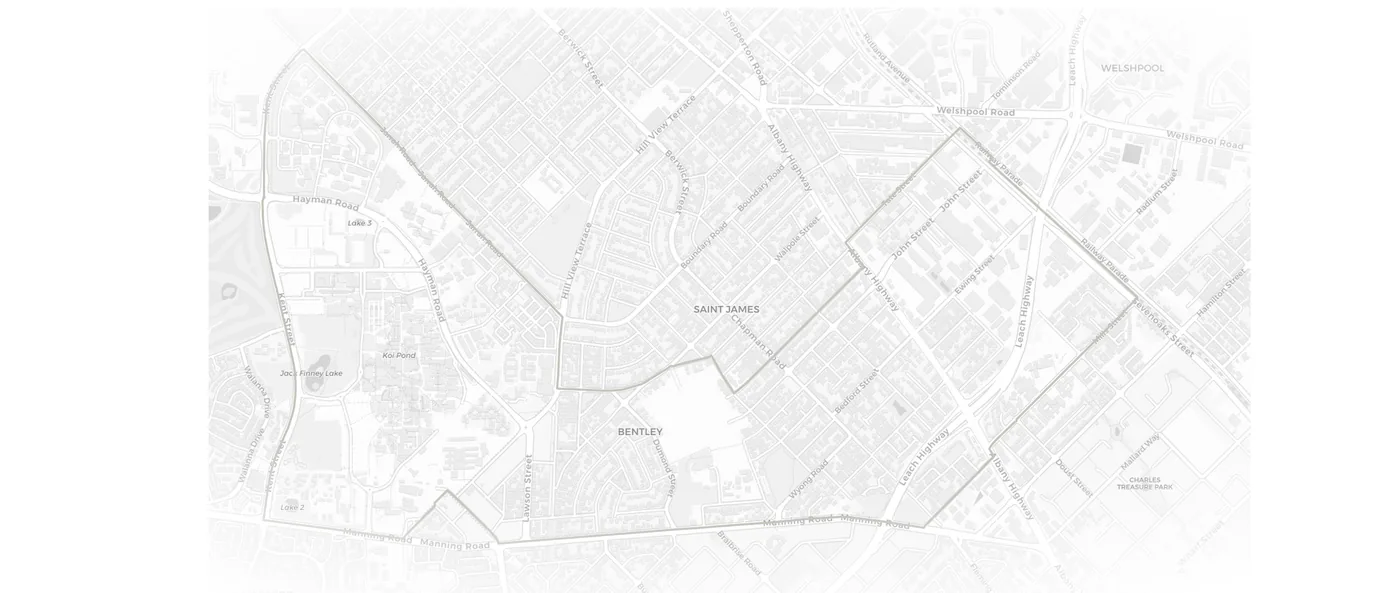
Explore Bentley on the Map
View parcels, zoning overlays, DA applications, schools and more.
Open Interactive Map