Crawley
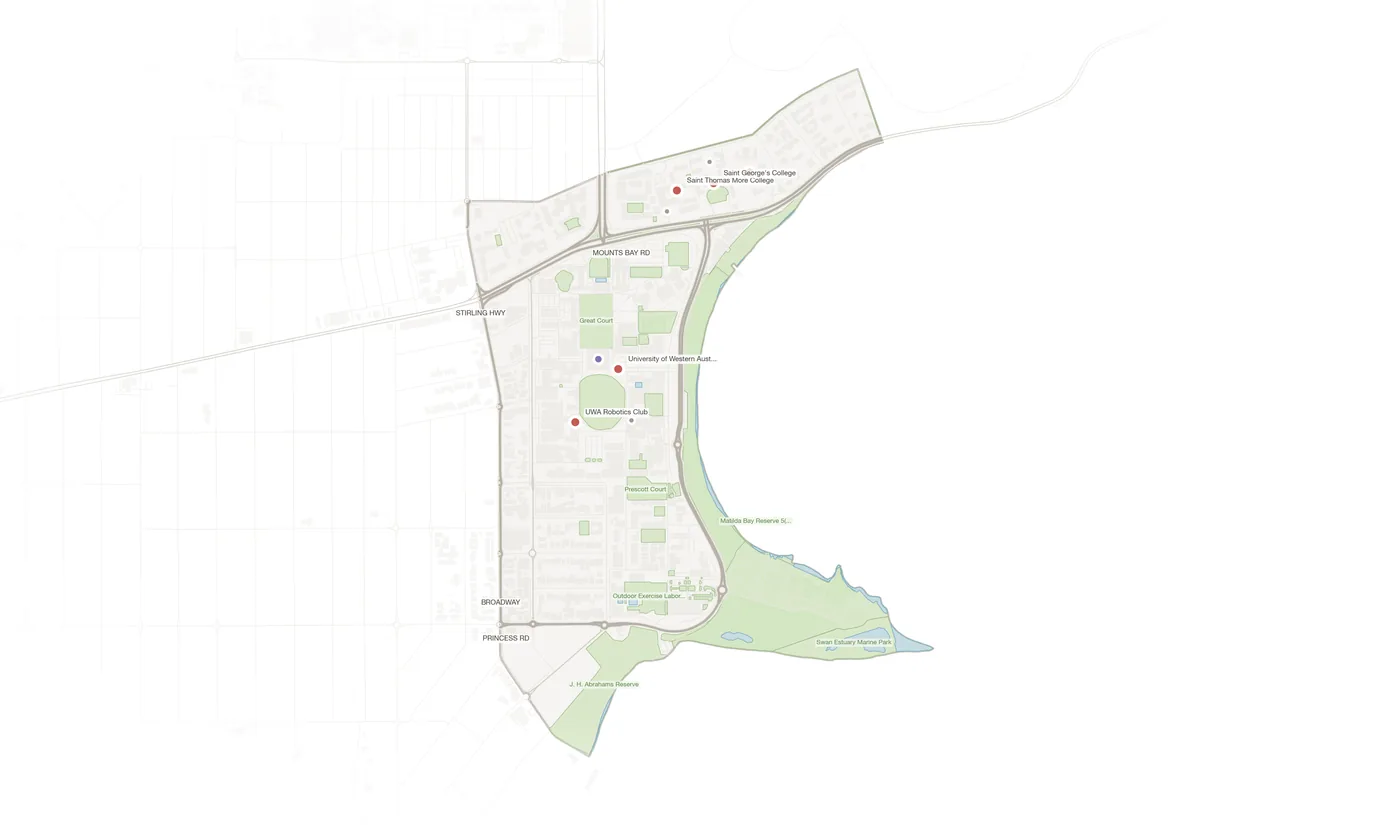
At a median age of 24, Crawley is 16 years younger than the national average, a gap that explains almost everything about the suburb. The University of Western Australia sits at its core, drawing a population where 65.6% hold university qualifications, which is 35.5 percentage points above national. That student weight shapes tenure (64.4% renting), stock (70.4% apartments) and vacancy (19.7%), the highest renter share and apartment concentration you will find in greater Perth. Despite household income landing in only the 35th percentile, SEIFA scores reach decile 10 on IRSAD, IEO and IRSD, reflecting the credential advantage that education imparts even before careers begin.
Population
3,975
Median Age
24.0
Household IncomeiMedian weekly household income (ABS Census)
$1,368/wk
DAs (12 months)iDevelopment Applications lodged in the past year
0
Median House
$464K
Estimated from rent (2025)
The estimated median house price of $464,000 is derived from rental data rather than observed sales, which signals that genuine house transactions in Crawley are scarce. Separate houses are just 6.1% of the stock, so most buyers are purchasing apartments (70.4%) or semi-detached dwellings (23.4%). Two-bedroom configurations dominate at 36.6% and three-bedroom at 34.0%, while the 0-1 bedroom category is elevated at 26.2%, reflecting the student rental base. Monthly mortgage repayments average $1,941, and the mortgage-to-income ratio is 32.8%, above the 30% stress threshold. Outright owners represent 26.6% of the market compared to just 9.1% carrying a mortgage, which is low even by apartment-suburb standards and suggests most occupied dwellings are held as investment properties rather than owner-occupied.
For Buyers
The estimated median house price of $464,000 is derived from rental data rather than observed sales, which signals that genuine house transactions in Crawley are scarce. Separate houses are just 6.1% of the stock, so most buyers are purchasing apartments (70.4%) or semi-detached dwellings (23.4%). Two-bedroom configurations dominate at 36.6% and three-bedroom at 34.0%, while the 0-1 bedroom category is elevated at 26.2%, reflecting the student rental base. Monthly mortgage repayments average $1,941, and the mortgage-to-income ratio is 32.8%, above the 30% stress threshold. Outright owners represent 26.6% of the market compared to just 9.1% carrying a mortgage, which is low even by apartment-suburb standards and suggests most occupied dwellings are held as investment properties rather than owner-occupied.
For Investors
Crawley's 64.4% renter share is well above the state average, giving landlords a deep and steady tenant pool, primarily students and early-career professionals. Weekly rent is $350, and the 19.7% vacancy rate is high on paper but reflects the academic calendar cycle rather than structural oversupply. Net overseas migration adds 778 residents a year to the broader SA2, making overseas arrivals the primary demand driver well above the national rate. Internal migration removes 121 residents a year as graduates move on, so demand renewal depends on the university intake remaining strong. Gentrification sits at an early-signs stage with a score of 31, driven by a population increase of 18% since 2011. Rent growth of 7.1% over the measured period indicates improving returns for existing landlords.
Demographics
The median age of 24 sits 16 years below the national figure, and the age structure reflects the student lifecycle rather than a family suburb. Overseas-born residents reach 53.8%, which is 32.2 percentage points above national, making Crawley majority overseas-born. Chinese ancestry (804 residents) ranks third after English (1,015) and Other (830), and Mandarin is the leading non-English language at 269 speakers. University qualifications at 65.6% run 35.5 points above the national average, among the highest in Australia. Average household size is 2.0, which is 0.5 below national, consistent with the student and young-professional composition where couples without children account for 44.3% of families. Volunteering runs at a strong 35.8%, likely reflecting the campus culture.
Age Distribution
Bedrooms
Dwelling Structure
6.1%
Houses
23.4%
Townhouse
70.4%
Apartment
Tenure
The stock is overwhelmingly apartments at 70.4%, with semi-detached dwellings at 23.4% and separate houses at just 6.1%, one of the lowest house shares in WA. Tenure is renter-dominated: 64.4% rent, 26.6% own outright and 9.1% hold a mortgage. The low mortgage share reflects the investment-property character of many apartments, bought by off-campus landlords and held long term. Two-bedroom dwellings account for 36.6% and three-bedroom 34.0%, while the 0-1 bedroom category sits at 26.2%, well above typical suburban levels. Vacancy at 19.7% is elevated, again tracking the academic year and the concentration of short-stay student leases. Mortgage-to-income at 32.8% exceeds the stress threshold, while rent-to-income at 25.6% sits just under the 30% stress line.
Mortgage / mo
$1,941
Rent / wk
$350
HH Size
2.0
Personal Income / wk
$435
Vacancy Ratei% of dwellings unoccupied on Census night (ABS 2021)
19.7%
Unoccupied
278
Rent / IncomeiMedian rent as % of household income. Over 30% = housing stress
25.6%
Mortgage / IncomeiMedian mortgage as % of household income. Over 30% = housing stress
32.8% stressed
Community Profile
Languages Spoken at Home
Ancestry
Household Composition
44.3%
Couples, no children
1,462
Total families
Economy & Employment
Education is the dominant industry at 25.0% of employed residents, well above what most suburbs record, driven directly by the University of Western Australia presence. Healthcare follows at 15.8%, then Professional/Tech at 12.4% and Hospitality at 11.9%, a cluster consistent with a campus-adjacent economy. Professionals account for 602 of the employed, the largest occupational group, and Community/Personal service workers number 449. The unemployment rate is 12.0%, higher than the national average, because a large share of the population is studying rather than employed. The full-time employment rate of 35.2% and the participation rate of 52.6% reflect the same student effect. SEIFA scores all reach decile 9 or 10 despite the 35th-percentile household income, because the indexes credit education and occupation quality ahead of current earnings.
Unemployment
2.1%
Labour Force
11,888
Unemployed
250
Quarterly Trend
Source: SALM Dec-25
Socio-Economic Indexes (SEIFA)iABS index ranking suburbs from 1 (most disadvantaged) to 10 (most advantaged)
Full-time
35.2%
Part-time
52.8%
Participation
52.6%
Employed
1,699
Occupations
Top Industries
University
65.6%
Postgraduate
28.0%
Born Overseas
53.8%
Dwellings
1,140
Transport to Work
Crawley stands out for non-car mobility: 24.8% walk or cycle and 18.5% use public transport, which together mean more than 43% of residents move without a car, far above WA norms. Car use at 52.4% is correspondingly lower than the national average. SEIFA decile scores are 10 for IRSAD and IRSD and 10 for IEO, placing Crawley in the top tier nationally for both advantage and education-occupation quality. Only 1.6% of residents (60 people) need daily assistance. No schools are recorded within the 1.42 km2 boundary, so families with children rely on institutions in neighbouring suburbs. The suburb's compact density of 2,800 residents per km2 and its university perimeter give residents walkable access to campus facilities, parks and the Swan River foreshore.
Drive
52.4%
Public Transport
18.5%
Walk / Cycle
24.8%
Work from Home
N/A
Population Forecast
+0.86%/yr
(+191 people/yr)
EstablishedPopulation growth is running at 0.86% per year, adding roughly 191 residents annually, and the medium forecast holds the SA2 near 22,521 by 2031. The 10-year population change was 7.9%, slower than many Perth suburbs but steady. Overseas migration at 778 net arrivals per year is the dominant driver, classifying Crawley as an internationally oriented suburb rather than one fuelled by domestic relocation. Net internal outflow of 121 per year offsets some of that gain as graduates leave. The gentrification score of 31 sits at early signs, supported by signals including a population increase of 18% since 2011 and an accelerating overseas-inflow trend. Affordability improved from 61.9% in 2011 to 48.9% in 2021, a meaningful 13-point easing relative to income growth of 10.2% in real terms.
Historical + Forecast
Hamilton-Perry + Holt smoothing on ERP 2001-2025
Age Cohort Forecast
Primary Driver
Overseas Migration
Net Overseas / yr
+778
Net Internal / yr
-121
Gentrification Signal
Early signs
Population +18% since 2011, Net internal outflow -121/yr, Strong overseas inflow +778/yr, Accelerating: 3% → 14%
National Ranking iPercentile rank among ~15,000 AU suburbs. 90% = higher than 90% of suburbs
How Crawley compares to ~15,000 Australian suburbs
Frequently Asked Questions
Is Crawley a good suburb to live in?
Crawley scores decile 10 on IRSAD, IEO and IRSD, the top advantage tier nationally. University qualifications reach 65.6%, which is 35.5 points above national. Walking and cycling account for 24.8% of commutes. The main trade-offs are a 19.7% vacancy rate, no schools inside the boundary and a 64.4% renter majority with limited house stock at 6.1% of dwellings.
What is the median house price in Crawley?
The estimated median house price is $464,000, derived from rental data for 2025 because direct sales of the 6.1% house stock are too infrequent for a market median. Weekly rent averages $350 and monthly mortgage repayments run around $1,941, giving a mortgage-to-income ratio of 32.8%, above the 30% stress threshold.
What schools are in Crawley?
No schools are recorded inside the 1.42 km2 Crawley boundary in this dataset. Families rely on schools in neighbouring suburbs. The local population is highly educated: 65.6% hold university qualifications, which is 35.5 percentage points above the national figure, consistent with the University of Western Australia being the suburb's anchor institution.
Is Crawley safe?
Crime statistics are not available for Crawley in this dataset. As an indirect indicator, the suburb scores decile 10 on the IRSD index of relative socioeconomic disadvantage, the highest advantage tier nationally, and only 1.6% of its 3,975 residents require daily assistance. Both measures are consistent with a low-disadvantage, well-resourced area.
Is Crawley good for property investment?
Crawley has a 64.4% renter share, well above the Perth average, providing a consistent tenant pool anchored by university enrolment. Weekly rent is $350 and rent growth was 7.1% over the measured period. The 19.7% vacancy rate is a risk to monitor but follows the academic calendar. Net overseas migration of 778 per year supports ongoing demand, and the gentrification score of 31 indicates early-stage uplift potential.
How is Crawley's population changing?
The population is growing at 0.86% per year, adding about 191 residents annually. The SA2-level population reached 22,236 in 2025, up 7.9% over 10 years. Overseas migration driving 778 net arrivals a year is the primary growth engine, offsetting an internal outflow of 121 per year as graduates depart. Medium forecasts project the SA2 population near 22,521 by 2031.
What languages are spoken in Crawley?
About 53.8% of residents were born overseas, which is 32.2 percentage points above the national figure. Mandarin is the leading non-English language at 269 speakers, followed by Cantonese at 46, Urdu at 36 and Bengali at 28. Chinese ancestry ranks third among ancestry groups at 804 residents, reflecting the international student composition.
How to read these comparisons
Phrases like "above the national average" reference the unweighted median across Australian suburbs with more than 1,000 residents, not population-weighted national figures. Suburb-level medians are more useful for ranking suburbs against each other; ABS census headlines are population-weighted (so dominated by Sydney and Melbourne) and can read very differently.
Current baseline (refreshed 2026-05-10): median age 40, university-educated 30.1%, born overseas 21.6%, average household size 2.5 people.
Data sources: ABS 2021 Census (demographics, income, tenure), state Valuer-General (house prices), Department of Jobs SALM (unemployment), ACARA (school ICSEA), state Crime Statistics agencies (offences), council DA portals (development applications). Population forecasts use a Hamilton-Perry cohort model calibrated to ABS ERP.
Explore Crawley on the Map
View parcels, zoning overlays, DA applications, schools and more.
Open Interactive Map