Dunlop
When 33.4% of workers are in public administration, a suburb's economic identity is inseparable from the federal government. Dunlop's 7,265 residents earn at the 92nd percentile nationally, yet the estimated median house price of $610,000 keeps mortgage stress at just 18.5% of income, one of the lowest ratios in the ACT. The 61.1% mortgage rate and 91.9% detached housing share confirm a purpose-built Canberra family suburb. With no schools within the suburb boundary and real income declining 2.3% over the decade, Dunlop's economic story is more nuanced than the headline income suggests.
Population
7,265
Median Age
36.0
Household IncomeiMedian weekly household income (ABS Census)
$2,503/wk
DAs (12 months)iDevelopment Applications lodged in the past year
4
Median House
$610K
Estimated from rent (2025)
At an estimated $610,000, Dunlop offers ACT homebuyers one of Canberra's most affordable entry points for detached housing, well below the national capital's median. Mortgage repayments absorb only 18.5% of household income, lower than the average for comparable ACT suburbs. The stock is 91.9% separate houses with 54.4% having 4-plus bedrooms and 41.1% three-bedroom. The 84.9% residential retention rate is the highest in this batch, indicating very low turnover and high satisfaction. Only 18.5% rent, and 20.4% own outright. The absence of schools within the suburb boundary is a planning gap that buyers should verify before committing.
For Buyers
At an estimated $610,000, Dunlop offers ACT homebuyers one of Canberra's most affordable entry points for detached housing, well below the national capital's median. Mortgage repayments absorb only 18.5% of household income, lower than the average for comparable ACT suburbs. The stock is 91.9% separate houses with 54.4% having 4-plus bedrooms and 41.1% three-bedroom. The 84.9% residential retention rate is the highest in this batch, indicating very low turnover and high satisfaction. Only 18.5% rent, and 20.4% own outright. The absence of schools within the suburb boundary is a planning gap that buyers should verify before committing.
For Investors
Weekly rent of $465 on the estimated $610,000 median generates a gross yield of approximately 4.0%. The 3% vacancy rate is tight, well below the national average. However, only 18.5% of households rent, limiting the tenant pool. Just 3 DAs were lodged in 12 months, indicating the suburb is fully built out with minimal new supply risk. Population has been declining from 7,419 in 2023 to 7,282 in 2025, though the medium projection reverses this to 8,037 by 2031. Net internal migration runs at -77 per year, with overseas arrivals adding only 27, meaning the suburb is losing residents domestically.
Development Activity
Total DAs
27
Last 12 Months
4
YoY ChangeiYear-over-year change in DA lodgements
+100.0%
Avg DA CostiAverage estimated cost per DA in the past year
N/A
Monthly DA Lodgements
DA Categories
Demographics
Dunlop's median age of 36 is 4 years below the national figure. University attainment at 37.2% sits 7.1 points above the national rate, driven by the public-sector workforce. English ancestry leads (2,503), with Irish (731) and Scottish (683) following. At 21.5% born overseas, the suburb aligns with the national average. Arabic (55 speakers), Mandarin (43), and Punjabi (30) are the most common non-English languages. Average household size of 2.9 is 0.4 above national, consistent with the family orientation. Christianity (3,378) dominates, with Islam (265) and Hinduism (197) providing religious diversity.
Age Distribution
Bedrooms
Dwelling Structure
91.9%
Houses
6.9%
Townhouse
1.2%
Apartment
Tenure
The estimated median house price of $610,000 is derived from rental data; no historical sales series is available. Detached houses at 91.9% dominate, with semi-detached at 6.9% and apartments at just 1.2%. Four-plus-bedroom homes (54.4%) and three-bedroom (41.1%) account for nearly all stock. The ownership pattern is mortgage-heavy at 61.1%, the second-highest in this batch, with 20.4% owning outright and 18.5% renting. Both rent-to-income (18.6%) and mortgage-to-income (18.5%) are virtually identical and well below stress thresholds, reflecting the strong ACT income base against moderate housing costs.
Mortgage / mo
$2,000
Rent / wk
$465
HH Size
2.9
Personal Income / wk
$1,176
Vacancy Ratei% of dwellings unoccupied on Census night (ABS 2021)
3.0%
Unoccupied
74
Rent / IncomeiMedian rent as % of household income. Over 30% = housing stress
18.6%
Mortgage / IncomeiMedian mortgage as % of household income. Over 30% = housing stress
18.5%
Community Profile
Languages Spoken at Home
Ancestry
Household Composition
18.1%
Couples, no children
6,361
Total families
Economy & Employment
Public administration dominates at 33.4% (904 workers), more than double any other sector and the highest single-industry concentration in this batch. Healthcare (13.7%), education (12.2%), professional services (9.3%), and construction (7.6%) follow. Professionals (916) and clerical/admin (720) lead occupations, consistent with the public-service workforce profile. Unemployment at 4% is near the national average, and the 69.7% participation rate is strong. Real income declined 2.3% over the decade, unusual for the ACT, suggesting Dunlop's public-sector workers have not kept pace with Canberra's broader income growth. SEIFA scores are uniformly high: IRSD decile 8, IEO decile 8, IER decile 9, IRSAD decile 8.
Unemployment
4.8%
Labour Force
4,374
Unemployed
208
Quarterly Trend
Source: SALM Dec-25
Socio-Economic Indexes (SEIFA)iABS index ranking suburbs from 1 (most disadvantaged) to 10 (most advantaged)
Full-time
70.7%
Part-time
25.3%
Participation
69.7%
Employed
3,720
Occupations
Top Industries
University
37.2%
Postgraduate
10.8%
Born Overseas
21.5%
Dwellings
2,429
Transport to Work
Dunlop has no schools within its suburb boundary, a significant gap for a family suburb with 54.4% four-plus-bedroom homes. Families access schools in neighbouring Belconnen suburbs. Car dependency at 89.6% is standard for outer Canberra, with public transport at 2.9% and walking/cycling at just 1%. The volunteering rate of 16.6% is above the national average. The need-for-assistance rate of 4.8% is close to average. The IRSAD decile of 8 places Dunlop in the top 20% nationally for socio-economic advantage, reflecting the ACT's overall high income rather than suburb-specific characteristics.
Drive
89.6%
Public Transport
2.9%
Walk / Cycle
1.0%
Work from Home
N/A
Population Forecast
+1.02%/yr
(+74 people/yr)
EstablishedPopulation data shows recent decline from 7,419 in 2023 to 7,282 in 2025, a loss of 137 residents over 2 years. The medium projection reverses this to 8,037 by 2031 at 1.02% annual growth, driven by assumed natural increase. Net internal migration runs at -77 per year with only +27 from overseas. The 10-year population change of just 2.2% is well below the national average for suburban areas. The senior share rose 4.3 points while the young share dropped 2.9 points, confirming an aging-in-place trajectory. Real income declined 2.3%, the only negative figure in this batch, lower than the ACT median, possibly because public-sector wage growth lagged Canberra's private-sector expansion.
Historical + Forecast
Hamilton-Perry + Holt smoothing on ERP 2001-2025
Age Cohort Forecast
Primary Driver
Overseas Migration
Net Overseas / yr
+27
Net Internal / yr
-77
Gentrification Signal
Not gentrifying
National Ranking iPercentile rank among ~15,000 AU suburbs. 90% = higher than 90% of suburbs
How Dunlop compares to ~15,000 Australian suburbs
Frequently Asked Questions
Is Dunlop a good suburb to live in?
Dunlop offers affordable ACT family housing at an estimated $610,000 with mortgage stress at just 18.5% of income. SEIFA decile 8 confirms strong socio-economic positioning. The main gap is no schools within the suburb; families must access Belconnen-area schools. Residential stability at 84.9% is the highest in this batch.
What is the median house price in Dunlop?
The estimated median house price is $610,000 as of 2025, derived from rental data. At household incomes in the 92nd percentile nationally, mortgage repayments absorb just 18.5% of income, one of the lowest stress ratios in the ACT.
What schools are in Dunlop?
Dunlop has no schools within its suburb boundary. Families access primary and secondary schools in neighbouring Belconnen suburbs. This is a notable planning gap for a suburb with 7,265 residents and 54.4% four-plus-bedroom homes oriented toward families.
Is Dunlop safe?
Crime data is not available for Dunlop in the current dataset. The SEIFA IRSD decile of 8 (low disadvantage) and the 84.9% residential retention rate, the highest in this batch, both correlate with lower crime. The ACT overall has lower per-capita crime rates than NSW and VIC.
Is Dunlop good for property investment?
Gross yield of approximately 4.0% ($465/week on $610,000) is reasonable. The 3% vacancy rate is tight. However, only 18.5% of households rent, limiting the tenant pool. Population recently declined from 7,419 to 7,282 (2023-2025), and net internal migration runs at -77 per year, a demand risk for landlords.
How is Dunlop's population changing?
Population declined from 7,419 in 2023 to 7,282 in 2025, losing 137 residents. Net internal migration runs at -77 per year with modest overseas inflow of +27. The 10-year population change of 2.2% is the lowest in this batch. The senior share rose 4.3 points, confirming aging-in-place dynamics.
How to read these comparisons
Phrases like "above the national average" reference the unweighted median across Australian suburbs with more than 1,000 residents, not population-weighted national figures. Suburb-level medians are more useful for ranking suburbs against each other; ABS census headlines are population-weighted (so dominated by Sydney and Melbourne) and can read very differently.
Current baseline (refreshed 2026-05-10): median age 40, university-educated 30.1%, born overseas 21.6%, average household size 2.5 people.
Data sources: ABS 2021 Census (demographics, income, tenure), state Valuer-General (house prices), Department of Jobs SALM (unemployment), ACARA (school ICSEA), state Crime Statistics agencies (offences), council DA portals (development applications). Population forecasts use a Hamilton-Perry cohort model calibrated to ABS ERP.
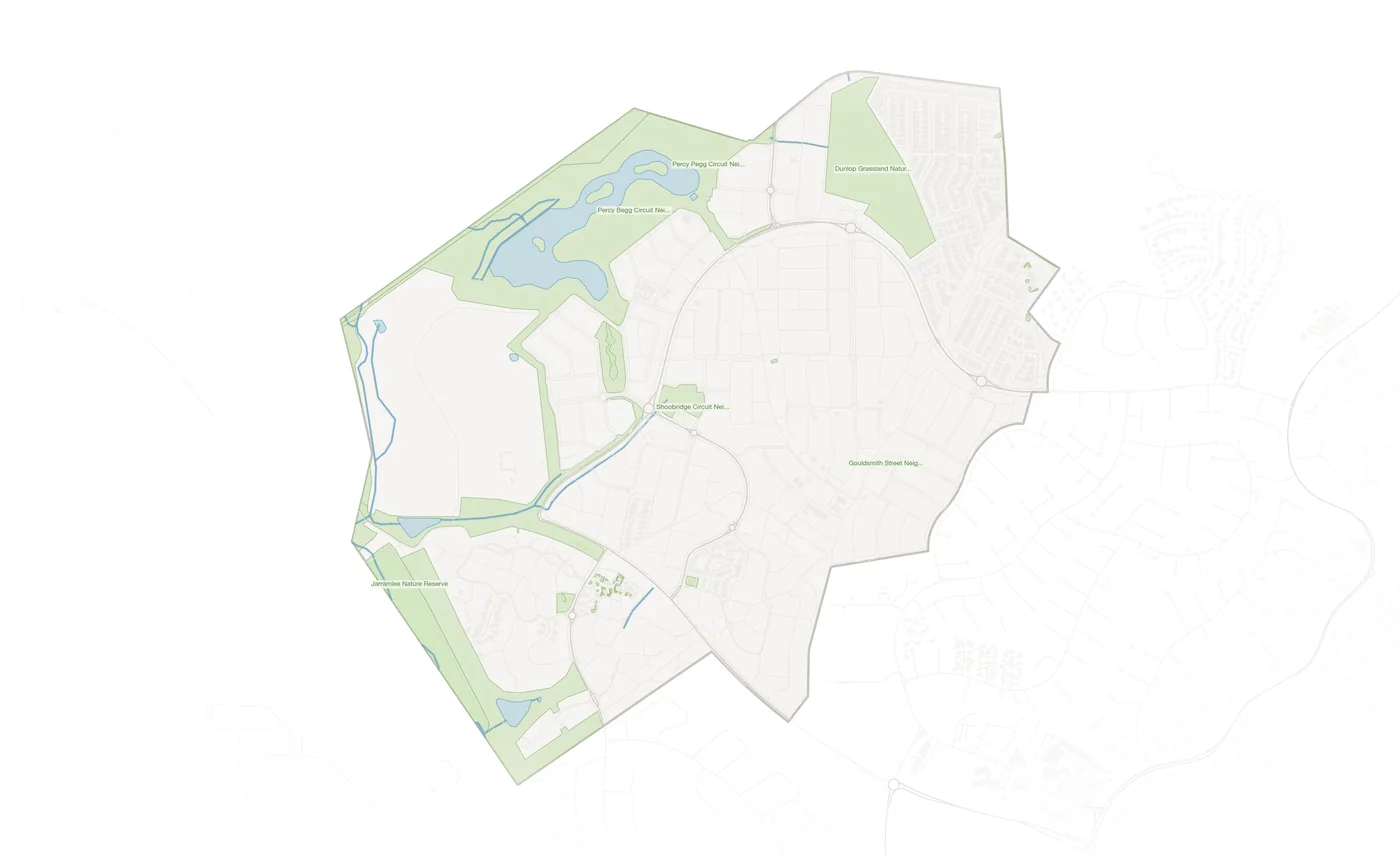
Explore Dunlop on the Map
View parcels, zoning overlays, DA applications, schools and more.
Open Interactive Map