Greenfields
Nearly half of Greenfields' residents sit outside the labour force (3,796 people), and the 10.2% unemployment rate among those who do participate runs more than double the national average. Household incomes at $1,004/week place the suburb in the 12.8th percentile nationally, yet 73.3% of households own or are purchasing their home, a rate well above the national average. The median age of 47 is 7 years above the national figure, and the senior share expanded by 4.8 percentage points over the decade. SEIFA readings are uniformly low: IRSAD decile 1, IRSD decile 1, and IEO decile 1, making Greenfields one of the most disadvantaged postcodes in Western Australia by every composite measure.
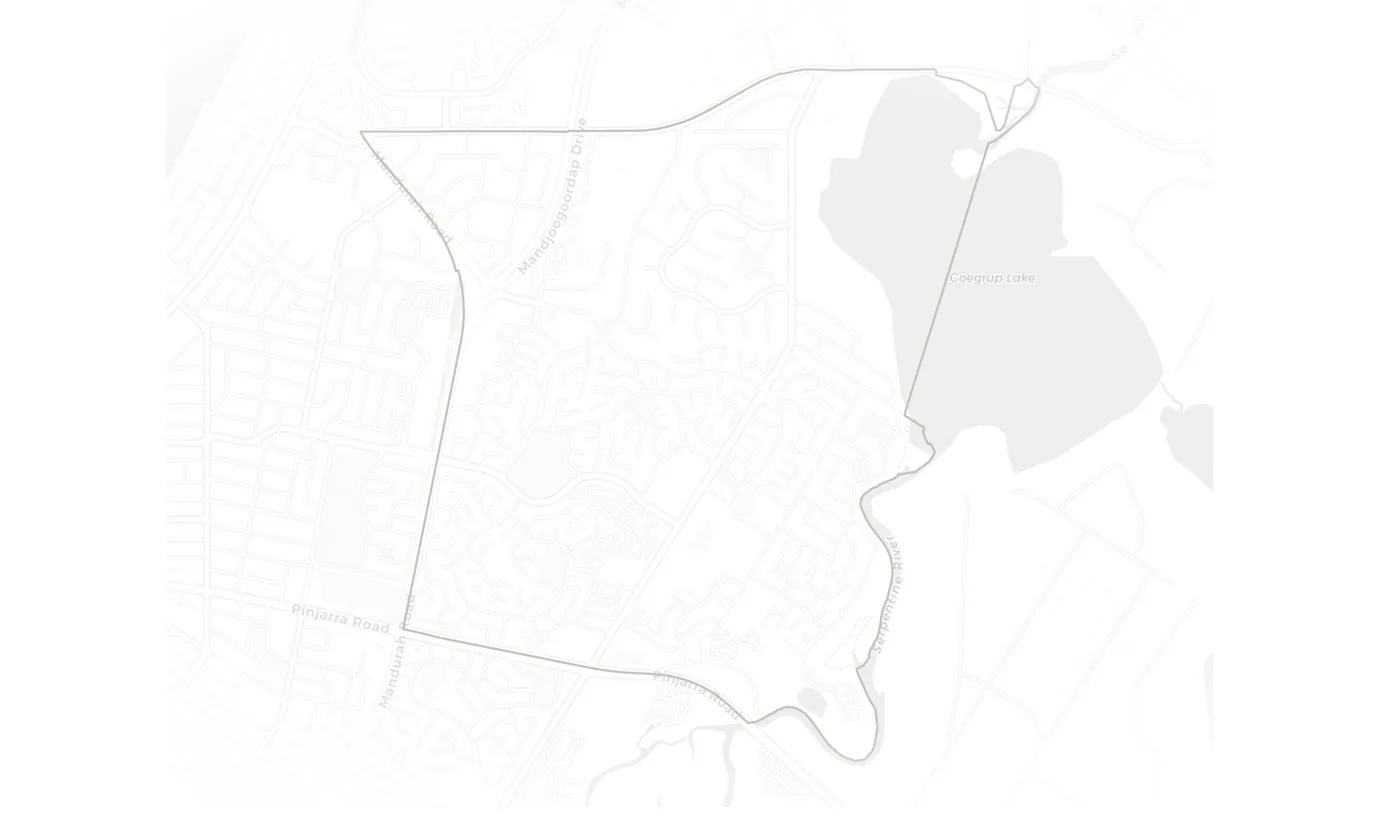
Population
9,869
Median Age
47.0
Household IncomeiMedian weekly household income (ABS Census)
$1,004/wk
DAs (12 months)iDevelopment Applications lodged in the past year
0
Median House
$363K
Estimated from rent (2025)
At an estimated $363,000, the median house price sits well below the national median, making Greenfields one of the more accessible entry points in the Mandurah corridor. Detached houses dominate at 77.5%, with 42.1% of stock having four or more bedrooms, meaning family-sized homes are the norm rather than a premium segment. Monthly mortgage repayments of $1,387 produce a mortgage-to-income ratio of 31.9%, which crosses the stress threshold despite low absolute prices, because household incomes ($1,004/week) rank in the bottom 13th percentile nationally. Semi-detached dwellings at 21.9% provide an alternative for downsizers, and 35.0% own outright, reflecting the suburb's established, aging ownership base.
For Buyers
At an estimated $363,000, the median house price sits well below the national median, making Greenfields one of the more accessible entry points in the Mandurah corridor. Detached houses dominate at 77.5%, with 42.1% of stock having four or more bedrooms, meaning family-sized homes are the norm rather than a premium segment. Monthly mortgage repayments of $1,387 produce a mortgage-to-income ratio of 31.9%, which crosses the stress threshold despite low absolute prices, because household incomes ($1,004/week) rank in the bottom 13th percentile nationally. Semi-detached dwellings at 21.9% provide an alternative for downsizers, and 35.0% own outright, reflecting the suburb's established, aging ownership base.
For Investors
The 26.7% renter share is below the national average, and a vacancy rate of 9.3% is alarmingly high, suggesting landlords face extended void periods. Median weekly rent of $295 against a $363,000 estimated median produces a gross yield around 4.2%, above average nationally but offset by that vacancy risk. Population growth of 0.54% per year (60 persons) is modest, driven primarily by internal migration averaging 160 arrivals per year. With zero development applications in the past 12 months, no new supply pipeline exists to compete with existing stock, but demand-side weakness keeps absorption slow.
Schools in Greenfields iICSEA: school advantage index. 1000 = national avg, higher = more advantaged
Foundation Christian College
PP-12 · 714 students
Riverside Primary School
K-6 · 449 students
Greenfields Primary School
K-6 · 427 students
Demographics
English ancestry leads overwhelmingly at 4,716, followed by Scottish (885) and Irish (830), creating a strongly Anglo-Celtic profile. Only 23.9% were born overseas, just 2.3 percentage points above the national average. University qualifications at 13.5% sit 16.6 points below the national rate, consistent with the IEO decile 1 reading. The median age of 47 is 7 years above the national baseline, and couples without children (32.5%) now outnumber couples with children, a demographic tilt that accelerated as the young share contracted by 2.1 percentage points over the decade. Average household size of 2.3 falls below the national 2.5.
Age Distribution
Bedrooms
Dwelling Structure
77.5%
Houses
21.9%
Townhouse
0.6%
Apartment
Tenure
Ownership is split between 35.0% outright and 38.3% with a mortgage, while renters comprise 26.7%. Detached houses at 77.5% dominate, with semi-detached at 21.9% and apartments nearly absent at 0.6%. Three-bedroom homes (40.5%) and four-plus-bedroom homes (42.1%) account for 82.6% of all stock, so smaller downsizer product is scarce. The $363,000 estimated median is derived from rental data because sales volume data is limited. The mortgage-to-income ratio of 31.9% exceeds the 30% stress benchmark, a paradox for a low-price suburb explained by the equally low income base at the 12.8th household percentile.
Mortgage / mo
$1,387
Rent / wk
$295
HH Size
2.3
Personal Income / wk
$540
Vacancy Ratei% of dwellings unoccupied on Census night (ABS 2021)
9.3%
Unoccupied
418
Rent / IncomeiMedian rent as % of household income. Over 30% = housing stress
29.4%
Mortgage / IncomeiMedian mortgage as % of household income. Over 30% = housing stress
31.9% stressed
Community Profile
Languages Spoken at Home
Ancestry
Household Composition
32.5%
Couples, no children
7,203
Total families
Economy & Employment
Healthcare leads employment at 19.6% (388 workers), followed by Education at 10.8% and Mining at 10.2%, the latter reflecting Mandurah's role as a FIFO dormitory for WA's resource sector. The occupation profile skews blue-collar: Community/Personal (532), Machinery/Drivers (491), and Labourers (484) rank above Professionals (365). Full-time employment at 58.1% is lower than the national average, and participation at 43.3% is notably weak, partly because 9.8% of the population (901 people) need assistance with daily tasks. The SEIFA IER decile 3 reading reflects limited economic resources relative to most Australian suburbs.
Unemployment
5.0%
Labour Force
4,557
Unemployed
230
Quarterly Trend
Source: SALM Dec-25
Socio-Economic Indexes (SEIFA)iABS index ranking suburbs from 1 (most disadvantaged) to 10 (most advantaged)
Full-time
58.1%
Part-time
31.7%
Participation
43.3%
Employed
3,177
Occupations
Top Industries
University
13.5%
Postgraduate
2.0%
Born Overseas
23.9%
Dwellings
4,057
Transport to Work
Three schools serve the suburb: Foundation Christian College (Independent, ICSEA 1,037, 714 students) sits above the national 1,000 benchmark, while Riverside Primary (933, 449 students) and Greenfields Primary (928, 427 students) rank below average. Car dependence is extreme at 85.5%, with public transport at 5.2% and walking/cycling at just 2.6%, all well below national urban averages. The IRSAD decile 1 confirms broad disadvantage, though the IER decile 3 suggests marginally better economic resource access than the education and disadvantage indices imply. Volunteering at 13.4% and rent-to-income at 29.4% sit close to the national median.
Drive
85.5%
Public Transport
5.2%
Walk / Cycle
2.6%
Work from Home
N/A
Population Forecast
+0.54%/yr
(+60 people/yr)
EstablishedPopulation grew by 0.54% per year (60 persons) over recent years, with the 2025 estimate reaching 11,011. Internal migration adds an average of 160 people annually, supplemented by 70 overseas arrivals. However, the 10-year population change was negative 0.7%, meaning recent growth is a reversal of prior contraction. The suburb sits on an aging trajectory: senior share expanded by 4.8 percentage points while the young share shrank by 2.1 points. Gentrification signals are minimal at a score of 20, with early signs limited to the internal migration inflow. Medium-term forecasts project the population reaching approximately 11,077 by 2031.
Historical + Forecast
Hamilton-Perry + Holt smoothing on ERP 2001-2025
Age Cohort Forecast
Primary Driver
Internal Migration
Net Overseas / yr
+70
Net Internal / yr
+160
Gentrification Signal
Early signs
Net internal migration +160/yr
National Ranking iPercentile rank among ~15,000 AU suburbs. 90% = higher than 90% of suburbs
How Greenfields compares to ~15,000 Australian suburbs
Frequently Asked Questions
Is Greenfields a good suburb to live in?
Greenfields suits buyers prioritising affordability over amenity, with an estimated median of $363,000 and 77.5% detached housing. The IRSAD decile 1 rating signals significant socioeconomic disadvantage, and the 10.2% unemployment rate is well above the national average. Car dependence at 85.5% means a vehicle is essential for daily commuting.
What is the median house price in Greenfields?
The estimated median is $363,000, derived from rental data. Monthly mortgage repayments average $1,387, but the mortgage-to-income ratio of 31.9% exceeds the 30% stress threshold because household incomes ($1,004/week) sit in the 12.8th percentile nationally. Median weekly rent is $295.
What schools are in Greenfields?
Three schools operate in Greenfields. Foundation Christian College (Independent Combined, ICSEA 1,037, 714 students) performs above the national 1,000 ICSEA benchmark. Riverside Primary School (Government, 933, 449 students) and Greenfields Primary School (Government, 928, 427 students) sit below the benchmark.
Is Greenfields safe?
Crime-specific data is not available in the current dataset. The IRSD decile 1 rating indicates high relative disadvantage, which typically correlates with higher property crime rates nationally. The 9.3% vacancy rate and 10.2% unemployment are indirect signals of socioeconomic stress that can influence safety perceptions.
Is Greenfields good for property investment?
Gross rental yield around 4.2% ($295/week on $363,000) is above the national median, but the 9.3% vacancy rate is a critical concern that erodes effective returns. Growth is modest at 0.54% per year (60 persons), and zero development applications were lodged in the past 12 months, indicating limited market activity. The low price base offers capital upside if the Mandurah region's fundamentals improve.
How is Greenfields's population changing?
The population is growing slowly at 0.54% per year (60 persons), reaching an estimated 11,011 in 2025. Over the decade, the population declined 0.7%, so current growth represents a reversal. The median age of 47 is 7 years above national, with the senior share expanding by 4.8 percentage points, placing Greenfields on a clear aging trajectory.
How to read these comparisons
Phrases like "above the national average" reference the unweighted median across Australian suburbs with more than 1,000 residents, not population-weighted national figures. Suburb-level medians are more useful for ranking suburbs against each other; ABS census headlines are population-weighted (so dominated by Sydney and Melbourne) and can read very differently.
Current baseline (refreshed 2026-05-10): median age 40, university-educated 30.1%, born overseas 21.6%, average household size 2.5 people.
Data sources: ABS 2021 Census (demographics, income, tenure), state Valuer-General (house prices), Department of Jobs SALM (unemployment), ACARA (school ICSEA), state Crime Statistics agencies (offences), council DA portals (development applications). Population forecasts use a Hamilton-Perry cohort model calibrated to ABS ERP.
Explore Greenfields on the Map
View parcels, zoning overlays, DA applications, schools and more.
Open Interactive Map