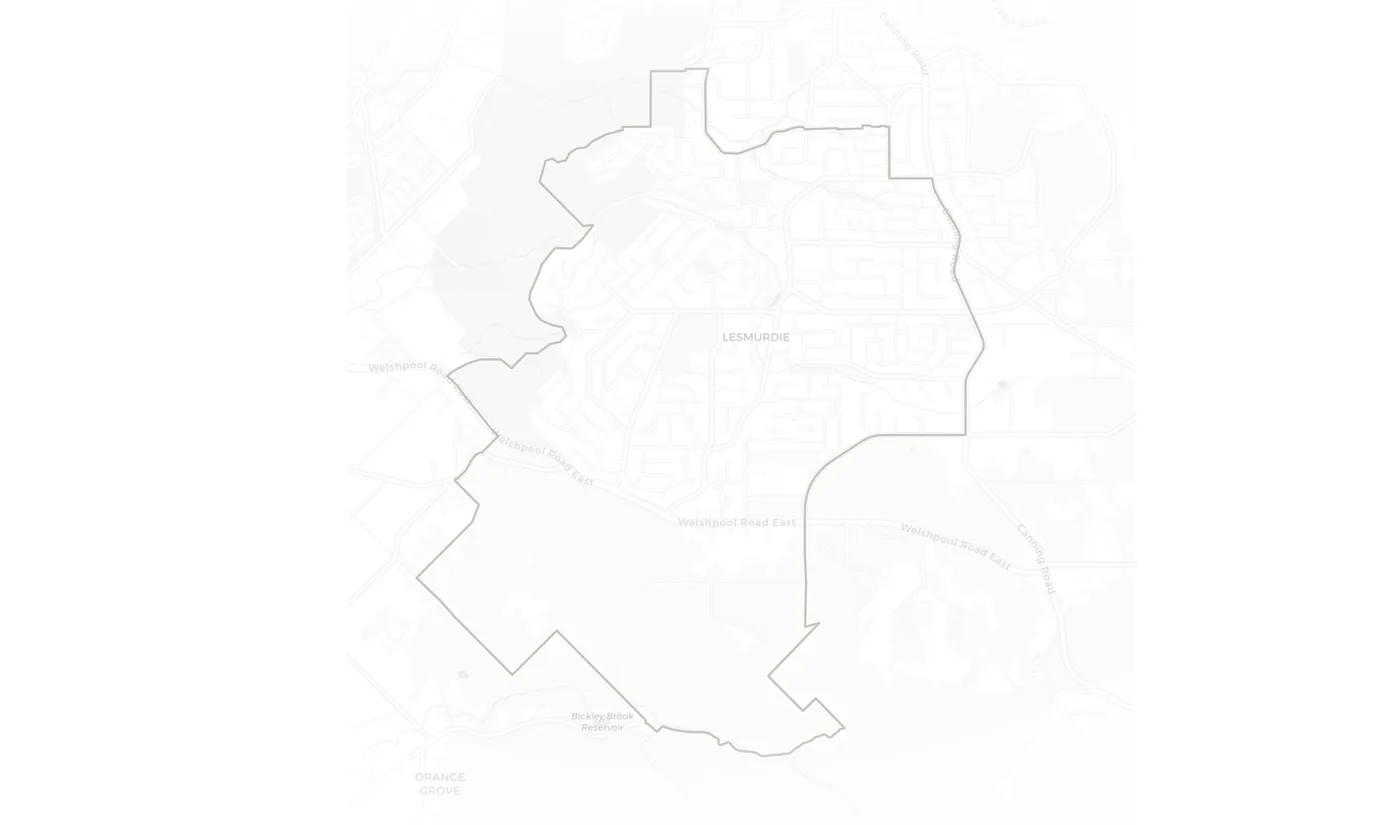
Lesmurdie
Four-bedroom-plus homes make up 64.5% of Lesmurdie's housing stock, the highest large-home concentration in this cohort by a wide margin, reflecting a bush-setting suburb where blocks are generous and families build big. Nearly all housing is detached (95.8%), with apartments at just 0.3%. Despite household incomes in the 78th percentile nationally, the estimated median house price of $482,000 creates an unusually favourable wealth-to-cost ratio. Mining employs 9.5% of the workforce, a WA signature that brings above-average incomes to a suburb that would otherwise resemble a typical middle-ring community. The 23.4% volunteering rate is the highest in this batch, well above the national average.
Population
8,413
Median Age
44.0
Household IncomeiMedian weekly household income (ABS Census)
$2,083/wk
DAs (12 months)iDevelopment Applications lodged in the past year
0
Median House
$482K
Estimated from rent (2025)
At an estimated $482,000, Lesmurdie offers large family homes at well below the Perth metro median. Detached houses at 95.8% and 64.5% being 4+ bedrooms mean buyers get substantial property for the price. Mortgage repayments of $2,100 per month against household income of $2,083 per week produce a mortgage-to-income ratio of 23.3%, firmly below the stress threshold. An exceptional 46.6% of residents carry mortgages and 43.3% own outright, giving a combined 89.9% ownership rate. The 10.2% renter share is the lowest in this cohort. This is a suburb of committed homeowners. Affordability improved over the decade (48.4% to 43.4% price-to-income ratio).
For Buyers
At an estimated $482,000, Lesmurdie offers large family homes at well below the Perth metro median. Detached houses at 95.8% and 64.5% being 4+ bedrooms mean buyers get substantial property for the price. Mortgage repayments of $2,100 per month against household income of $2,083 per week produce a mortgage-to-income ratio of 23.3%, firmly below the stress threshold. An exceptional 46.6% of residents carry mortgages and 43.3% own outright, giving a combined 89.9% ownership rate. The 10.2% renter share is the lowest in this cohort. This is a suburb of committed homeowners. Affordability improved over the decade (48.4% to 43.4% price-to-income ratio).
For Investors
With only 10.2% renting, Lesmurdie has the smallest tenant pool in this analysis, making it unsuitable for yield-focused investment. Weekly rent of $350 against the estimated $482,000 median produces a gross yield around 3.8%, modest in absolute terms. The 6.5% vacancy rate is elevated relative to the tiny rental stock. Zero development applications in 12 months means no new supply is coming, which could theoretically support values. Population grows at only 0.28% per year (35 people), providing minimal demand growth. This is a hold-value suburb for owner-occupiers, not an investor market.
Schools in Lesmurdie iICSEA: school advantage index. 1000 = national avg, higher = more advantaged
Falls Road Primary School
K-6 · 298 students
Mazenod College
7-12 · 862 students
St Brigid's College
PP-12 · 812 students
Lesmurdie Primary School
K-6 · 304 students
Lesmurdie Senior High School
7-12 · 976 students
Demographics
English ancestry leads strongly at 3,853 (46%), followed by Irish (994), Scottish (907), and Italian (725). The 27.9% overseas-born rate sits 6.3 points above national, though linguistic diversity is low: Italian (53), Afrikaans (28), German (23), and French (21) are the top non-English languages, reflecting European rather than Asian migration. University attainment of 32.1% is 2.0 points above the national rate. The median age of 44 is 4 years above national, and the senior share grew 5.9 percentage points over the decade, the largest senior expansion in this cohort. Average household size of 2.8 exceeds the national 2.5, consistent with larger family homes.
Age Distribution
Bedrooms
Dwelling Structure
95.8%
Houses
3.6%
Townhouse
0.3%
Apartment
Tenure
Detached houses account for 95.8% of dwellings, with semi-detached at 3.6% and apartments negligible at 0.3%. This is the most house-dominant profile in this entire analysis. The 64.5% share of 4+ bedroom homes vastly exceeds any other suburb here. Just 28.3% are 3-bedroom and 5.0% are 2-bedroom. Ownership is remarkably high: 43.3% outright and 46.6% mortgaged, totalling 89.9%, well above the national average. Only 10.2% rent. Mortgage stress at 23.3% and rent stress at 16.8% are both comfortable. The 83.7% residential stability rate (those who stayed at the same address) is among the highest in this batch. Affordability improved from 48.4% to 43.4% price-to-income over the decade.
Mortgage / mo
$2,100
Rent / wk
$350
HH Size
2.8
Personal Income / wk
$804
Vacancy Ratei% of dwellings unoccupied on Census night (ABS 2021)
6.5%
Unoccupied
199
Rent / IncomeiMedian rent as % of household income. Over 30% = housing stress
16.8%
Mortgage / IncomeiMedian mortgage as % of household income. Over 30% = housing stress
23.3%
Community Profile
Languages Spoken at Home
Ancestry
Household Composition
25.8%
Couples, no children
6,993
Total families
Economy & Employment
Education leads at 16.4% (457 workers), followed by healthcare at 13.6% (380), mining at 9.5% (264), construction at 9.4% (261), and professional services at 8.6% (240). The 9.5% mining share is a distinctive WA feature, bringing FIFO-adjacent incomes that support the high ownership rate. Professionals lead occupations (992), followed by clerical workers (556) and managers (546). Unemployment at 3.9% is below the national average, and the SEIFA profile is strong: IER decile 9 (economic resources, top 20%), IRSD decile 9, and IRSAD decile 8. This indicates a suburb with both high incomes and accumulated wealth, unlike places where one trails the other.
Unemployment
2.0%
Labour Force
6,820
Unemployed
133
Quarterly Trend
Source: SALM Dec-25
Socio-Economic Indexes (SEIFA)iABS index ranking suburbs from 1 (most disadvantaged) to 10 (most advantaged)
Full-time
59.9%
Part-time
36.2%
Participation
58.7%
Employed
3,838
Occupations
Top Industries
University
32.1%
Postgraduate
6.1%
Born Overseas
27.9%
Dwellings
2,836
Transport to Work
Five schools serve the area: Falls Road Primary (government, ICSEA 1067, 298 students), Mazenod College (independent secondary, ICSEA 1060, 862), St Brigid's College (independent combined, ICSEA 1060, 812), Lesmurdie Primary (government, ICSEA 1049, 304), and Lesmurdie Senior High (government secondary, ICSEA 1028, 976). All five score above the national median of 1000. Public transport usage is low at 2.9%, with 90.8% driving, reflecting the hills-district location. The SEIFA IRSAD decile of 8 and IER decile of 9 confirm above-average to strong socioeconomic conditions. The 23.4% volunteering rate is nearly double the national average.
Drive
90.8%
Public Transport
2.9%
Walk / Cycle
1.8%
Work from Home
N/A
Population Forecast
+0.28%/yr
(+35 people/yr)
EstablishedPopulation is growing very slowly at 0.28% per year, adding just 35 residents annually. Net overseas migration of 92 per year is partially offset by a small internal inflow of 10. Medium projections show 12,502 by 2031, up modestly from 12,420 in 2025. The gentrification score of 3 confirms the suburb is not gentrifying because it is already affluent. The defining trend is aging: the senior share expanded 5.9 percentage points (the largest in this batch), while the working-age share contracted 3.1 points. Real income grew just 2.2% over the decade, the lowest in this cohort and well below the national average, suggesting the high-income base has plateaued.
Historical + Forecast
Hamilton-Perry + Holt smoothing on ERP 2001-2025
Age Cohort Forecast
Primary Driver
Overseas Migration
Net Overseas / yr
+92
Net Internal / yr
+10
Gentrification Signal
Not gentrifying
National Ranking iPercentile rank among ~15,000 AU suburbs. 90% = higher than 90% of suburbs
How Lesmurdie compares to ~15,000 Australian suburbs
Frequently Asked Questions
Is Lesmurdie a good suburb to live in?
Lesmurdie excels for families wanting large homes (64.5% are 4+ bedrooms) in a bush setting at an affordable $482,000 estimated median. Five schools all score above the national ICSEA median. Mortgage stress at 23.3% is comfortable. SEIFA decile 8-9 scores and 23.4% volunteering rate indicate strong community. The trade-off is car dependency (90.8% drive) and aging demographics.
What is the median house price in Lesmurdie?
The estimated median house price is $482,000 (derived from rental data, 2025). Detached houses make up 95.8% of stock, with 64.5% having 4+ bedrooms. Monthly mortgage repayments average $2,100. The mortgage-to-income ratio of 23.3% sits well below the 30% stress threshold, making Lesmurdie accessible for dual-income households.
What schools are in Lesmurdie?
Lesmurdie has 5 schools, all above the national ICSEA median: Falls Road Primary (government, 1067, 298 students), Mazenod College (independent secondary, 1060, 862), St Brigid's College (independent combined, 1060, 812), Lesmurdie Primary (government, 1049, 304), and Lesmurdie Senior High (government, 1028, 976). Total combined enrolment exceeds 3,200.
Is Lesmurdie safe?
Specific crime statistics are not available for Lesmurdie. The SEIFA IER decile of 9 (top 20% for economic resources), IRSD decile of 9, 3.9% unemployment, and 89.9% home ownership rate are all strong indicators of low-risk conditions. The 23.4% volunteering rate and 83.7% residential stability further suggest a settled, engaged community.
Is Lesmurdie good for property investment?
Lesmurdie is unsuitable for rental investment: only 10.2% of residents rent, vacancy is 6.5%, and zero development applications were lodged in 12 months. Gross yield is approximately 3.8% ($350 weekly on $482,000). Population growth of 0.28% per year is negligible. This is a buy-and-hold owner-occupier market, not a yield or growth play.
How is Lesmurdie's population changing?
Population is nearly static, growing 0.28% per year (35 people annually). The dominant trend is aging: the senior share grew 5.9 percentage points over the decade, the largest expansion in this analysis. Working-age share contracted 3.1 points. Real income grew just 2.2%. Net overseas migration of 92 per year provides the main population input. Projections show 12,502 by 2031, barely changed from 12,420.
How to read these comparisons
Phrases like "above the national average" reference the unweighted median across Australian suburbs with more than 1,000 residents, not population-weighted national figures. Suburb-level medians are more useful for ranking suburbs against each other; ABS census headlines are population-weighted (so dominated by Sydney and Melbourne) and can read very differently.
Current baseline (refreshed 2026-05-10): median age 40, university-educated 30.1%, born overseas 21.6%, average household size 2.5 people.
Data sources: ABS 2021 Census (demographics, income, tenure), state Valuer-General (house prices), Department of Jobs SALM (unemployment), ACARA (school ICSEA), state Crime Statistics agencies (offences), council DA portals (development applications). Population forecasts use a Hamilton-Perry cohort model calibrated to ABS ERP.
Explore Lesmurdie on the Map
View parcels, zoning overlays, DA applications, schools and more.
Open Interactive Map