Mirrabooka
Over 55% of Mirrabooka residents were born overseas, placing it 34 percentage points above the national average and making it one of Perth's most culturally concentrated suburbs. Despite household incomes sitting at the 29th percentile nationally, housing stress remains contained with mortgage-to-income at 27.2% and rent-to-income at 22.9%. The median house price of $372,000 reflects affordability well below the Perth metro median, supported by a housing stock that is 85.5% detached houses. Healthcare employs 21.9% of workers, more than double the next sector.
Population
8,000
Median Age
36.0
Household IncomeiMedian weekly household income (ABS Census)
$1,267/wk
DAs (12 months)iDevelopment Applications lodged in the past year
23
Median House
$372K
Estimated from rent (2025)
At $372,000 estimated median, Mirrabooka sits well below Perth's broader median and offers genuine entry-level pricing for detached housing. The stock is overwhelmingly freestanding (85.5% separate houses) with 48.4% having 3 bedrooms and 38.5% with 4 or more, suiting families on moderate budgets. Mortgage repayments average $1,493 per month, translating to a 27.2% mortgage-to-income ratio, which is lower than the 30% stress threshold. With an average household size of 3.0 (0.5 above the national average), the suburb attracts larger family units rather than downsizers or singles.
For Buyers
At $372,000 estimated median, Mirrabooka sits well below Perth's broader median and offers genuine entry-level pricing for detached housing. The stock is overwhelmingly freestanding (85.5% separate houses) with 48.4% having 3 bedrooms and 38.5% with 4 or more, suiting families on moderate budgets. Mortgage repayments average $1,493 per month, translating to a 27.2% mortgage-to-income ratio, which is lower than the 30% stress threshold. With an average household size of 3.0 (0.5 above the national average), the suburb attracts larger family units rather than downsizers or singles.
For Investors
Rental yields look reasonable with weekly rent at $290 against a $372,000 median price, implying a gross yield around 4.1%, higher than many inner Perth suburbs. The 31.5% renter share provides a solid tenant pool, though the 6.8% vacancy rate sits above the Perth average and warrants caution on tenant turnover. With 20 development applications in the past 12 months, construction activity is modest. The suburb's affordability and proximity to Mirrabooka Square shopping centre underpin baseline demand, but income growth has been limited, with household incomes at just the 28.5th percentile nationally.
Development Activity
Total DAs
23
Last 12 Months
23
YoY ChangeiYear-over-year change in DA lodgements
—
Avg DA CostiAverage estimated cost per DA in the past year
N/A
Monthly DA Lodgements
DA Categories
Schools in Mirrabooka iICSEA: school advantage index. 1000 = national avg, higher = more advantaged
John Septimus Roe Anglican Community School
PP-12 · 1702 students
Boyare Primary School
K-6 · 176 students
Dryandra Primary School
K-6 · 176 students
Demographics
Mirrabooka's overseas-born population (55.3%) ranks 34 percentage points above the national average, reflecting deep migrant settlement patterns. Arabic is the most spoken non-English language (382 speakers), followed by Macedonian (126) and Cantonese (63). English ancestry accounts for 1,133 residents, while Vietnamese (796) and Chinese (471) communities add cultural breadth. The median age of 36 is 4 years below the national median, and the university-educated share at 25.2% trails the national rate by 5 percentage points. Islam (1,781 adherents) sits alongside Christianity (3,046) and Buddhism (769) as a major faith.
Age Distribution
Bedrooms
Dwelling Structure
85.5%
Houses
13.5%
Townhouse
1.0%
Apartment
Tenure
The $372,000 estimated median is derived from rent benchmarks, as sale volume data is limited. Detached houses dominate at 85.5%, with semi-detached at 13.5% and apartments at just 1.0%, making this overwhelmingly a low-density suburb. Ownership patterns split three ways: 29.8% own outright, 38.7% carry a mortgage, and 31.5% rent. Three-bedroom homes account for 48.4% of stock, with 4-plus bedrooms at 38.5%. Rent-to-income sits at 22.9%, lower than the 30% stress benchmark, suggesting tenants can absorb current pricing without hardship.
Mortgage / mo
$1,493
Rent / wk
$290
HH Size
3.0
Personal Income / wk
$482
Vacancy Ratei% of dwellings unoccupied on Census night (ABS 2021)
6.8%
Unoccupied
182
Rent / IncomeiMedian rent as % of household income. Over 30% = housing stress
22.9%
Mortgage / IncomeiMedian mortgage as % of household income. Over 30% = housing stress
27.2%
Community Profile
Languages Spoken at Home
Ancestry
Household Composition
14.9%
Couples, no children
6,606
Total families
Economy & Employment
Healthcare dominates local employment at 21.9% (330 workers), roughly 2.5 times larger than the next sectors: Retail and Education at 8.4% each. Construction (8.2%) and Manufacturing (7.8%) round out the top 5. The occupational profile skews blue-collar, with Labourers (632) the largest group, followed by Community and Personal Service workers (500) and Machinery Operators (346). Unemployment at 9.7% is nearly double the national average, and the participation rate of 50.7% is notably low, with 2,564 people not in the labour force. All four SEIFA deciles sit at 1 or 2, placing Mirrabooka in the most disadvantaged bracket nationally.
Socio-Economic Indexes (SEIFA)iABS index ranking suburbs from 1 (most disadvantaged) to 10 (most advantaged)
Full-time
57.8%
Part-time
32.5%
Participation
50.7%
Employed
2,892
Occupations
Top Industries
University
25.2%
Postgraduate
3.7%
Born Overseas
55.3%
Dwellings
2,476
Transport to Work
Public transport usage is very low at 3.6%, with 86.2% commuting by car. Walking and cycling combined account for just 1.4%, below the national average. School options include John Septimus Roe Anglican Community School (Combined, Independent, ICSEA 1,075, 1,702 students), which scores well above the national ICSEA benchmark of 1,000. Two government primaries, Boyare and Dryandra (ICSEA 887 and 883), sit below the benchmark, reflecting the suburb's socioeconomic profile. Mirrabooka Square provides shopping and services locally. Need-for-assistance rates at 7.6% are higher than the national average.
Drive
86.2%
Public Transport
3.6%
Walk / Cycle
1.4%
Work from Home
N/A
National Ranking iPercentile rank among ~15,000 AU suburbs. 90% = higher than 90% of suburbs
How Mirrabooka compares to ~15,000 Australian suburbs
Frequently Asked Questions
Is Mirrabooka a good suburb to live in?
Mirrabooka suits budget-conscious families seeking detached housing at $372,000 median, well below Perth's metro median. Mortgage stress is contained at 27.2% of income, and the suburb has strong cultural diversity with 55% born overseas. SEIFA scores in decile 1 indicate higher disadvantage than average, which affects services and infrastructure.
What is the median house price in Mirrabooka?
The estimated median house price is $372,000 (derived from 2025 rent benchmarks). Weekly rent averages $290, and monthly mortgage repayments sit around $1,493, giving a mortgage-to-income ratio of 27.2%.
What schools are in Mirrabooka?
Mirrabooka has 3 schools. John Septimus Roe Anglican Community School (Combined, Independent) leads with an ICSEA of 1,075 and 1,702 enrolments. Boyare Primary (Government, ICSEA 887, 176 students) and Dryandra Primary (Government, ICSEA 883, 176 students) serve the local primary catchment.
Is Mirrabooka safe?
Crime data is not available for Mirrabooka in the current dataset. The suburb's SEIFA disadvantage decile of 1 (lowest 10% nationally) correlates with higher-than-average crime in similar suburbs. The 9.7% unemployment rate, roughly double the national average, is a factor to consider.
Is Mirrabooka good for property investment?
At $290 weekly rent against a $372,000 median, the implied gross yield is around 4.1%, above many inner Perth suburbs. The 31.5% renter share provides tenant demand, but a 6.8% vacancy rate and household incomes at the 29th percentile limit rent growth potential. Capital gains prospects are modest given SEIFA decile 1 positioning.
How is Mirrabooka's population changing?
The current Census population is 8,000 with a median age of 36, which is 4 years below the national median. Residential turnover is low at 13.4%, indicating stability. With 55.3% born overseas (34pp above national average), the suburb continues to attract migrant families priced out of closer-in Perth markets.
What languages are spoken in Mirrabooka?
Arabic is the most spoken non-English language with 382 speakers, followed by Macedonian (126), Cantonese (63), Mandarin (34), and Serbian (32). Over 55% of residents were born overseas, placing the suburb 34 percentage points above the national average for overseas-born population.
How to read these comparisons
Phrases like "above the national average" reference the unweighted median across Australian suburbs with more than 1,000 residents, not population-weighted national figures. Suburb-level medians are more useful for ranking suburbs against each other; ABS census headlines are population-weighted (so dominated by Sydney and Melbourne) and can read very differently.
Current baseline (refreshed 2026-05-10): median age 40, university-educated 30.1%, born overseas 21.6%, average household size 2.5 people.
Data sources: ABS 2021 Census (demographics, income, tenure), state Valuer-General (house prices), Department of Jobs SALM (unemployment), ACARA (school ICSEA), state Crime Statistics agencies (offences), council DA portals (development applications). Population forecasts use a Hamilton-Perry cohort model calibrated to ABS ERP.
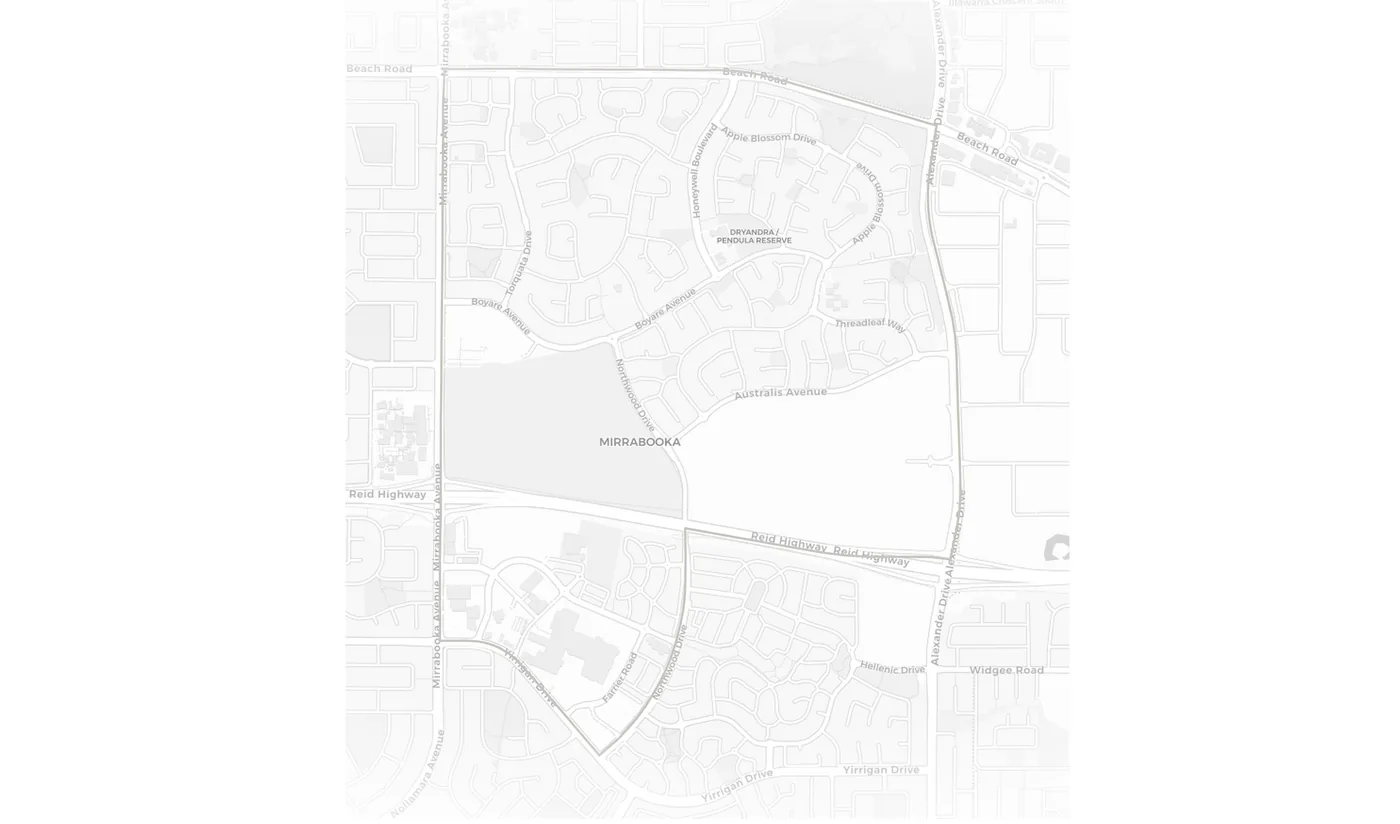
Explore Mirrabooka on the Map
View parcels, zoning overlays, DA applications, schools and more.
Open Interactive Map