Pink Lake
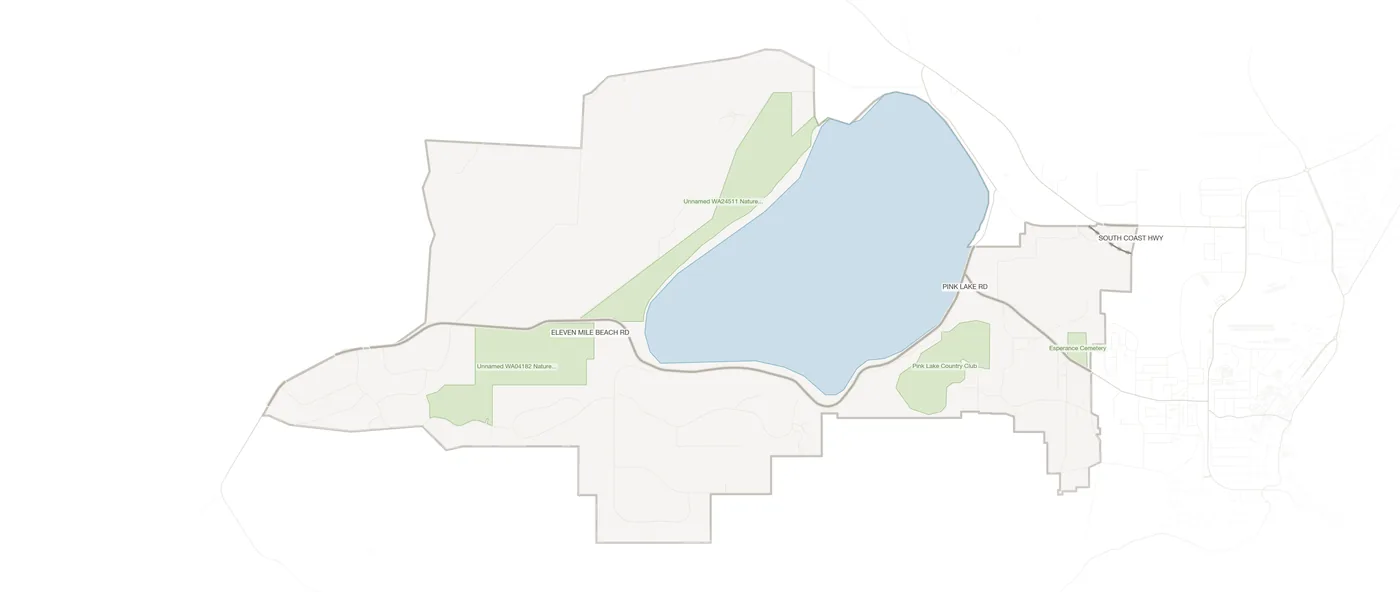
Pink Lake sits on the Esperance fringe with a population of just 1,042 across 42 sq km, giving it a low density of 24.7 people per km2, well below typical suburban averages. Despite a small headcount, household income ranks in the 65.5th percentile nationally, above the median for WA regional communities. Vacancy at 13.2% is the standout figure: one in eight dwellings sits unoccupied, which is high compared to metro Perth and signals a property market driven by owner-occupiers rather than rental demand. The suburb is almost entirely detached housing at 91.2%, and 46.9% of homes have four or more bedrooms, reflecting families in large lots rather than urban density.
Population
1,042
Median Age
43.0
Household IncomeiMedian weekly household income (ABS Census)
$1,817/wk
DAs (12 months)iDevelopment Applications lodged in the past year
0
Median House
$406K
Estimated from rent (2025)
The median house price is estimated at $406,000, a figure derived from rent data for 2025 given the suburb's small transaction volume. Monthly mortgage repayments average $1,733, producing a mortgage-to-income ratio of 22.0%, comfortably below the 30% stress threshold. Separate houses dominate at 91.2% of stock, and the bedroom profile is skewed large: 46.9% of dwellings have four or more bedrooms, compared to around 25% nationally. Outright owners (42.7%) nearly match mortgage holders (44.3%), suggesting a stable, established base of residents rather than a speculative market. At $406,000, Pink Lake is considerably cheaper than Perth metro medians, making it accessible to buyers priced out of coastal cities.
For Buyers
The median house price is estimated at $406,000, a figure derived from rent data for 2025 given the suburb's small transaction volume. Monthly mortgage repayments average $1,733, producing a mortgage-to-income ratio of 22.0%, comfortably below the 30% stress threshold. Separate houses dominate at 91.2% of stock, and the bedroom profile is skewed large: 46.9% of dwellings have four or more bedrooms, compared to around 25% nationally. Outright owners (42.7%) nearly match mortgage holders (44.3%), suggesting a stable, established base of residents rather than a speculative market. At $406,000, Pink Lake is considerably cheaper than Perth metro medians, making it accessible to buyers priced out of coastal cities.
For Investors
Rental conditions are the main caution for investors. Vacancy stands at 13.2%, high compared to the 2-3% range typical of tight WA rental markets, which means finding a tenant can take longer and downtime hits yield. Weekly rent is $300, and against a $406,000 median that implies a gross yield near 3.8%, modest by regional standards. The renting population is thin at 13.0%, meaning demand comes largely from a small pool. With zero development applications in the past 12 months and no known large-scale employment catalyst, capital growth catalysts are limited. The suburb's strongest investment case is affordability: entry cost is lower than most WA coastal towns, reducing downside risk on an absolute dollar basis.
Demographics
The median age of 43 is 3.0 years above the national figure, pointing to an older resident base, possibly reflecting retirees or long-tenure families. Overseas-born residents account for 17.3%, which is 4.3 percentage points below the national average, consistent with a predominantly Australian-born community. Ancestry is led by English (406 residents), followed by Irish (91) and Scottish (90), a strongly Anglo-Celtic profile. University qualifications are held by 16.5% of residents, which is 13.6 percentage points below the national figure, reflecting the workforce structure of a regional trade and services community. Average household size is 2.6, marginally above the national average, consistent with the large proportion of couples with children (367 families compared to 228 couples without children).
Age Distribution
Bedrooms
Dwelling Structure
91.2%
Houses
N/A
Townhouse
N/A
Apartment
Tenure
Tenure is unusual for a suburb with a 13.2% vacancy: 42.7% own outright and 44.3% carry a mortgage, leaving only 13.0% renting, far below national renter shares. This explains the vacancy rate, as empty dwellings likely include holiday homes and inherited properties rather than failed rental stock. The stock is almost entirely separate houses at 91.2%, with no recorded apartment or semi-detached component in the brief. Four-plus bedroom dwellings dominate at 46.9%, and three-bedroom homes add another 29.8%, so the typical Pink Lake home is a large detached house. Mortgage-to-income sits at 22.0% and rent-to-income at 16.5%, both below the 30% stress line, indicating repayments are manageable at current price and income levels.
Mortgage / mo
$1,733
Rent / wk
$300
HH Size
2.6
Personal Income / wk
$851
Vacancy Ratei% of dwellings unoccupied on Census night (ABS 2021)
13.2%
Unoccupied
52
Rent / IncomeiMedian rent as % of household income. Over 30% = housing stress
16.5%
Mortgage / IncomeiMedian mortgage as % of household income. Over 30% = housing stress
22.0%
Community Profile
Ancestry
Household Composition
30.0%
Couples, no children
759
Total families
Economy & Employment
Construction and Healthcare each account for 12.9% of the local workforce (40 workers apiece), followed by Education at 10.9% (34 workers) and Public Administration at 7.1%. By occupation, the suburb splits broadly between Machinery and Drivers (64), Labourers (63), Professionals (62) and Clerical/Admin (61), a more even spread than most suburbs, suggesting Pink Lake draws workers from Esperance's mixed service and trade economy. The unemployment rate is 3.5%, below the national benchmark, and the full-time employment rate of 65.4% is solid. Household weekly income of $1,817 places the suburb at the 65.5th percentile nationally, above the midpoint despite its regional location. Participation rate is 58.3%, reflecting the older age profile where 201 residents are not in the labour force.
Socio-Economic Indexes (SEIFA)iABS index ranking suburbs from 1 (most disadvantaged) to 10 (most advantaged)
Full-time
65.4%
Part-time
31.1%
Participation
58.3%
Employed
462
Occupations
Top Industries
University
16.5%
Postgraduate
2.4%
Born Overseas
17.3%
Dwellings
331
Transport to Work
Car dependence is near total: 88.4% of residents drive to work, well above the national average, and only 1.5% use public transport, consistent with a low-density suburban fringe without a train line or frequent bus service. Walking and cycling accounts for 3.1%. No schools are recorded within the Pink Lake boundary, so families rely on Esperance town schools nearby. Crime data is not available for this suburb. Housing stress is low on both measures: rent-to-income at 16.5% and mortgage-to-income at 22.0% both sit below the 30% threshold, meaning the cost of housing consumes a manageable share of income relative to national benchmarks. The need-assistance rate of 2.5% (23 residents) is in line with comparably sized regional communities.
Drive
88.4%
Public Transport
1.5%
Walk / Cycle
3.1%
Work from Home
N/A
National Ranking iPercentile rank among ~15,000 AU suburbs. 90% = higher than 90% of suburbs
How Pink Lake compares to ~15,000 Australian suburbs
Frequently Asked Questions
Is Pink Lake a good suburb to live in?
Pink Lake suits buyers seeking space and affordability. The median house price of $406,000 is low compared to Perth metro, mortgage-to-income sits at 22.0% (below the 30% stress line), and 91.2% of homes are detached houses with four-plus bedrooms making up 46.9% of stock. Car access is essential as public transport covers only 1.5% of commuters.
What is the median house price in Pink Lake?
The median house price is estimated at $406,000 based on 2025 rent data. Monthly mortgage repayments average $1,733. Rent-to-income is 16.5% and mortgage-to-income is 22.0%, both below the 30% stress threshold, making repayments manageable at current income levels.
What schools are in Pink Lake?
No schools are recorded within the Pink Lake boundary. With a population of 1,042 across 42 sq km, families rely on schools in nearby Esperance. The suburb's university qualification rate of 16.5% is 13.6 percentage points below the national figure, reflecting a trade and services workforce base.
Is Pink Lake safe?
Detailed crime statistics are not available for Pink Lake in this dataset. Indirect indicators suggest a stable community: 82.9% of residents stayed at the same address in the prior year, the volunteering rate is 27.7% (above typical metro levels), and only 2.5% of the 1,042 residents need daily assistance.
Is Pink Lake good for property investment?
The investment case is mixed. A $406,000 entry price is accessible compared to WA coastal towns, and a gross yield near 3.8% (weekly rent $300) beats metro inner-city returns. However, vacancy is 13.2%, well above the 2-3% range typical of tight WA markets, and the renter pool is thin at 13.0% of households.
How is Pink Lake's population changing?
Pink Lake has a population of 1,042 and shows high residential stability, with 82.9% of residents remaining at the same address year over year, above national norms. No formal growth forecast is available, but the older median age of 43 (3.0 years above national) and low renter share suggest limited in-migration pressure in the near term.
How to read these comparisons
Phrases like "above the national average" reference the unweighted median across Australian suburbs with more than 1,000 residents, not population-weighted national figures. Suburb-level medians are more useful for ranking suburbs against each other; ABS census headlines are population-weighted (so dominated by Sydney and Melbourne) and can read very differently.
Current baseline (refreshed 2026-05-10): median age 40, university-educated 30.1%, born overseas 21.6%, average household size 2.5 people.
Data sources: ABS 2021 Census (demographics, income, tenure), state Valuer-General (house prices), Department of Jobs SALM (unemployment), ACARA (school ICSEA), state Crime Statistics agencies (offences), council DA portals (development applications). Population forecasts use a Hamilton-Perry cohort model calibrated to ABS ERP.
Explore Pink Lake on the Map
View parcels, zoning overlays, DA applications, schools and more.
Open Interactive Map