Victoria Park
Net overseas migration of 642 per year against internal outflow of 176 per year makes Victoria Park one of Perth's most migration-dependent suburbs, with 46.1% born overseas. The dwelling mix is unusually distributed: 38.4% houses, 36.8% semi-detached and 24.6% apartments, a three-way split rarely seen elsewhere. Despite a gentrification score of 34 with early signs detected, the estimated $462,000 median keeps prices affordable, and rent-to-income at 18.9% is one of the lowest in this batch. Mining (9.0%) features in the top 5 industries, reflecting Perth's resources-sector proximity, but healthcare (15.8%) and professional services (14.0%) dominate.
Population
9,334
Median Age
35.0
Household IncomeiMedian weekly household income (ABS Census)
$1,828/wk
DAs (12 months)iDevelopment Applications lodged in the past year
0
Median House
$462K
Estimated from rent (2025)
The estimated $462,000 median makes Victoria Park affordable by Perth standards. The dwelling mix is evenly distributed: houses (38.4%), semi-detached (36.8%) and apartments (24.6%), giving buyers options across price points. Three-bedroom homes dominate at 47.2%, with two-bedrooms at 26.7%. Monthly mortgage repayments of $1,946 produce a mortgage-to-income ratio of 24.6%, comfortable. Only 25.8% hold mortgages and 20.3% own outright. Public transport at 21.1% is well above the national average, supported by proximity to Perth CBD and multiple bus routes. Walking/cycling at 4.7% and car driving at 68.3% reflect a walkable inner suburb.
For Buyers
The estimated $462,000 median makes Victoria Park affordable by Perth standards. The dwelling mix is evenly distributed: houses (38.4%), semi-detached (36.8%) and apartments (24.6%), giving buyers options across price points. Three-bedroom homes dominate at 47.2%, with two-bedrooms at 26.7%. Monthly mortgage repayments of $1,946 produce a mortgage-to-income ratio of 24.6%, comfortable. Only 25.8% hold mortgages and 20.3% own outright. Public transport at 21.1% is well above the national average, supported by proximity to Perth CBD and multiple bus routes. Walking/cycling at 4.7% and car driving at 68.3% reflect a walkable inner suburb.
For Investors
Renters at 54.0% provide a deep tenant pool, and median weekly rent of $345 against a $462,000 estimated price gives a gross yield of roughly 3.9%, above the national average. However, vacancy at 11.3% is elevated and suggests oversupply. Zero DAs in 12 months means no new supply pipeline, which should help absorb the existing vacancy over time. Net overseas migration of 642 per year is very strong, providing sustained demand. The 34.7% turnover rate is high, indicating a transient tenant base. Population growth at 1.72% per year (323 persons) is strong. Gentrification score of 34 suggests early-stage value uplift potential.
Development Activity
Total DAs
89
Last 12 Months
0
YoY ChangeiYear-over-year change in DA lodgements
—
Avg DA CostiAverage estimated cost per DA in the past year
N/A
Monthly DA Lodgements
Schools in Victoria Park iICSEA: school advantage index. 1000 = national avg, higher = more advantaged
Regent College
PP-6 · 340 students
Victoria Park Primary School
K-6 · 510 students
Ursula Frayne Catholic College
PP-12 · 1442 students
Victoria Park Christian School
PP-6 · 113 students
Demographics
English ancestry leads at 2,838, with Irish (873), Scottish (799) and Chinese (732) following. The 46.1% overseas-born rate is 24.5 points above the national average. University qualification at 50.4% is 20.3 points above national, and the IEO decile 9 confirms strong educational credentials. Mandarin (141), Nepali (121), Hindi (89), Italian (74) and Cantonese (60) lead non-English languages. Median age of 35 is 5 years below national. Male share at 51.8% is slightly above the national baseline. Average household size of 2.1 is below the national 2.5. Christianity (2,938), Hinduism (604) and Buddhism (402) are the main religions.
Age Distribution
Bedrooms
Dwelling Structure
38.4%
Houses
36.8%
Townhouse
24.6%
Apartment
Tenure
Ownership splits between 20.3% outright and 25.8% on mortgages, with renters dominant at 54.0%. The dwelling mix is unusually balanced: 38.4% houses, 36.8% semi-detached and 24.6% apartments. Three-bedroom homes at 47.2% dominate, with two-bedrooms at 26.7% and studios/one-bedrooms at 15.0%. The estimated $462,000 median is derived from rents. At household income of $1,828/week, the price-to-income ratio is approximately 4.9x annual income, below the 5x affordability benchmark and among the most affordable in this batch. Turnover at 34.7% is high, consistent with the renter-majority composition.
Mortgage / mo
$1,946
Rent / wk
$345
HH Size
2.1
Personal Income / wk
$1,047
Vacancy Ratei% of dwellings unoccupied on Census night (ABS 2021)
11.3%
Unoccupied
534
Rent / IncomeiMedian rent as % of household income. Over 30% = housing stress
18.9%
Mortgage / IncomeiMedian mortgage as % of household income. Over 30% = housing stress
24.6%
Community Profile
Languages Spoken at Home
Ancestry
Household Composition
39.3%
Couples, no children
5,979
Total families
Economy & Employment
Healthcare leads at 15.8% (672 workers), followed by professional/technical at 14.0% (593), education at 9.9% (420), mining at 9.0% (382) and hospitality at 7.4% (315). The mining presence at 9.0% is distinctive for an inner-city suburb and reflects Perth's resources economy, with FIFO workers choosing to live centrally. Professionals dominate at 1,873, with managers (648) and community/personal workers (639) following. Full-time employment at 65.6% is moderate, and participation at 69.0% is well above the national average. Unemployment at 4.9% is moderate. The IEO decile 9 confirms strong educational credentials.
Unemployment
3.4%
Labour Force
12,919
Unemployed
434
Quarterly Trend
Source: SALM Dec-25
Socio-Economic Indexes (SEIFA)iABS index ranking suburbs from 1 (most disadvantaged) to 10 (most advantaged)
Full-time
65.6%
Part-time
29.5%
Participation
69.0%
Employed
5,315
Occupations
Top Industries
University
50.4%
Postgraduate
15.8%
Born Overseas
46.1%
Dwellings
4,179
Transport to Work
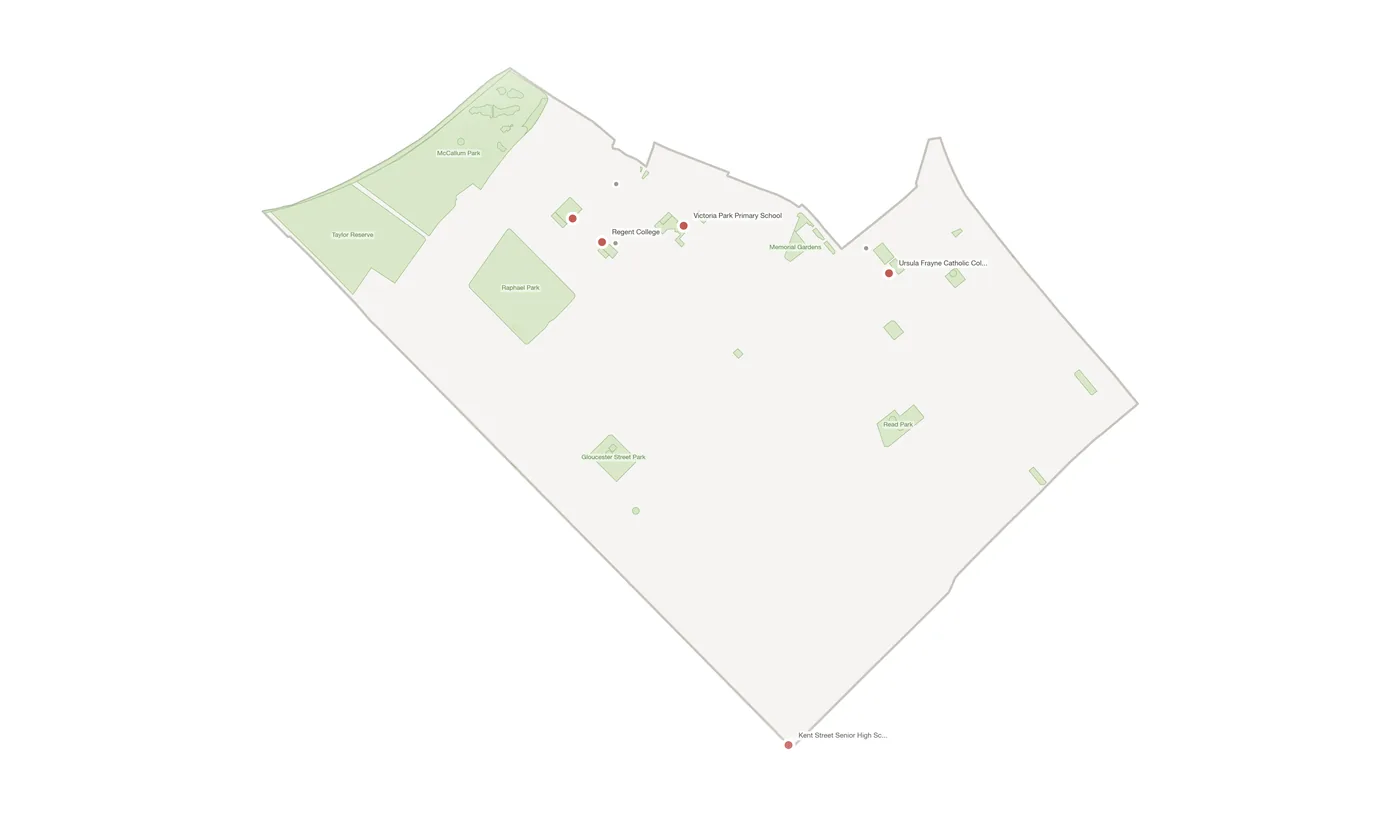
Public transport at 21.1% is well above the national average, supported by bus corridors and proximity to Perth CBD. Car driving at 68.3% is below the national rate, and walking/cycling at 4.7% is moderate. Victoria Park has 4 schools, all above the national benchmark: Regent College (ICSEA 1,142, 340 students, independent), Victoria Park Primary (ICSEA 1,127, 510 students, government), Ursula Frayne Catholic College (ICSEA 1,108, 1,442 students, Catholic) and Victoria Park Christian School (ICSEA 1,035, 113 students, independent). The IRSAD decile 8 and IRSD decile 8 confirm above-average advantage.
Drive
68.3%
Public Transport
21.1%
Walk / Cycle
4.7%
Work from Home
N/A
Population Forecast
+1.72%/yr
(+323 people/yr)
EstablishedPopulation growth averages 1.72% per year (323 persons), strong for an inner suburb. Net overseas migration of 642 per year is very high, the highest in this batch, while internal outflow of 176 per year is a secondary flow. The 10-year population change of 16.2% is above the national average. Historical population rose from 17,718 in 2023 to 18,736 in 2025. Medium projections reach 20,203 by 2031. The senior share expanded 3.3 points while working-age contracted 1.5 points, a modest aging signal. Gentrification score of 34 with early signs including accelerating growth (from 4% to 23% growth rate) and strong overseas inflow.
Historical + Forecast
Hamilton-Perry + Holt smoothing on ERP 2001-2025
Age Cohort Forecast
Primary Driver
Overseas Migration
Net Overseas / yr
+642
Net Internal / yr
-176
Gentrification Signal
Early signs
Population +28% since 2011, Net internal outflow -176/yr, Strong overseas inflow +642/yr, Accelerating: 4% → 23%
National Ranking iPercentile rank among ~15,000 AU suburbs. 90% = higher than 90% of suburbs
How Victoria Park compares to ~15,000 Australian suburbs
Frequently Asked Questions
Is Victoria Park a good suburb to live in?
Victoria Park suits professionals wanting affordable inner-Perth access ($462,000 estimated median) with good public transport (21.1%). All 4 local schools exceed the ICSEA 1,000 benchmark, and the IRSAD decile 8 confirms above-average advantage. Rent-to-income at 18.9% is very comfortable. University qualification at 50.4% is 20.3 points above the national average. The 11.3% vacancy rate gives renters negotiating leverage.
What is the median house price in Victoria Park?
The estimated median is $462,000 (derived from rents). Monthly mortgage repayments average $1,946 and median weekly rent is $345. At household income of $1,828/week (65.9th percentile), the price-to-income ratio is approximately 4.9x annual income, below the commonly cited 5x affordability benchmark and among the most affordable inner-city locations nationally.
What schools are in Victoria Park?
Victoria Park has 4 schools, all above the national 1,000 ICSEA benchmark. Regent College (1,142, 340 students, independent), Victoria Park Primary (1,127, 510 students, government), Ursula Frayne Catholic College (1,108, 1,442 students, Catholic) and Victoria Park Christian School (1,035, 113 students, independent). Total capacity exceeds 2,400 students, providing K-12 options across sectors.
Is Victoria Park safe?
Crime data is not available for Victoria Park in the current dataset. The IRSD decile 8 indicates low disadvantage, and the IRSAD decile 8 confirms above-average socio-economic conditions. University qualification at 50.4% and participation at 69.0% are demographic factors that correlate with moderate crime levels. WA Police Force data should be consulted for current statistics.
Is Victoria Park good for property investment?
Gross yield is roughly 3.9% ($345/week on $462,000), above the national average. The 54.0% renter share provides a deep tenant pool, but the 11.3% vacancy rate is elevated. Zero DAs in 12 months means no new supply pressure. Net overseas migration of 642 per year is very strong demand. Gentrification score of 34 with early signs suggests potential value uplift. The 34.7% turnover rate means frequent tenant changeover.
How is Victoria Park's population changing?
Growth is strong at 1.72% per year (323 persons), driven by net overseas migration of 642 per year, the highest in this batch. Population rose from 17,718 in 2023 to 18,736 in 2025, a 16.2% gain over the decade. Medium projections reach 20,203 by 2031. Gentrification score of 34 with early signs includes accelerating growth rates and strong overseas inflow replacing internal departures.
What languages are spoken in Victoria Park?
Mandarin (141 speakers), Nepali (121), Hindi (89), Italian (74) and Cantonese (60) lead non-English languages. With 46.1% born overseas (24.5 points above national), Victoria Park is one of Perth's most cosmopolitan suburbs. Chinese ancestry (732) is the largest non-English group, reflecting Perth's growing East Asian professional community.
How to read these comparisons
Phrases like "above the national average" reference the unweighted median across Australian suburbs with more than 1,000 residents, not population-weighted national figures. Suburb-level medians are more useful for ranking suburbs against each other; ABS census headlines are population-weighted (so dominated by Sydney and Melbourne) and can read very differently.
Current baseline (refreshed 2026-05-10): median age 40, university-educated 30.1%, born overseas 21.6%, average household size 2.5 people.
Data sources: ABS 2021 Census (demographics, income, tenure), state Valuer-General (house prices), Department of Jobs SALM (unemployment), ACARA (school ICSEA), state Crime Statistics agencies (offences), council DA portals (development applications). Population forecasts use a Hamilton-Perry cohort model calibrated to ABS ERP.
Explore Victoria Park on the Map
View parcels, zoning overlays, DA applications, schools and more.
Open Interactive Map