White Gum Valley
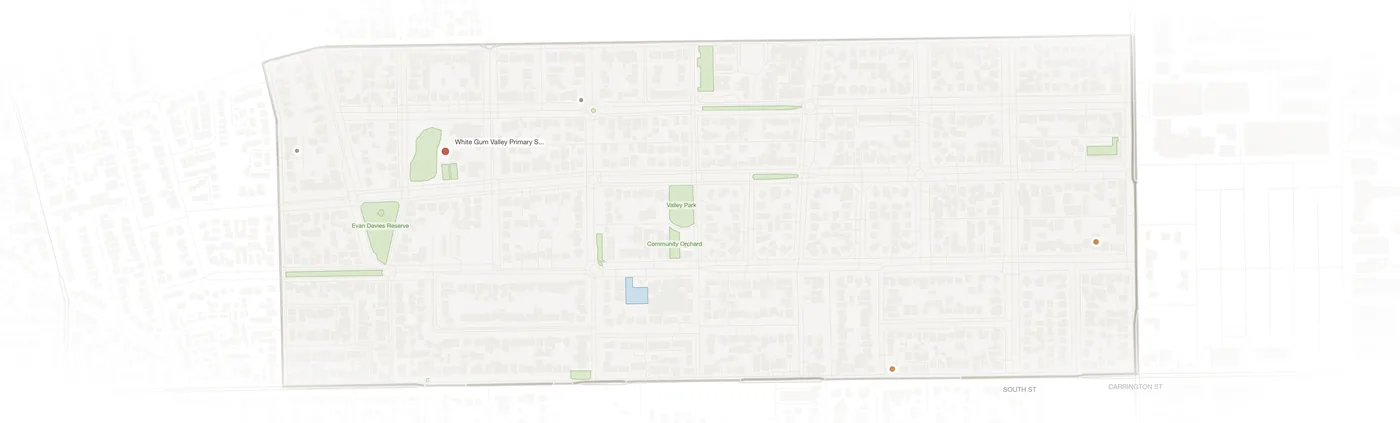
At 1.17 square kilometres with 3,358 residents, White Gum Valley packs a density of 2,870 people per km2 into a small Fremantle-adjacent footprint. The standout number is education: 49% of residents hold university qualifications, which is 18.9 percentage points above the national average. Household income sits in the 70.6th percentile nationally, pairing a meaningful professional tilt with housing priced more modestly than inner-city comparators. The suburb skews toward detached houses at 80.6% of dwellings, unusual for a suburb this dense and close to the city.
Population
3,358
Median Age
41.0
Household IncomeiMedian weekly household income (ABS Census)
$1,891/wk
DAs (12 months)iDevelopment Applications lodged in the past year
6
Median House
$470K
Estimated from rent (2025)
The estimated median house price is $470,000, positioned well below comparable inner-Perth and inner-Fremantle suburbs. Monthly mortgage repayments average $2,167, and mortgage-to-income sits at 26.5%, below the 30% stress threshold, meaning purchase costs remain manageable relative to local incomes in the 70.6th national percentile. Separate houses dominate at 80.6% of dwellings, with apartments at 10% and semi-detached at 9%. The bedroom mix leans toward 3-bedroom homes at 45.2%, followed by 4-plus bedroom at 24.6%. Outright owners (31%) and mortgage holders (39.8%) together make up about 71% of occupied dwellings, with renters at 29.2%.
For Buyers
The estimated median house price is $470,000, positioned well below comparable inner-Perth and inner-Fremantle suburbs. Monthly mortgage repayments average $2,167, and mortgage-to-income sits at 26.5%, below the 30% stress threshold, meaning purchase costs remain manageable relative to local incomes in the 70.6th national percentile. Separate houses dominate at 80.6% of dwellings, with apartments at 10% and semi-detached at 9%. The bedroom mix leans toward 3-bedroom homes at 45.2%, followed by 4-plus bedroom at 24.6%. Outright owners (31%) and mortgage holders (39.8%) together make up about 71% of occupied dwellings, with renters at 29.2%.
For Investors
Renters make up 29.2% of occupied dwellings, providing a moderate tenant base for investors. Weekly rent is $320, and a vacancy rate of 8.2% is elevated compared to typical healthy-market benchmarks near 3%, which points to softer rental demand or a period of supply adjustment. Development activity is modest at 3 applications in the past 12 months, including 1 two-storey house and 1 subdivision, so near-term new supply is limited. The 77.9% resident retention rate signals that once people settle here, they tend to stay, which supports long-term capital stability more than yield-driven returns given the high vacancy.
Development Activity
Total DAs
6
Last 12 Months
6
YoY ChangeiYear-over-year change in DA lodgements
—
Avg DA CostiAverage estimated cost per DA in the past year
N/A
Monthly DA Lodgements
DA Categories
Schools in White Gum Valley iICSEA: school advantage index. 1000 = national avg, higher = more advantaged
White Gum Valley Primary School
PP-6 · 246 students
Demographics
The median age is 41, which is 1 year above the national figure, placing White Gum Valley among slightly older inner-suburban populations. University qualifications reach 49%, running 18.9 percentage points higher than the national average, a clear marker of a professional, knowledge-worker demographic. Overseas-born residents account for 30.3% of the population, 8.7 points above national, with European heritage dominant: English (1,418), Irish (486), Scottish (386) and Italian (361) are the leading ancestries. The average household size is 2.4, fractionally below national. Couples with children make up 1,055 of 2,381 families, while couples without children number 601, or about 25.2% of family households.
Age Distribution
Bedrooms
Dwelling Structure
80.6%
Houses
9.0%
Townhouse
10.0%
Apartment
Tenure
White Gum Valley is detached-house territory: 80.6% of dwellings are separate houses, well above what you find in most suburbs at similar densities. The estimated median price is $470,000, using a rent-based methodology, so direct year-on-year price movement data is not available. Rent-to-income sits at 16.9%, comfortably below the 30% stress threshold, and mortgage-to-income at 26.5% is also below stress levels. Three-bedroom homes account for 45.2% of the stock and 4-plus bedroom homes 24.6%, so families are the primary housing consumer. One- and two-bedroom dwellings together make up 30.2%, catering to couples and singles attracted by the proximity to Fremantle.
Mortgage / mo
$2,167
Rent / wk
$320
HH Size
2.4
Personal Income / wk
$930
Vacancy Ratei% of dwellings unoccupied on Census night (ABS 2021)
8.2%
Unoccupied
117
Rent / IncomeiMedian rent as % of household income. Over 30% = housing stress
16.9%
Mortgage / IncomeiMedian mortgage as % of household income. Over 30% = housing stress
26.5%
Community Profile
Languages Spoken at Home
Ancestry
Household Composition
25.2%
Couples, no children
2,381
Total families
Economy & Employment
Healthcare is the largest employment sector at 19.5% (265 workers), followed by Education at 15.3% (207), Professional/Tech at 13.2% (179), Construction at 8.2% (111) and Public Administration at 7.8% (106). By occupation, Professionals lead with 657 workers, Managers follow with 267, and Community/Personal Service roles account for 219. These figures align with the 49% university qualification rate, which is 18.9 points above national. The unemployment rate is 5.6% against a participation rate of 63.3%, leaving 754 residents outside the labour force. The full-time employment rate of 58.5% is moderate, reflecting a mix of full-time professionals and part-time workers in the education and care sectors.
Socio-Economic Indexes (SEIFA)iABS index ranking suburbs from 1 (most disadvantaged) to 10 (most advantaged)
Full-time
58.5%
Part-time
35.9%
Participation
63.3%
Employed
1,656
Occupations
Top Industries
University
49.0%
Postgraduate
14.2%
Born Overseas
30.3%
Dwellings
1,306
Transport to Work
Car use is dominant at 82% of commuters, though 5.8% walk or cycle and 6.9% use public transport, above zero but limited for an inner suburb. No schools are recorded inside the 1.17 km2 boundary, so families depend on schools in surrounding Fremantle-area suburbs. Crime statistics are not available for White Gum Valley in this dataset. Volunteering runs at 21.3% of residents, above typical suburban rates, which is consistent with the education and community-service employment profile. Only 6.8% of residents (216 people) need daily assistance, and housing stress indicators are benign: rent-to-income at 16.9% and mortgage-to-income at 26.5% both sit below stress thresholds, making the suburb accessible for a range of household budgets.
Drive
82.0%
Public Transport
6.9%
Walk / Cycle
5.8%
Work from Home
N/A
National Ranking iPercentile rank among ~15,000 AU suburbs. 90% = higher than 90% of suburbs
How White Gum Valley compares to ~15,000 Australian suburbs
Frequently Asked Questions
Is White Gum Valley a good suburb to live in?
White Gum Valley suits professional households well. University qualifications reach 49%, which is 18.9 percentage points above the national average. Household income sits in the 70.6th national percentile, housing stress indicators are below stress thresholds, and the volunteer rate of 21.3% suggests an engaged community. The main practical gap is no recorded schools within the 1.17 km2 boundary.
What is the median house price in White Gum Valley?
The estimated median house price is $470,000, derived from rental data for 2025. Monthly mortgage repayments average $2,167, and the mortgage-to-income ratio of 26.5% sits below the 30% stress threshold. Weekly rent averages $320.
What schools are in White Gum Valley?
No schools are recorded within the White Gum Valley boundary in this dataset. The suburb covers just 1.17 km2 and families access schools in neighbouring Fremantle-area suburbs. Locally, 49% of adult residents hold university qualifications, which is 18.9 percentage points above the national figure.
Is White Gum Valley safe?
Crime statistics are not available for White Gum Valley in this dataset. As a broad proxy, household income sits in the 70.6th national percentile, only 6.8% of residents (216 people) need daily assistance, and housing stress rates are below standard thresholds, all indicators that tend to correlate with lower disadvantage and safer conditions.
Is White Gum Valley good for property investment?
The investment case is mixed. Renters represent 29.2% of households, and the $320 weekly rent against a $470,000 median implies a gross yield near 3.5%. However, the 8.2% vacancy rate is elevated compared to a healthy-market benchmark near 3%, which weighs on rental income reliability. Development activity is minimal at 3 applications in 12 months, limiting near-term supply risk.
How is White Gum Valley's population changing?
Detailed population forecasts are not available for White Gum Valley. The current population is 3,358 across 1.17 km2, giving a density of 2,870 per km2. A turnover rate of 22.1% indicates active movement, while 77.9% of residents stayed over the measured period, suggesting a stable core population despite some churn.
What languages are spoken in White Gum Valley?
About 30.3% of residents were born overseas, which is 8.7 percentage points above the national figure. English is the dominant language. Among non-English languages, Italian (54 speakers) leads, followed by French (31), German (16) and Portuguese (15), reflecting a predominantly European-heritage overseas-born population.
How to read these comparisons
Phrases like "above the national average" reference the unweighted median across Australian suburbs with more than 1,000 residents, not population-weighted national figures. Suburb-level medians are more useful for ranking suburbs against each other; ABS census headlines are population-weighted (so dominated by Sydney and Melbourne) and can read very differently.
Current baseline (refreshed 2026-05-10): median age 40, university-educated 30.1%, born overseas 21.6%, average household size 2.5 people.
Data sources: ABS 2021 Census (demographics, income, tenure), state Valuer-General (house prices), Department of Jobs SALM (unemployment), ACARA (school ICSEA), state Crime Statistics agencies (offences), council DA portals (development applications). Population forecasts use a Hamilton-Perry cohort model calibrated to ABS ERP.
Explore White Gum Valley on the Map
View parcels, zoning overlays, DA applications, schools and more.
Open Interactive Map