
A development feasibility that shows 20% profit on paper and delivers 3% in reality isn't a feasibility. It's a fantasy. And it happens far more often than anyone in the industry likes to admit.
After looking at hundreds of development projects across Australia, the same mistakes come up again and again. Here are the five that do the most damage.
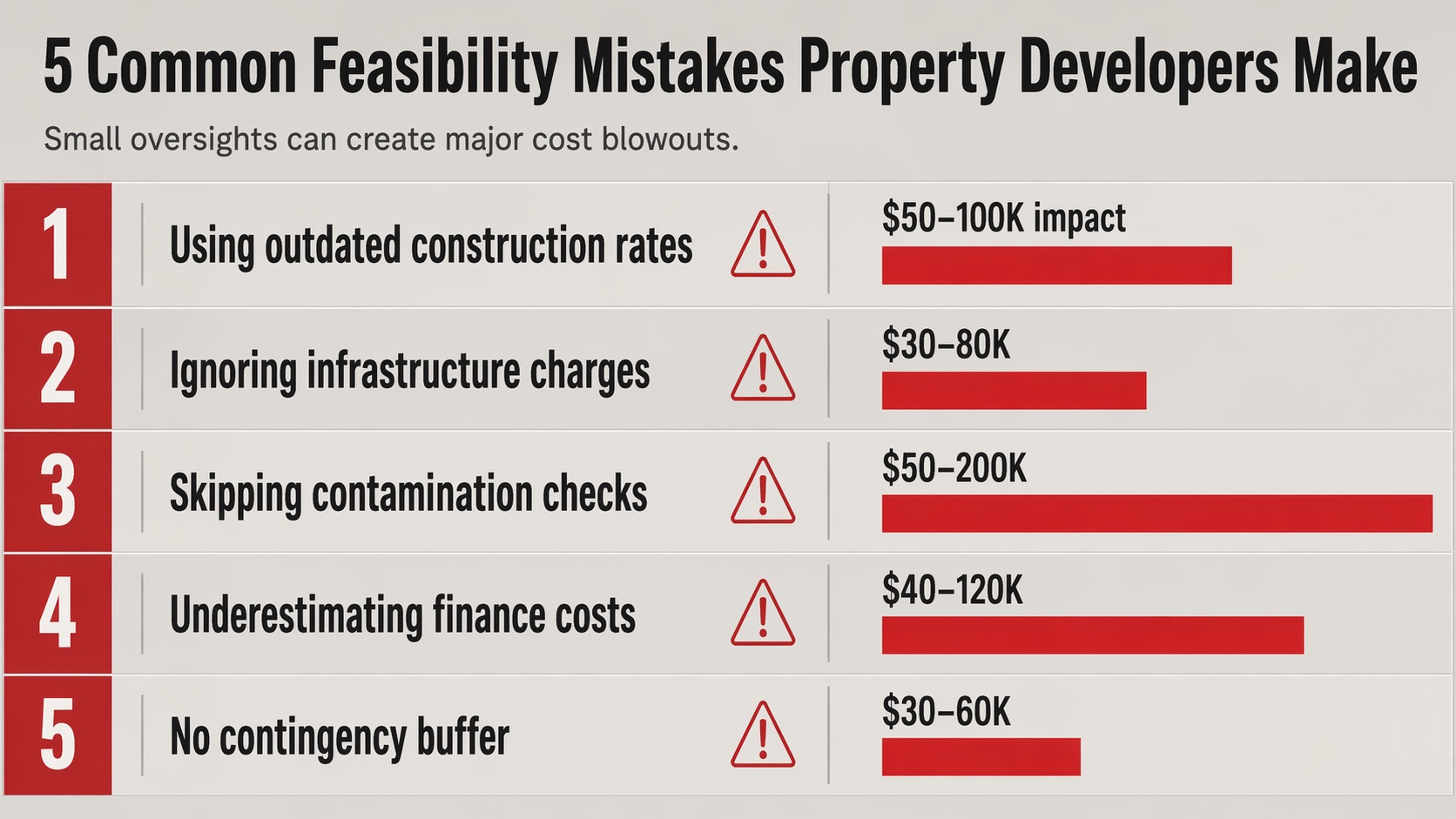
The five most common feasibility mistakes and their estimated cost impact. Any one of these can turn a profitable project into a loss.
Mistake 1: Underestimating Holding Costs
Holding costs are the silent margin killer. They don't show up as one big scary number in your spreadsheet. Instead, they accumulate quietly and relentlessly across every single month your project takes longer than you originally expected, which is almost every project.
What gets forgotten
Most first-time feasibility models include interest on the construction loan. Not enough. You also need:
- Interest on the land loan from settlement to construction start (typically 6–12 months while you get permits)
- Land tax (assessed annually, and your development site is not exempt)
- Council rates (they don't stop because you're waiting for a permit)
- Insurance (public liability on the vacant site, plus building insurance during construction)
- Site maintenance (securing the site, mowing, vandalism repairs)
The real numbers
Take a typical Melbourne scenario: you buy a $900,000 site with a $630,000 loan (70% LVR) at 7.5% interest.
Monthly interest alone: $3,938.
Add land tax ($275/month on an $800,000 unimproved value), council rates ($180/month), insurance ($150/month), and site maintenance ($100/month). That's $4,643 per month in holding costs.
If your permit takes 10 months instead of the 4 months you budgeted, that extra six months costs you $27,858 you never planned for. And that's before construction delays add another 2–3 months.
How to avoid it
Budget holding costs from settlement through to final sale, not just during construction. Add a 3-month buffer on your estimated permit timeline and a 2-month buffer on construction. In your feasibility model, holding costs should be a separate line item for each phase: pre-permit, construction, and selling period.
Mistake 2: Ignoring Council Contributions and Infrastructure Charges
Development contributions (also called infrastructure levies, public open space contributions, or developer contributions) are mandatory charges councils impose on new developments. They fund roads, drainage, parks, and community facilities.
How much are we talking?
It varies wildly by council and by state:
| Jurisdiction | Range per dwelling |
|---|---|
| VIC, established suburbs | $10,000–$20,000 |
| VIC, growth areas | $30,000–$90,000+ |
| NSW, Section 7.12 levy | 1–3% of development cost |
| NSW, Section 7.11 contributions | Can exceed $50,000/dwelling in some areas |
| QLD, infrastructure charges | $20,000–$40,000 per dwelling |
What surprises developers
Open space contribution. In Victoria, most councils charge a 5% open space levy on the value of the land being subdivided. On a $1 million site being subdivided into four lots, that's $50,000. Some developers don't discover this until the subdivision stage.
Drainage contributions. Council may require you to upgrade stormwater drainage infrastructure. This can run $20,000–$100,000+ depending on the capacity of existing infrastructure.
Road and footpath reinstatement. If your construction damages the council road, footpath, or nature strip, you'll pay for full reinstatement. Council typically holds a bond ($5,000–$15,000) against this.
How to avoid it
Before buying a site, call the council's planning department and ask specifically about development contributions, open space levies, and infrastructure charges applicable to a multi-dwelling development at that address. Get it in writing. Then add 10% contingency on top of what they tell you.
Mistake 3: Using the Wrong Construction Rate
The difference between $2,800/m² and $3,500/m² on a three-townhouse project is $302,400. That's the difference between a profitable project and a loss.
Common errors
Using outdated rates. Construction costs in Australia rose roughly 30% between 2021 and 2024 and have continued climbing at 4–5% annually since. A rate that was accurate in 2024 is likely too low in 2026.
Using the wrong product type. A slab-on-ground townhouse costs less per square metre than a split-level design. A single-storey dwelling costs less than two-storey. A project with a basement car park costs dramatically more than surface parking.
Forgetting site-specific costs. The per-square-metre rate from your builder typically excludes: - Demolition of the existing dwelling ($20,000–$50,000) - Site cut and fill ($15,000–$40,000 on sloping sites) - Rock removal (can add $30,000+ if the site has rock at shallow depth) - Contamination remediation ($50,000–$200,000+ for former industrial sites) - Tree removal and replacement ($5,000–$15,000 per significant tree)
Confusing fixed-price with cost-plus. A fixed-price building contract gives you certainty. A cost-plus contract (common for larger projects) exposes you to cost blowouts. If you're using cost-plus, your contingency should be 10–15%, not 5%.
2026 benchmark rates (Melbourne)
| Product type | Range per m² (inc. builder margin) |
|---|---|
| Standard townhouse (slab-on-ground, 2-storey) | $2,800–$3,300 |
| Premium townhouse (higher finishes) | $3,300–$3,800 |
| Standard apartment (walk-up, 3–4 storey) | $3,500–$4,200 |
| Apartment with basement parking | $4,200–$5,000+ |
How to avoid it
Get at least two builder quotes for your specific project type before finalising your feasibility. Use the higher quote as your base case and add 5–7% contingency. Never use a rate from more than 12 months ago without adjusting for cost escalation.
Mistake 4: Optimistic Sale Price Assumptions
This is the big one. Dangerous, too. Developers who have already fallen in love with a site unconsciously inflate their sale price assumptions to make the numbers work, cherry-picking the highest comparable sale while ignoring the three that sold for less, adjusting upwards "because our finishes will be better," and generally turning confirmation bias into something that looks like market research but isn't.
How it happens
You find three comparable sales: - Townhouse A sold for $820,000 (good quality, quiet street) - Townhouse B sold for $785,000 (average quality, main road) - Townhouse C sold for $860,000 (premium finishes, near station)
You tell yourself your project will be "similar to Townhouse C, maybe even better." So you plug in $850,000 as your end value.
But the honest assessment is that your site is on a busier street than A, your finishes will be standard (not premium), and you're 800 metres from the station. Your realistic end value is $790,000. That's $60,000 less per dwelling. On three dwellings, $180,000 less revenue.
The dangers of timing
Comparable sales data is backwards-looking. Those sales happened 3–6 months ago. Your project won't settle for another 18–24 months. If the market softens 3–5% in that time, your assumptions are even further off.
How to avoid it
- Use the median of your comparables, not the top
- Apply a 3–5% discount for market risk on projects settling more than 12 months out
- Talk to local agents about what's actually selling versus what's listed (the gap between asking price and sold price is real data)
- Check days on market. If comparable townhouses are sitting for 60+ days, the market is softer than headline numbers suggest
- Run your feasibility at three price points: optimistic, base case, and conservative. If the project doesn't work at the conservative price, it's too risky
If you want to see how sale price sensitivity affects your margin in practice, the duplex vs townhouse comparison walks through the numbers.
Mistake 5: Ignoring Garden Area Requirements
This mistake is specific to Victoria (and increasingly relevant in other states with similar mandated open space ratios), but it's devastating when it happens.
The scenario
A developer buys a 650m² GRZ site in Bentleigh East, planning to build four townhouses. The financial feasibility works beautifully at four dwellings.
Then the architect says: with 35% garden area (227.5m²), there isn't enough building envelope for four dwellings with adequate private open space, car parking, and setbacks. The site can realistically fit three.
Dropping from four to three dwellings: - Revenue drops by $780,000 (one less townhouse) - Construction costs drop by only ~$470,000 (fixed costs like demolition, drainage, and driveway are spread across fewer dwellings) - Net impact: ~$310,000 less profit
That $310,000 was the entire margin. The project is now barely break-even.
What counts as garden area
The definition is strict. Garden area must be: - At ground level (not on a podium or roof) - Permeable surface (not paved, concreted, or decked) - Not covered by a building or structure - Not a driveway or car space
Even a 3-metre-wide garden bed running the length of a boundary contributes, but narrow strips along fences are hard to reach and maintain. Councils increasingly push for meaningful, usable garden spaces, not just token strips around the edges.
How to avoid it
Calculate garden area compliance before buying the site. Sketch a rough site layout showing dwelling footprints, driveways, garages, and setbacks. Whatever area is left is your potential garden area. If it's less than the required percentage, reduce your dwelling count (and re-run the feasibility) before committing.
The Common Thread
All five mistakes share a root cause: the feasibility was done after the decision to buy, not before. When a developer falls in love with a site first and runs the numbers second, the numbers get massaged to fit the conclusion they've already reached.
The discipline of feasibility analysis is doing it first, honestly, with conservative assumptions, and walking away from sites that don't stack up. The best developers reject far more sites than they buy.
To see how these mistakes play out in practice, read our case study of a rejected DA where heritage, parking, and setback issues turned a 17% margin into 7%.
Build Your Feasibility the Right Way
The DA Leads feasibility calculator is designed to catch these mistakes before they cost you money. It calculates holding costs across the full project timeline, includes council contribution estimates, uses current construction cost benchmarks, pulls real comparable sales data, and checks garden area compliance against the site's zoning. Plug in an address and get an honest assessment, not one shaped by the excitement of finding a new site.
Sources and Further Reading
- Development Contributions Plans - Planning Victoria - DCP levies and open space contributions in Victoria
- Section 7.11 and 7.12 contributions - NSW Planning - NSW developer contribution frameworks
- Victorian Planning Provisions - Residential zones - GRZ garden area requirements (35%)
- State Revenue Office Victoria - Land tax - land tax assessment for development sites
- DA Leads internal database snapshot, queried 2026-03-14
- DA Leads feasibility calculator


