
Ask who approves a warehouse in Australia and the honest answer is: almost always the local council. The Western Sydney mega-estates get the headlines, and in NSW their own approval pathway, but the everyday warehouse, a tilt-slab shed with an ancillary office on a few hectares of industrial land, is an ordinary development application decided on planning merits by the council. Our national DA database holds 4,796 warehouse-keyword applications, and almost none of them ever saw a state assessment team.
So the question splits in two: which tier does your project land in, and what decides the outcome once it gets there? The first has a precise answer in NSW. The second is a merits question, and the issues are the same whichever chamber the decision sits in.
NSW: the $50 million line
The same June 2021 amendment to the State and Regional Development SEPP that gave data centres their megawatt test gave warehouses a dollar one. Warehouses and distribution centres above a capital investment value of $30 million became State Significant Development, and the trigger moved to $50 million CIV on 1 June 2023. (The data centre half of that amendment, the 15 MW line, is its own story.)
$50 million of capital investment is estate money, not shed money: a single-facility warehouse on an infill lot rarely gets near it, while a multi-building logistics estate clears it comfortably. In practice the SSD tier is an estate developers' pathway, and single-facility scale stays with the council. The amendment was also introduced as temporary and its threshold has moved once already, so confirm the current setting on the department's page before the deal model hardens around a pathway assumption.
The SSD tier in practice: Kemps Creek, twice
Two determinations show what this tier processes. The Aspect Industrial Estate at Kemps Creek in the Mamre Road precinct (SSD-10448) received concept consent on 24 May 2022, a multi-warehouse logistics estate approved as a concept with stage approvals following. Three years later and a few kilometres away, a warehouse and distribution estate at 113-153 Aldington Road, Kemps Creek, roughly 30 hectares in the Western Sydney Employment Area, was approved as SSD on 28 July 2025.
Note the shape of both: estates, not buildings. Concept consents, staged delivery, precinct-scale land. The SSD route runs the full state sequence, secretary's requirements, an environmental impact statement, public exhibition, with the Minister or a delegate determining. If your project is one building on one lot, this is not your world, and the rest of this article is about the world you are actually in.
The council tier is where the volume is
We queried our national DA database, 848,604 council-lodged applications, for warehouse, distribution centre and logistics keywords: 4,796 records. NSW leads with 1,518, then South Australia with 1,331, Queensland 1,271, Victoria 530 and the ACT 103. A coverage note on SA: PlanSA is a single statewide portal, so our SA record is unusually complete, which flatters it in raw count comparisons.
DA Leads database snapshot, queried 2026-07-12.
The council ranking is more useful, because industrial land is a precinct phenomenon. Brisbane City Council tops the table with 645 applications. Then comes City of Casey in Melbourne's south east with 333, Port Adelaide Enfield with 300, Logan City with 234, Salisbury 193, Charles Sturt 192, Penrith 147 and Moreton Bay 140. Adelaide's inner industrial north placing three councils in the top eight is the quiet surprise; the Brisbane-to-Logan corridor and Melbourne's fringe belts behave exactly as the industrial land market says they should.
The 2026 count stood at 823 by early July, tracking ahead of 2025. Recent lodgements show what this tier really looks like: a warehouse with an ancillary office at Berrimah in Darwin's industrial belt, on exhibition; a part change of use from office to warehouse (a self-storage facility in two stages) in Darwin City, on exhibition; and traffic the other way, a change of use from warehouse to a pilates studio at Coconut Grove, also on exhibition. The everyday tier is not just new sheds; it is floor space cycling in and out of warehouse use as precincts evolve. (These sit with the NT's Development Consent Authority rather than a municipal council, the Territory's version of the same tier.)
What decides a warehouse DA on the merits
Thresholds decide who assesses the application. They say nothing about whether the site can carry the use. To ground that half we ran our 19-constraint screening engine over a real 2.9 hectare infill lot on Fitzgerald Road in Laverton North (Wyndham), zoned Industrial 2. The screen came back "No fatal flaws identified": zero major constraints, five moderate, all 19 constraints assessed, and a risk score of 50/100, which our banding calls heavily constrained. A perfectly buildable site, with a specific list of work. Even finding it was instructive: two Ravenhall parcels that read as industrial belt on satellite returned Special Use zones, and another Laverton North parcel came back zoned conservation reserve. Satellite imagery does not know what the planning scheme knows.
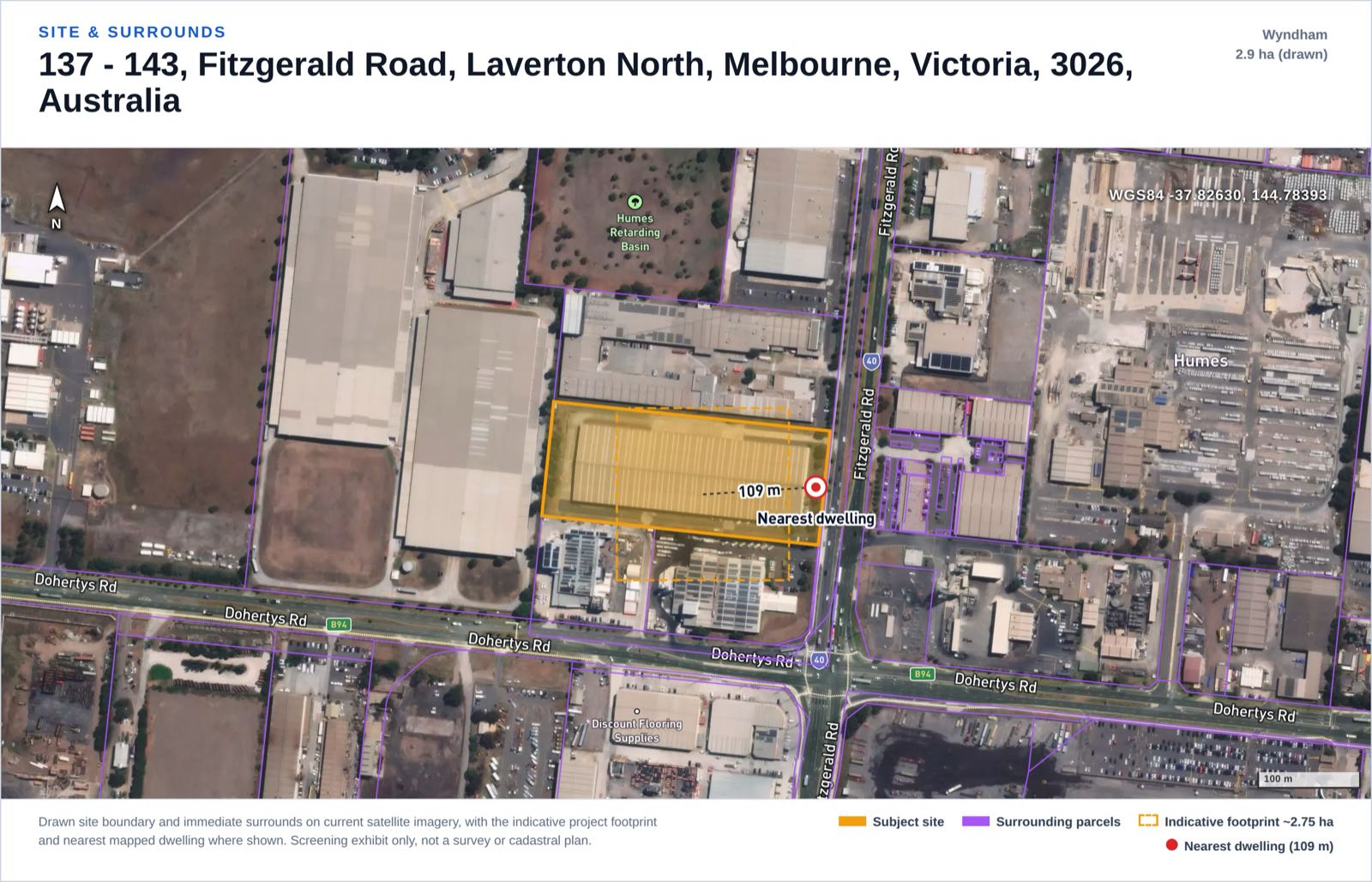
Exhibit from the screening report our engine generated on a real Laverton North parcel as a demonstration. Not a client project, and not a proposal for that land.
The freight task is a primary matter, not a footnote. For most development types, traffic is a construction-phase nuisance that fades once the builders leave. A warehouse is the opposite: the trucks are the business. Our engine rates Traffic and Access moderate for any freight or logistics use on exactly that logic, finding that "operational heavy-vehicle traffic is intrinsic and a Traffic Impact Assessment with intersection modelling is required", plus heavy-vehicle access design and swept paths. It also stays honest about what a desktop cannot see: the rating is flagged data-limited because no traffic count data is queried, so the screen tells you to commission the TIA rather than pretending to be one.
Easements decide where the building can actually sit. On the Laverton North lot, an infrastructure corridor crosses the site, with a 66 kV line within 50 metres and a gas pipeline about 24 metres away in the surrounds. The engine's finding is blunt: registered easements "carry registered easements and setbacks that constrain where plant can be built", and a Certificate of Title must be ordered to confirm ownership, covenants and the exact easement terms. On a 2.9 hectare lot, an easement through the middle is not a legal technicality; it redraws the developable envelope, and with it the racking layout, dock positions and yield.
Ecology follows you onto infill land in Melbourne's west. The site intersects mapped threatened biota associated with the Southern Plains, including the Western Victorian volcanic plain, and the Angliss Grassland (Laverton North) Nature Conservation Reserve sits about 478 metres away. That context pushed two constraints to moderate: flora and fauna, and a likely EPBC referral for matters of national environmental significance. Volcanic plain grassland is one of the most heavily listed ecological communities in the country, and it persists in exactly the paddocks and road reserves that the western industrial belt is built through. Being zoned industrial does not switch it off.
What you store is a question no desktop can answer. The engine's hazard finding for a warehouse is deliberately conditional: "A warehouse's on-site hazard is set by what it stores, which is not knowable from a desktop: general freight carries no significant fire / explosion hazard, while dangerous-goods storage triggers licensing, separation and placarding requirements under state DG legislation." It rates the constraint minor and tells you to confirm the intended storage profile against state dangerous goods thresholds. A screen that assumed general freight would be quietly wrong for every chemical distribution tenant; one that assumed dangerous goods would cry wolf on every parcel shed.
Which pathway is yours
| NSW State Significant Development | Council development application | |
|---|---|---|
| Trigger | Warehouse or distribution centre above $50 million CIV (introduced at $30 million in June 2021, raised 1 June 2023) | Everything under the line, and warehouse development generally in the other states |
| Decision-maker | Minister for Planning or departmental delegate | The local council (or a local planning panel) |
| Instrument | SSD development consent, preceded by SEARs, an EIS and public exhibition | Development consent or planning permit, decided on planning merits |
| Typical project | Multi-building estates at Western Sydney Employment Area scale | The 4,796 applications in our database: single facilities, extensions, changes of use |
Victoria deserves its own line: there is no warehouse CIV trigger, so industrial development applications sit with councils under the relevant planning scheme. The state's lever is the Development Facilitation Program, an expedited pathway where the Minister for Planning becomes the decision-maker under Clause 53.22 of the Victoria Planning Provisions for projects accepted as significant economic development. It is a case-by-case gate, not an automatic threshold: the default assumption for a Victorian warehouse is the council counter.
Screen the site before you argue the merits
Whichever tier a warehouse lands in, the merits list above is waiting, and every item is knowable to a useful degree before lodgement. That is the job our screen does: 19 planning and environmental constraints against a drawn site boundary, one business day, A$1,000 per site on the pilot. It is a desktop screen, not planning advice; it does not replace the consultants, it tells you which ones you need and why, with the evidence attached. The Laverton North run above is published in full as a live sample report, and the service is described at /solutions/warehouse-site-screening/.
The free first move: the zoning, overlay and parcel check on our map works for any address in Australia, and would have caught the Ravenhall zone traps in thirty seconds. Developers wiring this into their own site-selection tooling can hit the same data through the API.
FAQ
Who approves warehouses in Australia? In most cases the local council, through an ordinary development application assessed on planning merits. The exception is NSW, where a warehouse or distribution centre above $50 million in capital investment value is State Significant Development, determined by the Minister for Planning or a departmental delegate instead.
When does a warehouse become State Significant Development in NSW? Above $50 million CIV, a threshold set by a June 2021 amendment to the State and Regional Development SEPP at $30 million and raised to $50 million on 1 June 2023. The amendment was introduced as temporary and has moved once already, so check the department's SSD page for the current setting if your project is near the line.
Who approves warehouses in Victoria? The local council, under the relevant planning scheme; Victoria has no warehouse CIV trigger. The Development Facilitation Program can make the Minister for Planning the decision-maker under Clause 53.22 for projects accepted as significant economic development, but that is a case-by-case gate, not an automatic threshold.
Which councils receive the most warehouse applications? In our database of 4,796 warehouse-keyword applications, Brisbane City leads with 645, followed by City of Casey (333), Port Adelaide Enfield (300), Logan City (234), Salisbury (193), Charles Sturt (192), Penrith (147) and Moreton Bay (140). These are counts of our council-lodged records, not audited market totals.
Does a warehouse DA need a Traffic Impact Assessment? Treat it as a given. Operational heavy-vehicle traffic is intrinsic to a freight or logistics use, so assessment authorities expect a TIA with intersection modelling and heavy-vehicle access design, not just a construction traffic note. Our engine rates the freight task a primary assessment matter on every warehouse run.
Can a desktop screen tell me whether my warehouse needs a dangerous goods licence? No, and it should say so. On-site hazard is set by what the building stores: general freight carries no significant fire or explosion hazard, while dangerous goods storage triggers licensing, separation and placarding requirements under state DG legislation. Our screen flags the question and tells you to confirm the intended storage profile against state thresholds.
What does the DA Leads warehouse screen actually check? Nineteen planning and environmental constraints against a drawn site boundary: zoning, overlays, easements, ecology and EPBC context, bushfire and flood, noise receptors, traffic framing and more, delivered in one business day at A$1,000 per site on the pilot. It is a desktop screen with its data status stated per constraint, not planning advice, and the Laverton North sample report shows exactly what it looks like.


