Woodside
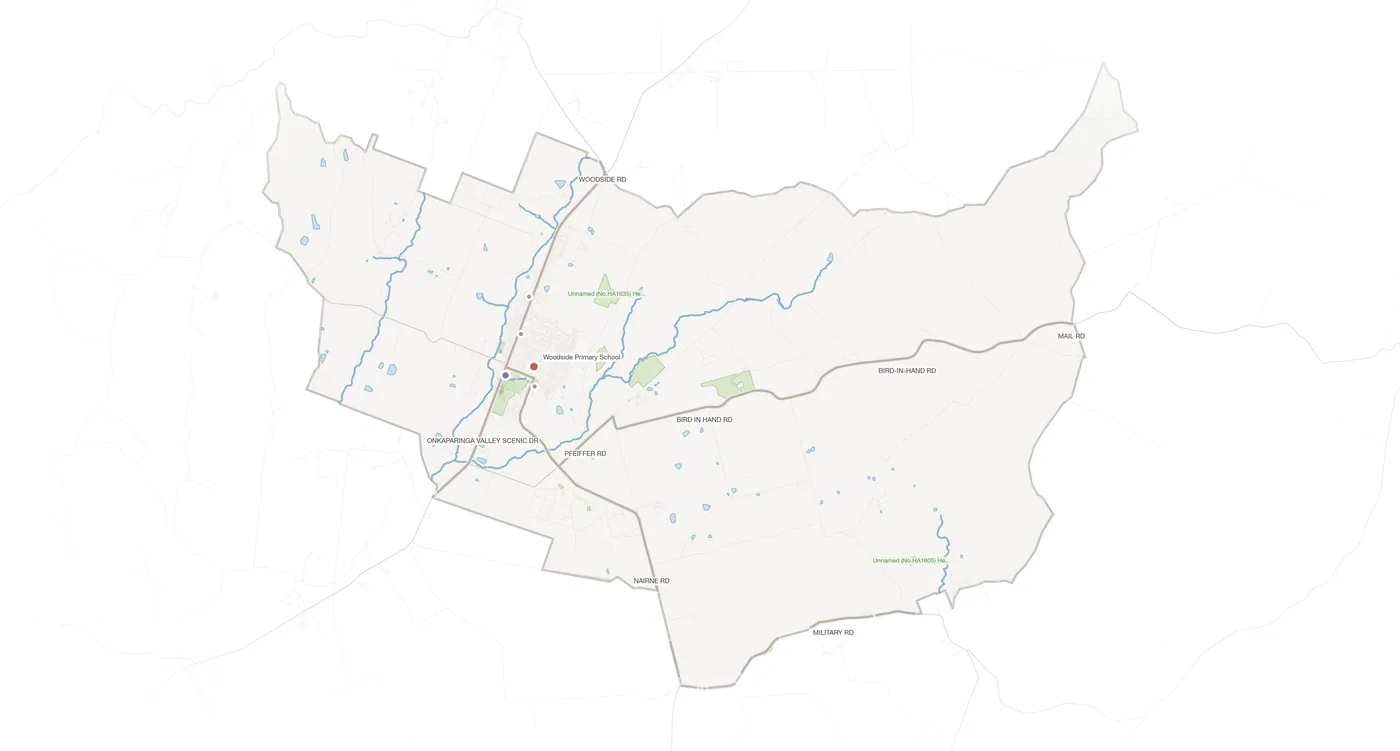
At a median age of 45, Woodside skews 5.0 years older than the national figure, and 38.4% of dwellings are owned outright, a share that signals long-term residents rather than active turnover. The suburb recorded a median house price of $965,000 in 1Q 2026, up 11.8% from $863,250 a year earlier, a growth rate well above what low-density Adelaide Hills towns typically deliver. Crime sits at 18.5 incidents per 1,000 residents, below average for SA. Detached houses account for 90.1% of stock across a 57.44 km2 footprint, giving the suburb a density of just 47 residents per km2 compared to metropolitan norms.
Population
2,701
Median Age
45.0
Household IncomeiMedian weekly household income (ABS Census)
$1,483/wk
DAs (12 months)iDevelopment Applications lodged in the past year
58
Median House
$965K
Median 1Q 2026
The median house price reached $965,000 in 1Q 2026, rising from $863,250 in 1Q 2025, an 11.8% gain in one year. That price sits firmly above the SA state median, and monthly mortgage repayments average $1,627, producing a mortgage-to-income ratio of 25.3%, which is below the 30% stress threshold. Separate houses dominate at 90.1% of dwellings, with semi-detached at 7.0% and apartments at only 2.9%. The bedroom profile leans large: 50.9% of homes have 3 bedrooms and 32.8% have 4 or more, making Woodside well suited to families seeking space rather than downsizers. Outright owners at 38.4% outnumber renters at 20.3%, reinforcing the settled, owner-occupier character of the area.
For Buyers
The median house price reached $965,000 in 1Q 2026, rising from $863,250 in 1Q 2025, an 11.8% gain in one year. That price sits firmly above the SA state median, and monthly mortgage repayments average $1,627, producing a mortgage-to-income ratio of 25.3%, which is below the 30% stress threshold. Separate houses dominate at 90.1% of dwellings, with semi-detached at 7.0% and apartments at only 2.9%. The bedroom profile leans large: 50.9% of homes have 3 bedrooms and 32.8% have 4 or more, making Woodside well suited to families seeking space rather than downsizers. Outright owners at 38.4% outnumber renters at 20.3%, reinforcing the settled, owner-occupier character of the area.
For Investors
Renters make up 20.3% of households, below the national average, and weekly rent of $320 against a $965,000 median implies a gross yield near 1.7%, which is low even by regional SA standards. The vacancy rate of 11.1% is elevated, pointing to soft rental demand relative to supply. However, 55 development applications over the past 12 months, including land divisions and residential additions, indicate the suburb is not stagnant. House prices climbed 11.8% over the year from 1Q 2025 to 1Q 2026, so the capital growth case is stronger than the yield case. Investors should weigh the high vacancy rate against the price momentum and the suburb's position in the Adelaide Hills lifestyle corridor, which tends to attract owner-occupiers rather than renters.
Development Activity
Total DAs
387
Last 12 Months
58
YoY ChangeiYear-over-year change in DA lodgements
-15.9%
Avg DA CostiAverage estimated cost per DA in the past year
N/A
Monthly DA Lodgements
DA Categories
Schools in Woodside iICSEA: school advantage index. 1000 = national avg, higher = more advantaged
Woodside Primary School
R-6 · 317 students
Demographics
The median age of 45 sits 5.0 years above the national figure, consistent with a resident base that has aged in place rather than turned over. Mobility is low: 79.1% of residents lived at the same address five years earlier, compared to national turnover norms. Overseas-born residents account for 12.8%, which is 8.8 percentage points below the national figure, reflecting a predominantly locally-born population. Ancestry is heavily Anglo-Celtic, led by English (1,193), German (362) and Scottish (305), with German ancestry notably stronger here than the national average, a legacy of 19th-century Adelaide Hills settlement. The volunteering rate of 27.1% is high compared to most suburbs, suggesting strong civic engagement. Average household size of 2.4 is marginally below national.
Age Distribution
Bedrooms
Dwelling Structure
90.1%
Houses
7.0%
Townhouse
2.9%
Apartment
Tenure
Tenure is split 38.4% outright ownership, 41.2% mortgage, and 20.3% renting. The high mortgage share at 41.2% is notable alongside the elevated median price of $965,000, implying a mix of long-term owners who bought at lower prices and newer buyers carrying substantial debt. Prices moved from $863,250 in 1Q 2025 to $965,000 in 1Q 2026, a 11.8% annual gain. Rent-to-income sits at 21.6% and mortgage-to-income at 25.3%, both below stress thresholds, meaning neither owners nor renters are under acute financial pressure by those measures. The stock skews toward larger homes: 83.7% of dwellings have 3 or more bedrooms. Vacancy at 11.1% is above typical low-crime, lifestyle suburbs.
Median House Price Trend
Source: State Valuer-General
Mortgage / mo
$1,627
Rent / wk
$320
HH Size
2.4
Personal Income / wk
$757
Vacancy Ratei% of dwellings unoccupied on Census night (ABS 2021)
11.1%
Unoccupied
122
Rent / IncomeiMedian rent as % of household income. Over 30% = housing stress
21.6%
Mortgage / IncomeiMedian mortgage as % of household income. Over 30% = housing stress
25.3%
Community Profile
Ancestry
Household Composition
32.3%
Couples, no children
2,014
Total families
Economy & Employment
Healthcare leads the local industry mix at 15.8% of employed residents (139 workers), followed by Education at 10.5% (92) and Construction at 10.1% (89). Public Administration accounts for 10.0% (88 workers), suggesting a base of government-sector employment likely linked to nearby Mount Barker and Adelaide. Managers (234) and Professionals (222) are the top two occupation groups, meaning the suburb draws higher-skilled workers despite having a household income percentile of 46.2, which is near the national median. Unemployment sits at 3.1%, below national average. SEIFA tells a nuanced story: the IER (economic resources) decile is 8, above average nationally, while IRSAD and IEO both sit at decile 6, moderate, indicating some divergence between asset-holding and income.
Socio-Economic Indexes (SEIFA)iABS index ranking suburbs from 1 (most disadvantaged) to 10 (most advantaged)
Full-time
60.4%
Part-time
36.5%
Participation
55.4%
Employed
1,234
Occupations
Top Industries
University
29.1%
Postgraduate
7.0%
Born Overseas
12.8%
Dwellings
979
Transport to Work
Car dependency is high: 87.6% of residents drive to work, and only 1.5% use public transport, consistent with an outer-Hills location without rail access. Walking and cycling account for 6.5%, above what purely rural areas show, indicating a walkable town centre. Crime is low at 18.5 incidents per 1,000 residents, below average for SA. IRSAD decile 6 places the suburb in the moderate-advantage band nationally, neither affluent nor disadvantaged. Assistance needs affect 7.1% of the population (180 residents), slightly elevated, reflecting the older median age of 45. No schools are recorded in this dataset for the Woodside boundary, so families rely on facilities in nearby townships. The housing stress metrics are contained: rent-to-income at 21.6% and mortgage-to-income at 25.3% both sit below the 30% stress threshold.
Drive
87.6%
Public Transport
1.5%
Walk / Cycle
6.5%
Work from Home
N/A
Safety & Crime
Total Offences
50
Year ending June 2024
Rate per 1,000 People
18.5
Source: Crime Statistics Agency Victoria / SA Police
National Ranking iPercentile rank among ~15,000 AU suburbs. 90% = higher than 90% of suburbs
How Woodside compares to ~15,000 Australian suburbs
Frequently Asked Questions
Is Woodside a good suburb to live in?
Woodside suits owner-occupiers seeking space and lower crime. Crime sits at 18.5 per 1,000 residents, below SA average, and 79.1% of residents stay put for 5 years or more. The median age of 45 is 5 years above national, pointing to a stable long-term resident base. Car dependency is high at 87.6% because public transport is limited to 1.5% of commuters.
What is the median house price in Woodside?
The median house price is $965,000 as of 1Q 2026, up 11.8% from $863,250 in 1Q 2025. Monthly mortgage repayments average $1,627, and the mortgage-to-income ratio of 25.3% stays below the 30% stress threshold despite the elevated price.
What schools are in Woodside?
No schools are recorded inside the Woodside boundary in this dataset. Families rely on schools in nearby Adelaide Hills townships. Locally, 29.1% of residents hold university qualifications, 1.0 percentage point below the national figure, suggesting a reasonably well-educated resident base.
Is Woodside safe?
Woodside recorded 50 total crimes, equivalent to a rate of 18.5 per 1,000 residents, which is low compared to SA urban averages. The suburb also carries an IRSD decile of 8, above the national midpoint, indicating low relative disadvantage, which generally correlates with lower crime rates.
Is Woodside good for property investment?
Capital growth is strong at 11.8% over the year to 1Q 2026, lifting the median from $863,250 to $965,000. However, the rental yield is low given a $320 weekly rent against a $965,000 median, and a vacancy rate of 11.1% signals soft rental demand. Investors favour the suburb for capital growth rather than yield.
How is Woodside's population changing?
Woodside has 2,701 residents across a 57.44 km2 area, giving a density of 47 residents per km2. Residential turnover is low at 20.9%, meaning 79.1% of people stayed at the same address over 5 years. The aging profile, with a median age of 45, is 5 years above the national figure, suggesting natural growth will be slow without new family migration.
How much development is happening in Woodside?
Woodside had 55 development applications lodged in the past 12 months. Most are residential additions like verandahs and carports, with at least one land division (1 into 2) lodged in April 2026. Activity is moderate for a township of 2,701 residents, indicating incremental rather than rapid expansion.
How to read these comparisons
Phrases like "above the national average" reference the unweighted median across Australian suburbs with more than 1,000 residents, not population-weighted national figures. Suburb-level medians are more useful for ranking suburbs against each other; ABS census headlines are population-weighted (so dominated by Sydney and Melbourne) and can read very differently.
Current baseline (refreshed 2026-05-10): median age 40, university-educated 30.1%, born overseas 21.6%, average household size 2.5 people.
Data sources: ABS 2021 Census (demographics, income, tenure), state Valuer-General (house prices), Department of Jobs SALM (unemployment), ACARA (school ICSEA), state Crime Statistics agencies (offences), council DA portals (development applications). Population forecasts use a Hamilton-Perry cohort model calibrated to ABS ERP.
Explore Woodside on the Map
View parcels, zoning overlays, DA applications, schools and more.
Open Interactive Map