
Every englobo listing eventually attracts the same question from a first-time buyer: can I get a DA on this? For a house block, the right question. For a 10 or 100 hectare paddock on the urban fringe, the wrong first one, because by the time a subdivision application reaches a council officer's desk, the decisions that made the land developable were taken years earlier, by bodies that are not the council, in instruments most buyers have never read.
Englobo land, in the ordinary industry sense, is a large parcel sold in one line before subdivision: the paddock, not the lots. Its value hinges on when and how the planning system will let it become lots, so the useful way to understand approval is to walk the pathway in order. This guide does that for the two states where the machinery is most formalised, Victoria and New South Wales, then looks at the council tier through our development application database.
Two tiers, and the order matters
Greenfield approval in both states is two-tier. The top tier is an enabling instrument made at state level: a Precinct Structure Plan in Victoria, a precinct rezoning in NSW. The bottom tier is the council application, in a growth area mostly staged subdivision permits. Buyers who price englobo land off the bottom tier alone are pricing the last mile of a journey the land may not have started.
| Victoria (growth corridors) | NSW (growth areas) | |
|---|---|---|
| Land signal | Inside the Urban Growth Boundary, zoned Urban Growth Zone | An identified precinct in a growth area |
| Enabling instrument | Precinct Structure Plan, incorporated into the planning scheme | Precinct rezoning |
| Who makes it | VPA prepares; Minister for Planning approves and gazettes | State-led through the NSW planning system |
| Infrastructure funding and staging | ICP or DCP levies collected as land develops | Staging plans and dwelling caps tied to infrastructure capacity |
| What flows afterwards | Subdivision permits at council, generally in accordance with the PSP | Development applications, metered by the staging controls |
Victoria: the growth-corridor machine
Victoria runs the most systematised greenfield pathway in the country. Broadacre land inside Melbourne's Urban Growth Boundary identified for future urban development carries the Urban Growth Zone, designed so that strategic planning and rezoning happen as one step rather than two.
The instrument that unlocks a UGZ paddock is the Precinct Structure Plan: in the Victorian Planning Authority's words, a long-term plan for urban development that describes how the land is expected to be developed and how and where services and infrastructure are planned to support new communities. It is a master plan for a whole future suburb: roads, town centres, schools, open space, drainage, and the developable area left over. The VPA prepares it, and the Minister for Planning approves and gazettes the amendment that incorporates it into the local planning scheme.
Once the PSP is incorporated, the schedule to the Urban Growth Zone puts it to work. Each PSP gets its own UGZ schedule, which can specify applied zones (the residential, commercial and industrial zones that will govern use as if the land were conventionally zoned) and strips back the approval load: permit applications generally in accordance with the PSP are exempt from notice requirements and third-party review. Development consistent with an approved, incorporated PSP can be permitted by council without further advertising; that is the whole point of the design.
An Infrastructure Contributions Plan (or, in older and regional precincts, a Development Contributions Plan) levies developers for the basic and essential local infrastructure a new community needs: intersections, local open space, community facilities. The levy attaches as land develops, which is why contributions are a line item in every serious englobo feasibility.
For a live example of the machine completing a cycle, the Shepparton South East PSP and its Development Contributions Plan were approved by the Minister and gazetted on 26 June 2025 under Amendment C117gshe, planning for approximately 2,980 dwellings, 7,200 residents and 274 jobs. From gazettal day, landowners there hold PSP-backed development land, and what follows are council-tier subdivision permits.
One more Victorian mechanic worth knowing before you buy, not after: where a high impact activity is planned in an area of cultural heritage sensitivity, a Cultural Heritage Management Plan is mandatory under the Aboriginal Heritage Regulations 2018. Sensitivity is mapped, so it is knowable at the paddock stage, long before a PSP exists.
NSW: precinct rezonings, and the honest lesson in Appin
NSW runs the same two-tier logic with different labels. In the growth areas the enabling instrument is a precinct rezoning: a state-led process converting rural land to urban zones across a whole precinct at once, structure planning included.
The recent precedent every englobo buyer in the Macarthur corridor knows is Appin. The Appin (Part) Precinct was rezoned on 15 December 2023: 1,378 hectares planned for up to 12,900 new homes with open space and local centres, and approximately 470 hectares protected as an environmental conservation zone securing parts of the Nepean River and Ousedale Creek koala corridors.
Here is the part first-time buyers most often misprice:
Victoria works the same lever differently: ICP and DCP levies fund infrastructure as development proceeds, while NSW's staged precincts hold development back until the infrastructure exists. Either way, the enabling tier, not the council tier, sets the pace at which englobo land converts to settled lots.
The council tier: what actually arrives, in numbers
Once the enabling instrument exists, the paperwork moves to councils, the tier our data sees directly. Our database of council development applications holds 848,604 records, and 78,670 of them, 9.3 percent, are subdivision applications. By state: NSW 38,336, SA 19,325, QLD 12,807, VIC 7,734. The busiest councils for subdivision in our records are Brisbane City Council with 5,323, Canterbury-Bankstown with 2,011, Charles Sturt with 1,968, Port Adelaide Enfield with 1,881, Logan with 1,844 and the City of Casey, Melbourne's growth-corridor heavyweight, with 1,655.
DA Leads database snapshot, queried 2026-07-12.
Two caveats change what that chart means.
First, coverage. These are records in our database, not market totals. Our scraper history means earlier years are sparse, which is why we chart 2021 to 2025 only, and why the growth in the series partly reflects our coverage growing alongside the market. WA barely registers (280 records), and the WA example in the next section is logged as an invitation to comment on a WAPC application rather than a council determination: these are council-lodged records, and whole approval channels sit outside them.
Second, composition. Council subdivision DAs skew heavily to infill: battle-axe splits, duplex subdivisions, a suburban block becoming two. Englobo-scale staged subdivision is the tail of the distribution, not the body, which is what the two-tier system predicts: greenfield land generates fewer, much larger applications, after the hard planning is done upstream.
The englobo tail: what staged subdivision looks like on arrival
To see that tail, we filtered for recent applications of 50 or more lots. One honesty note: lot counts are populated on only 2,963 of our subdivision records, so this is a sample of what councils publish, not a census.
The five largest in the filter, all lodged in the first half of 2026, look like this: Fraser Coast QLD, one lot into 535 lots in five stages at Dundowran; City of Swan WA, 533 lots at Brabham (the WAPC comment referral noted above); City of Casey VIC, a 418 lot staged subdivision with easement removal and creation; Wakefield SA, a variation lifting an approved land division at Port Wakefield from 351 to 416 allotments; and Murray Bridge SA, 346 allotments plus roads and public reserves at Gifford Hill.
DA Leads database snapshot, queried 2026-07-12.
These do not arrive as "subdivide into 535 lots" in one motion: they arrive as stages, as variations to consents granted years earlier, as bundles of easements, reserves and balance lots. A staged subdivision consent is a delivery schedule wearing a planning permit's clothes, and reading one tells you more about an englobo asset's real cash-flow timing than the headline lot yield does.
Where screening fits: the constraints predate the plan
Everything the enabling tier eventually does, it does around constraints that are already on the land today. Grassland conservation values, cultural heritage sensitivity, flood behaviour: the PSP or rezoning does not remove them, it designs around them, and the surviving developable area is what an englobo buyer is actually paying for. Appin gave up roughly a third of its precinct to conservation zoning. A desktop screen before purchase tells you what the future instrument will have to work around, while the price still assumes it works around nothing.
We ran our 19-constraint screening engine over a real growth-corridor parcel to show what that looks like: 10.5 hectares on Forsyth Road at The Crossing, Truganina, zoned UGZ2 in Melbourne's western corridor. All 19 constraints assessed, 100 percent data completeness, verdict "No fatal flaws identified": risk score 36/100 in our "Workable with conditions" band, with 0 major, 2 moderate, 10 minor and 7 insignificant findings and nothing pending. The two moderates are the western-plains signature: threatened biota associated with the Victorian volcanic plain (the Truganina South Nature Conservation Reserve is about 1.6 km away) and a likely EPBC trigger, with a Commonwealth referral to budget for. Exactly the constraints a future PSP redraws its developable area around.
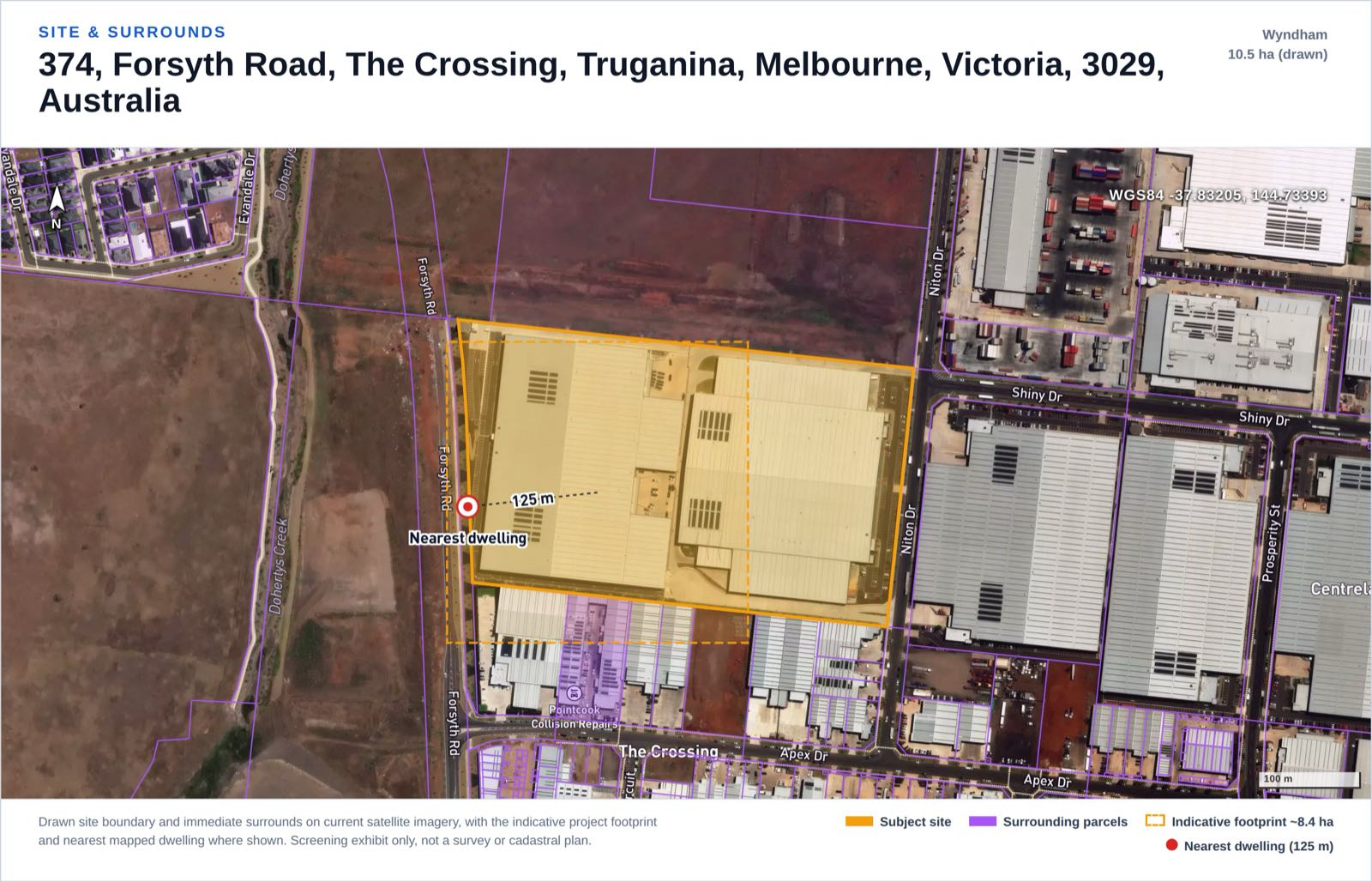
Site and surrounds exhibit from the screening report our engine generated on a real Truganina parcel as a demonstration. A screening demo on real cadastral data, not a client project and not a proposal for this land.
If you are weighing an englobo parcel, the englobo site screening service runs that 19-constraint desktop screen for A$1,000 per site in one business day, and the full Truganina sample report shows exactly what you get. It is a desktop screen, not planning advice, and does not replace your planner or lawyer; it exists so what you pay them to solve is known before you sign, not after. For the wider due diligence checklist beyond the approval pathway, see our companion guide to englobo land due diligence, and you can check any parcel's zoning and overlays free on the map.
FAQ
What does englobo land mean? Englobo is industry shorthand for a large parcel held or sold in one line before subdivision: the paddock rather than the lots. Its value depends on where it sits in the planning pathway, because the enabling instruments permitting subdivision are made at state level, years before any council application.
What is a Precinct Structure Plan? A PSP is Victoria's master plan for a new community: a long-term plan describing how land will develop and how services and infrastructure will support it, prepared by the Victorian Planning Authority and incorporated into the local planning scheme once the Minister approves the amendment. Shepparton South East, gazetted 26 June 2025 with capacity for about 2,980 dwellings, is a recent completed example.
How does the Urban Growth Zone work? The UGZ applies to broadacre land inside Melbourne's Urban Growth Boundary identified for urban development. Before a PSP, it holds the land; after a PSP is incorporated, the zone's schedule applies the plan, can impose applied zones, and exempts applications generally in accordance with the PSP from notice and third-party review, so subdivision permits flow with far less friction.
Does rezoned land in NSW mean I can build straight away? No, and Appin is the cautionary precedent: rezoned in December 2023 for up to 12,900 homes, it currently carries a dwelling cap of 2,499 tied to infrastructure capacity. The cap lifts only as infrastructure is confirmed: rezoning creates the entitlement, infrastructure sets the timetable.
Who actually approves the subdivision of englobo land? Both tiers do, in order. The state tier creates the enabling instrument (a PSP in Victoria, a precinct rezoning in NSW), and the council tier then determines the staged subdivision applications made under it. In our database of 848,604 development applications, 78,670 are subdivision applications, but most are small infill splits; englobo-scale staged subdivisions are the large-lot-count tail.
What should I check before buying an englobo parcel? The constraints that the future enabling instrument will have to design around: ecological values such as volcanic plain grassland, cultural heritage sensitivity (which in Victoria can make a Cultural Heritage Management Plan mandatory), flood behaviour, and infrastructure easements. Our 19-constraint desktop screen surfaces these per parcel in one business day; it is a screen to direct your consultants, not a substitute for them.


